Total Pageviews

Saturday, October 16, 2021

Bible In One Year Day 289 (1 Maccabees 8, Sirach 22-23, Proverbs 22: 26-29)

      You may subscribe yourself at the Ascension site here and receive notifications in your email, or just follow along on my blog.  Bible in One Year Readings Index 


Day 289 Wise Influences 

+++
A Daily Defense 

DAY 289 Eternal Life

CHALLENGE: “Christians can’t lose salvation. Scripture says, ‘He who believes in the Son has eternal life’ (John 3:36a), and if life is eternal, it can’t end.”

DEFENSE: This fails to understand both the biblical concept of eternal life and other things Scripture says.

A basic truth of linguistics is that you can’t define a term simply by looking at its parts; you must look at how it’s used in practice. To violate this principle is to commit the etymological fallacy (e.g., the word awful is a combination of awe and full; it originally meant something full of awe and that thus inspired reverence, but now it means something exceedingly bad).

Similarly, you can’t look at the phrase “eternal life” and define it just by looking at its parts. You must look at how it’s used in the New Testament. When you do this, it is clear that eternal life does not refer simply to unending bodily life. That is something even the damned will have after the resurrection of the dead, but it is clear the damned don’t have eternal life in the sense the New Testament is interested in (see, e.g., John 3:36b). Eternal life thus deals not just with a quantity but a quality or kind of life.

Further, while there are verses that speak of eternal life as a present possession of believers, there are also passages that speak of it as something they have not yet achieved. Thus Paul says that on the last day God “will give eternal life” to believers (Rom. 2:7) and “he who sows to the Spirit will from the Spirit reap eternal life . . . if we do not lose heart” (Gal. 6:8–9; cf. 1 Tim. 6:12, Titus 1:2, 3:7).

Thus we don’t yet have eternal life in the final sense. We may have a promise (1 John 2:25) and even a partial experience of it, but we can lose these through mortal sin (see Day 302). Thus John warns his audience: “Any one who hates his brother is a murderer, and you know that no murderer has eternal life abiding in him” (1 John 3:15).

To receive eternal life on the last day, Scripture says to “keep yourselves in the love of God; wait for the mercy of our Lord Jesus Christ unto eternal life” (Jude 21).

Jimmy Akin, A Daily Defense: 365 Days (Plus One) to Becoming a Better Apologist 

Friday, October 15, 2021

Bible In One Year Day 288 (1 Maccabees 7, Sirach 19-21, Proverbs 22: 22-25)

     You may subscribe yourself at the Ascension site here and receive notifications in your email, or just follow along on my blog.  Bible in One Year Readings Index 


Maccabias vs Bacchides 


Day 288:  Battling Against Gossip 

+++ 
A Daily Defense 

DAY 288 Quoting the Deuterocanonicals

CHALLENGE: “Jesus and the authors of the New Testament never quote from the deuterocanonical books, so they do not belong in the Bible.”

DEFENSE: The absence of a quotation does not prove that a book is noncanonical.

Jesus and the authors of the New Testament sometimes introduce quotations in a way that makes it clear they regarded the source as a book of Scripture. This is indicated when they use formulas like “scripture says” (John 19:37; Rom. 9:17, 10:11, 11:2) or “it is written” (Matt. 4:4; Mark 1:2; Luke 7:27, etc.).

When these formulas are not present, it is not always clear they regard the source as Scripture. Indeed, they sometimes quote sources that are not Scripture. Thus Acts 17:28 quotes Epimenides, 1 Corinthians 15:33 quotes Menander, Titus 1:12 quotes Epimenides, Jude 9 quotes The Assumption of Moses, and Jude 14–15 quotes 1 Enoch.

If we restricted ourselves to books of the Old Testament that are quoted with formulas like “scripture says” or “it is written,” many books would have to be cut out of the canon.

However, even if we allow quotations without such formulas to count, twelve of the thirty-nine protocanonical books of the Old Testament—almost a third of the total—remain without quotations in the New.

These twelve are: Judges, Ruth, 2 Kings, Esther, Ezra, Nehemiah, Song of Songs, Ecclesiastes, Lamentations, Obadiah, Jonah, and Zephaniah (cf. Gleason Archer and C.G. Chirichigno, Old Testament Quotations in the New Testament: A Complete Survey, xvii).

In the first century, books of the Bible were combined in ways they are not today. For example, 2 Kings was then part of 1 Kings, and Obadiah, Jonah, and Zephaniah were included with the other minor prophets in a book known as “the Twelve” (Aramaic, Trey ‘Asar).

Taking this into account, there would still be eight protocanonical books not quoted in the New Testament. Unless we are prepared to excise these books from the Old Testament, then we must acknowledge that the test proposed in this challenge does not work: An Old Testament book does not have to be quoted in the New Testament to be canonical.

The proposed test thus does not exclude the deuterocanonical books, and we must be ready to consider the arguments for their inclusion in the canon (see Days 273, 296, and 305).

Jimmy Akin, A Daily Defense: 365 Days (Plus One) to Becoming a Better Apologist 

Thursday, October 14, 2021

Bible In One Year Day 287 (1 Maccabees 6, Sirach 16-18, Proverbs 22: 17-21)

    You may subscribe yourself at the Ascension site here and receive notifications in your email, or just follow along on my blog.  Bible in One Year Readings Index 


Day 287:  Eleazar’s Sacrifice

+++
A Daily Defense 

DAY 287 Being Born Again in the Church Fathers

CHALLENGE: “The idea we’re born again or regenerated in baptism is an invention of men that the early Christians would never have heard of.”

DEFENSE: The writings of the Church Fathers reveal that they believed in baptismal regeneration. We elsewhere cover the scriptural basis for this teaching (see Day 286), and the writings of the Church Fathers confirm that they believed it too. In fact, despite searching, I have been unable to discover any Father who denied that Jesus’ statements regarding being “born again” and “born of water and Spirit” (John 3:3, 5) referred to baptism.

For example, around A.D. 151, St. Justin Martyr wrote:

As many as are persuaded and believe that what we teach and say is true, and undertake to be able to live accordingly . . . are brought by us where there is water, and are regenerated in the same way we were ourselves regenerated. For, in the name of God, the Father and Lord of the universe, and of our Savior Jesus Christ, and of the Holy Spirit, they receive the washing with water. For Christ also said, “Unless you be born again, you shall not enter into the kingdom of heaven” [John 3:3] (First Apology 61).

Around A.D. 190, St. Irenaeus of Lyons wrote:

It was not for nothing that Naaman, when suffering from leprosy, was purified upon being baptized [2 Kings 5:14], but as an indication to us. For as we are lepers in sin, we are made clean of our old transgressions by means of the sacred water and the invocation of the Lord; we are spiritually regenerated as newborn babes, even as the Lord has declared: “Except a man be born again through water and the Spirit, he shall not enter into the kingdom of heaven” [John 3:5] (Fragment 34).

And around A.D. 203, Tertullian wrote:

The prescript is laid down that “without baptism, salvation is attainable by none” chiefly on the ground of that declaration of the Lord, who says, “Unless one be born of water, he has not life” (Baptism 12).

These are just three examples among many.


Jimmy Akin, A Daily Defense: 365 Days (Plus One) to Becoming a Better Apologist 

Wednesday, October 13, 2021

Bible In One Year Day 286 (1 Maccabees 5, Sirach 13-15, Proverbs 22: 13-16)

   You may subscribe yourself at the Ascension site here and receive notifications in your email, or just follow along on my blog.  Bible in One Year Readings Index 


Day 286 The Battle to Choose God 

+++
A Daily Defense 

DAY 286 Being Born Again in Scripture

CHALLENGE: “People don’t need to be baptized, just born again.”

DEFENSE: Scripture teaches people are born again in baptism.

The phrase translated “born again” occurs in John 3:3, where Jesus tells Nicodemus, “Except a man be born again, he cannot see the kingdom of God” (KJV). In Greek the phrase involves a pun.

The word for “again” is anōthen, which can mean either “again” or “from above.” The point is one must receive a second birth and this birth must be from God.

Context reveals how the second birth occurs. Clarifying his initial statement, Jesus tells Nicodemus, “unless one is born of water and the Spirit, he cannot enter the kingdom of God” (John 3:5). The reference to water and the action of the Spirit indicates baptism (John 1:33).

Jesus expects Nicodemus to already be familiar with this concept (John 3:10), suggesting an Old Testament background to his teaching. Thus Ezekiel 36:25–27 says that at the restoration of Israel God will sprinkle clean water on people, give them a new heart, and put his Spirit within them so they may keep his commandments, all of which point to Christian baptism.

Further, in the verse immediately after Jesus ’ discussion with Nicodemus, John tells us: “After this Jesus and his disciples went into the land of Judea; there he remained with them and baptized” (John 3:22). This, in turn, is followed by a controversy sparked by Jesus beginning to baptize (John 3:23–4:3). The conversation with Nicodemus sets up the controversy.

All this indicates being “born again” in baptism. This is confirmed by other passages, which link the reception of new life and regeneration to baptism.

Thus Paul tells the Romans: “Do you not know that all of us who have been baptized into Christ Jesus were baptized into his death? We were buried therefore with him by baptism into death, so that as Christ was raised from the dead by the glory of the Father, we too might walk in newness of life” (Rom. 6:3–4). And Paul tells Titus that “he saved us, not because of deeds done by us in righteousness, but in virtue of his own mercy, by the washing of regeneration and renewal in the Holy Spirit” (Titus 3:5).


Jimmy Akin, A Daily Defense: 365 Days (Plus One) to Becoming a Better Apologist 
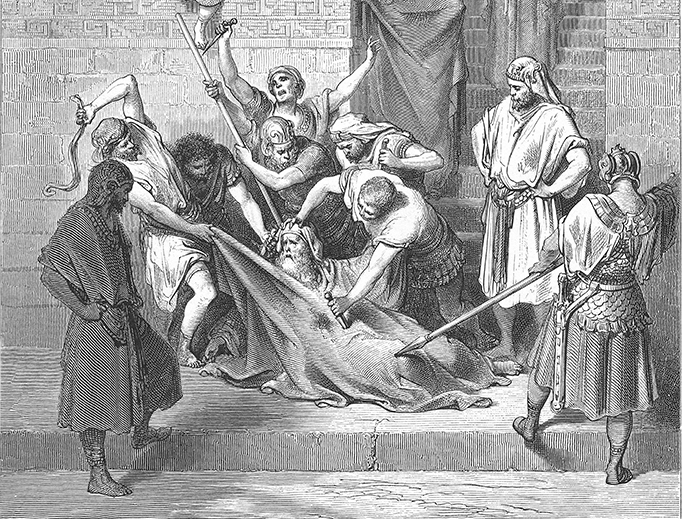

Tuesday, October 12, 2021

Bible In One Year Day 285 (1 Maccabees 4, Sirach 10-12, Proverbs 22: 9-12)

  You may subscribe yourself at the Ascension site here and receive notifications in your email, or just follow along on my blog.  Bible in One Year Readings Index 


Day 285: The Story of Hanukkah 

+++
A Daily Defense 

DAY 285 Can Science Eliminate God?

CHALLENGE: “Science has progressively explained more and more of the world, leaving less room for God. Why can’t science one day explain everything, eliminating the need for (and possibility of) God?”

DEFENSE: This objection makes several mistakes.

First, it commits the fallacy of “God of the gaps” thinking by supposing that scientific explanations somehow take something away from God. They don’t. God is the ultimate explanation for the world, including those things that science is capable of investigating (see Day 246).

Second, it assumes that science will continue to explain more and more, with no barriers to its future growth, but this is not to be taken for granted (see Day 97).

Third, while many physicists have harbored the dream of producing a “Theory of Everything”—a single set of formulas describing the behavior of all physical phenomena—there are serious doubts about whether such a theory is possible.

In 1931, the mathematician Kurt Gödel shocked his colleagues by demonstrating that there will always be mathematical truths that cannot be proved. (He did this using two proofs known as Gödel’s Incomple teness Theorems.) Mathematics is closely allied with physics, and some physicists have concluded that the same is true of their field—that there will always be physical truths that cannot be proved. Thus Stephen Hawking wrote:

Some people will be very disappointed if there is not an ultimate theory that can be formulated as a finite number of principles. I used to belong to that camp, but I have changed my mind. I’m now glad that our search for understanding will never come to an end, and that we will always have the challenge of new discovery (“Gödel and the End of the Universe,” available online).

Fourth, even if there was a “Theory of Everything”—a single, master law explaining the behavior of all physical phenomena—it would explain only that and no more. It would not explain why that law exists, why there is something rather than nothing, or what may take place outside the realm of nature.

Fifth, we have very good proofs for the existence of God, and the future growth of science will not change that. The scientific method is only capable of dealing with certain types of questions, and it cannot disprove truths that are established by other methods.

Jimmy Akin, A Daily Defense: 365 Days (Plus One) to Becoming a Better Apologist 


Monday, October 11, 2021

Bible In One Year Day 284 (1 Maccabees 3, Sirach 7-9, Proverbs 22: 5-8)

   You may subscribe yourself at the Ascension site here and receive notifications in your email, or just follow along on my blog.  Bible in One Year Readings Index 


Mattathais 


Day 284:  Near Occasion of Sin 

+++
A Daily Defense 

DAY 284 Justification in James and Paul

CHALLENGE: “James says we’re justified by faith and works (James 2:24), but that contradicts Paul, who says we’re justified by faith without works (Rom. 3:28, Gal. 2:16).”

DEFENSE: A careful examination shows the two are using key terms—faith, works, and justification—in different senses.

James uses faith to refer to intellectual assent to the truths of faith. Thus he says, “You believe that God is one; you do well. Even the demons believe—and shudder” (James 2:19).

But Paul refers to what theologians call “formed faith” or “faith formed by charity.” Thus he says what counts is “faith working through love” (Gal. 5:6).

James uses works to refer to positive actions flowing from belief in God—good works—such as giving food and clothing to the needy (James 2:15–16) or the actions performed by Abraham and Rahab in God’s service (James 2:23, 25).

But Paul refers to “works of the law”—i.e., works done because they’re required by the Law of Moses (see Day 63). He thus sees works of the law as characteristic of Jews but not Gentiles (Rom. 3:28–29; Gal. 2:11–16), and the key work he is concerned with is the Jewish initiation ritual of circumcision (Rom. 2:25–29, 3:30; Gal. 5:6, 6:13–15).

James refers to a different kind of justification than Paul. In addition to the justification that occurs when we first come to God and are forgiven, there is an ongoing growth in righteousness throughout the Christian life. Thus James refers to Abraham as being justified when he offered Isaac on the altar (James 2:21). However, this was in Genesis 22, long after Abraham was initially justified. Indeed, he had been explicitly pronounced righteous as early as Genesis 15:6.

But Paul is principally concerned with initial justification—the kind that occurs when we first come to God. Thus he speaks of justification in the context of Christian conversion (1 Cor. 6:9–11, Gal. 2:16), and he stresses that circumcision does not need to be part of Christian initiation (Gal. 5:4, 6:15).

James thus holds that intellectual faith alone does not save and that our ongoing, postconversion growth in righteousness is furthered by doing good works, while Paul holds that if we have faith working through love, then we have been forgiven and do not need to obey the Jewish law to be justified.

Jimmy Akin, A Daily Defense: 365 Days (Plus One) to Becoming a Better Apologist 


Sunday, October 10, 2021

Bible In One Year Day 283 (1 Maccabees 2, Sirach 4-6, Proverbs 22: 1-4)

   You may subscribe yourself at the Ascension site here and receive notifications in your email, or just follow along on my blog.  Bible in One Year Readings Index 


Day 283:  Mattathias Attacks 

+++
A Daily Defense 

DAY 283

The Benefits of Religion

CHALLENGE: “Religion is a destructive force that harms people.”

DEFENSE: This is not supported by the evidence.

Every institution—churches, hospitals, schools, governments—makes mistakes and harms people on occasion. However, to claim an institution is fundamentally harmful, one needs to provide evidence it does more harm than good.

Further, one would need to show not just that individual examples of an institution do more harm than good (individual churches, hospitals, schools, or governments may, in fact, be destructive).

Instead, one would need to show that the institution itself, conceived generally, is, on balance, harmful. This claim is implausible when applied to major, widespread human institutions. People aren’t stupid, and if an institution were fundamentally harmful then it would not become a major, widespread one. People would abandon it before it ever got that far.

The reason people support and patronize institutions is they perceive the benefits the institutions bring to their lives. Some are so successful that they have become human universals—institutions that appear in every culture in history. Examples include religion, medicine, education, and government.

In particular historical circumstances, the track record of these institutions is decidedly mixed (paleolithic medicine was nowhere near as good as modern medicine), but they still have provided enough benefit that they achieved universal status.

Indeed, it’s hard to see how an institution that did net harm could become a universal, because biological and cultural evolution would select against it (i.e., people who did not practice some form of it would outcompete and out-reproduce those who did, and the institution would die out).

In the case of religion, it’s easy to see how it provides benefits to people even in this life. These include helping individuals find meaning and purpose, helping groups bond together and share resources, and helping societies promote moral behaviors (“Honor thy father and mother”) and discourage immoral ones (“Thou shalt not kill”).

Also, statistically speaking, religious individuals live longer on average than non-religious ones.


Jimmy Akin, A Daily Defense: 365 Days (Plus One) to Becoming a Better Apologist