Total Pageviews

Showing posts with label Ezekiel. Show all posts

Wednesday, August 25, 2021

Bible In One Year Day 237 (Jeremiah 18-19, Ezekiel 47-48, Proverbs 15:21-24)

 You may subscribe yourself at the Ascension site here and receive notifications in your email, or just follow along on my blog.  Bible in One Year Readings Index 


Day 237: Water from the Temple 

Agape Bible Study 
Jeremiah
18 - 19 

Chapter 18

In chapters 18-19 we have two more of Jeremiah's ten object lessons:
Object lesson #4: Jeremiah 18:1-17 ~ The object lesson of the potter's clay
Object lesson #5: Jeremiah 19:1-12 ~ The object lesson of the broken clay jars


Jeremiah 18:1-12 ~ The Object Lesson of the Potter and his Clay

The key word in this passage is shuv in verses 8 and 11which means "turn back;" it is a link back to Yahweh's call for Jeremiah's repentance in 15:19 where the word is used three times. It is now used in a call for the possibility of Judah's repentance. This is Jeremiah's fourth object lesson; see the complete list of Jeremiah's Object Lessons in handout 3 for Lesson One. The passage is in prose and is divided into three parts:

  1. Object lesson #4 (verses 1-4)
  2. Oracle #1 (verses 5-10)
  3. Oracle #2 (verses 11-12)

In the fourth object lesson, Yahweh sends Jeremiah to a potter's workshop where the prophet observes a potter working at his wheel. The inspired writer of Sirach has a description of the working potter: Similarly with the potter, sitting at his work, turning the wheel with his feet; constantly on the alert over his work, each flick of the finger premeditated; he pummels the clay with his arm, and with his feet he kneads it; he concentrates on applying the glaze right and stays up late to clean the kiln (Sir 38:29-30).

Jeremiah observed that when the clay the potter was using didn't yield to what the potter intended and turned out misshapen, the potter would ball it up and began again to reshape the clay (verses 1-4). The word of Yahweh then came to Jeremiah in two divine oracles that follow Jeremiah's experience of observing the potter.

The first oracle makes an analogy between the potter and his clay on the one hand and God and Israel on the other.
Question: What is the object lesson of the potter and his clay?
Answer: If a potter can rework clay that is misshapen and not lending itself to his intended creation, how much more can God, the divine Creator, rework the nation of Israel that has turned out not as intended.


Like the potter who reworked the misshapen pot, God has the sovereign authority to reject what He has created when individual humans or nations refuse to yield to God's divine plan. He can destroy a sinful nation that turned out, because of God's gift of free-will, not as the perfect creation He intended unless they repent before it is too late. Jeremiah is told to use this object lesson in preaching to the people of Jerusalem. The point is that Yahweh has both creative and destructive power over the nations of the earth. God is also free to revoke a judgment He has planned for a nation when the people repent their sins and seek His intervention, as in the case of the withdrawal of divine judgment against the nation of Judah and the Assyrian siege of the city of Jerusalem in 722 BC when King Hezekiah led his people in communal repentance (2 Kng 19:20-37).

A question arises from verses 7-10: does God change His mind like a human being? The Hebrew word in verse 10 is wenihami (Strong's H6162)and is more literally translated "then I will repent." Yahweh is not like a human being who changes his mind. God knows the future, and therefore He knows when a people will respond to His warnings of divine punishment by offering genuine repentance. In those cases, God will revoke what could have been their destruction. 

The first oracle after the object lesson ends on an ominous note: God says that nations judged as good will have that good revoked if they do evil or no longer listen to His voice. Of course, the only nation that has listened to the voice of Yahweh in the past has been Israel/Judah.


Jeremiah 18:13-17 ~ The Failure of Virgin Israel

This poetic section is God's judgment concerning the object lesson in verses 1-12. The people are told to ask the neighboring states two rhetorical questions to which the answer is "No." To make His point, Yahweh uses two examples from nature. Both questions concern natural laws to which the elements of nature are obedient, like the perpetual snow that covers the top of Mt. Hermon in Lebanon and feeds the rivers that flow from the mountain. God compares the obedience of nature to the disobedience of the people of Israel who abandoned the God who created the mountains and the rivers.

Question: What is the "horrible thing" in verse 13b and the "object of horror in verse 16?
Answer: The "horrible thing" is Virgin Israel's adultery with pagan gods/idol worship and defilement of Yahweh's Temple with illicit worship (verse 15).

15 And yet my people have forgotten me! They burn incense to a Nothing! They have been made to stumble in their ways, the ancient paths, to walk in paths, on an unmade road...
The complaint that the people have forgotten Yahweh is repeated again (see Jer 2:323:2113:2523:27), and refers back to Moses' accusation against future generations in his final homily: You forget the Rock who fathered you, the God who made you, you no longer remember (Dt 32:18). Instead of walking the righteous path God set for the people if they followed His Law and kept His covenant, their forgetting has caused them to "stumble in their ways" and to walk a path of idolatry.


Jeremiah 18:18 ~ The Plot Against Jeremiah

In this short prose section, the people plan to do away with Jeremiah by making false accusations against him. They reason to themselves, what does the loss of life of just one priest matter? In this passage, Jeremiah becomes another Christ figure whose people also slandered His name and brought false charges against Him, calling Jesus a blasphemer, agent of Satan, and planned His death (Mt 12:2426:59Mk 2:6-7Jn 7:111:49-53). Persecution and plots against Jeremiah are mentioned twelve times: 11:1912:615:20-2118:182020:1026:2436:2637:11-1238:1-16.

Jeremiah 18:19-23 ~ Jeremiah Appeals to Yahweh

In this poetry section, Jeremiah appeals to Yahweh to protect him from his enemies. He reminds the Lord that, in the past, he had offered prayers of intercession for the people, but now, since that are actively planning his death, Jeremiah asks for God's judgment to be delivered against them. Notice how Jeremiah repeats the same judgments God gave him in his various judgment oracles (c.f., Jer 11:112212:12-1314:1215:216:4). Jeremiah's anger at his people's betrayal recalls his similar angry denunciation of them in 11:20. Jeremiah's reaction is very humanly realistic: when it becomes personal, Jeremiah is not willing to ask for mercy for the people!

Chapter 19

The fifth object lesson and its preaching oracle must date prior to 605 BC. In the fourth year of King Jehoiakim's reign, in 605 BC, the Temple hierarchy barred Jeremiah from entrance into the Temple precincts (Jer 36:15). The incident recorded in 19:14, when Yahweh commanded Jeremiah to preach the oracle associated with the fifth object lesson within the inner courtyard of the Temple, probably disrupted the daily liturgical worship service and led to the drastic measure of completely banning Jeremiah from entering the Temple.

Jeremiah 19:1-9 ~ The Fifth Object Lesson

All of chapter 19 is in prose. The event of the fifth object lesson and the pronouncement of Yahweh's judgment on Jerusalem associated with the object lesson probably took place in 598 BC, just before the Babylonian siege and capture of the city. As in the linen waistcloth in 13:1, Jeremiah is told to go and purchase an object to use in his preaching. This time the object is a pottery jug.

Take some of the people's elders and some of the senior priests with you. Go out towards the Valley of Ben-Hinnom, just outside the Gate of the Potsherds.
That Jeremiah is able to enlist certain of the elders of the people and chief priests from the Temple to accompany him says something about Jeremiah's importance in the city and at the Temple. Perhaps these are the same elders who spoke up in Jeremiah's defense at his trial about a decade earlier at the beginning of the reign of King Jehoiakim in 609 BC (see Jer 26:117). The Potsherd's Gate must have been a gate leading out of the city to the south. It was probably near the district where professional potters had their shops and where broken pots were dumped.

The Valley of Ben-Hinnom was south of the city of Jerusalem and had an infamous reputation as the site where children were burned alive in sacrificed to Baal/Molech, and it was the location of the ceremonial graveyard called the Topheth, meaning "incinerator" (see Lev 18:2120:2-5Dt 12:3118:101 Kng 16:321:623:102 Chr 33:16Jer 7:3132:35Ez 16:21).

The oracle that begins in verse 3 is to be addressed to the Kings of Judah and the people in the presence of the delegation of elders and chief priests. That Jeremiah's announcement is to include the "Kings of Judah" (plural in verse 3), may suggest that Jehoiakim had made his eighteen-year-old son, Jehoiachin, a co-ruler. Both Davidic Kings Jehoiakim and Jehoiachin were deposed by the Babylonians and carried away into exile in 598 BC (2 Kng 24:1-92 Chr 36:5-10). Chapter 21 will take place during the reign of Jehoiachin's successor, King Zedekiah, the last Davidic king of Judah.

In verses 3-15 Jeremiah lays out the reason for the covenant lawsuit: the kings of Judah and their people have abandoned Yahweh and His covenant and have worshipped false gods (verse 4). What follows is a list of sins and a description of divine punishment for their apostasy and idol worship.

They have filled this place with the blood of the innocent; for they have built high places for Baal to burn their sons as burnt offerings to Baal, a thing I never ordered, never mentioned, that had never entered my thoughts.
The "blood of the innocent" probably not only includes child sacrifice but the miscarriage of justice. Yahweh's firm stand against the Canaanite practice of child sacrifice, later adopted by the Phoenicians and other neighboring states, is repeated numerous times in the Law (see for example: Lev 18:2120:2-5Dt 12:3118:10). If God feels so strongly about the misguided practice of sacrificing children to a false god like Baal/Molech, what will be the judgment against nations that have legalized abortion?

I shall make them eat the flesh of their own sons and daughters: they will eat one another during the siege, in the shortage to which their enemies, and those determined to kill them, will reduce them.'
It is a fact that sometimes people suffering under a prolonged siege will resort to cannibalism. This happened to Jerusalem during the Babylonian siege and centuries later during the Roman siege of Jerusalem in 70 AD. It was an event that was prophesied in the covenant curse-judgments in Deuteronomy 28:53-57.

Jeremiah 19:10-15 ~ The Broken Jug

Jeremiah completes the object lesson by delivering the oracle and breaking the clay jug in the presence of the crowd while announcing that Yahweh will destroy the city and its people in the same way and with such force that it will never be the same again. He delivered the first part of his oracle in the ritual cemetery outside the southern gate of Jerusalem in the Valley of Ben-Hinnom, and then he returned to the Temple, perhaps to the inner court where the sacrificial altar stood, to complete the last part of his oracle.

Question: According to Jeremiah's prophecy, the ceremonial burial ground for sacrificed children will be put to what new purpose?
Answer: It will become a burial ground for the citizens of Jerusalem.


Agape Bible Study 
Ezekiel
47 - 48 

Chapter 47: The Spring in the Temple and the Frontiers of the Holy Land


Ezekiel 47:1-12 ~ The Spring Flowing from the Temple

The water flowed out of the Temple from the west to the east and out of the closed eastern gate (44:1-2) all the way down the Arabah that is Rift Valley and includes the Jordan River Valley and the Dead Sea area stretching to Elath and the Gulf of Aqaba. Everywhere the water from the Temple flowed it became deeper until it formed a great river, and the land was purified and brought forth life. The only exception was the marshes and lagoons that remained salty. The fruit trees on either side of the river were eternally healthy and continually bearing fruit and leaves that healed sickness.

Question: What are the similarities between Ezekiel's vision of the River of Life and St. John's vision in the Book of Revelation 22:1-2?
Answer: The comparison between the vision of the River of Life in Ezekiel and the Book of Revelation:

River of Life in Ezekiel 47:1-12River of Life in Revelation 22:1-2
It began as a stream flowing to the east from under the Temple threshold (Ez 47:1).The angel identifies the river as "the river of life" (Rev 22:1a).
The water flowed out of the Temple's outer east gate on the right side (Ez 47:2).It began flowing, crystal clear, from the throne of God and the Lamb and flowed down the middle of the new Jerusalem (Rev 22:1b-2a).
Every thousand cubits, the stream grew deeper as Ezekiel waded in the waters (Ez 47:3-5).John sees the river but does not wade into it (Rev 22:1a)
It became a great river impossible to cross, and the guide placed Ezekiel on the shore (Ez 47:6).John only sees the river flowing through the new Jerusalem.
Trees grew on either side of the river banks that bore fruit every month and with leaves with healing properties (Ez 47:712).On either bank were "trees of life" that bore twelve crops of fruit a year and leaves "which are the cure for the nations" (Rev 22:2).
The waters flowed east to the Arabah and then south to the Dead Sea which became purified (Ez 47:8).John does not see the river's destination.
Everywhere the river flowed, it brought forth abundant life (Ez 47:9-10).The river will bring life "to the nations" (Rev 22:2c).
The marshes and lagoons will remain salty (Ez 47:11). 
Michal E. Hunt Copyright © 2018

Ezekiel shares his vision of the river flowing from the end of the Temple and emptying into the Dead Sea as it revitalizes everything it meets on its journey, including the purification of the salty, lifeless waters of the Dead Sea. However, there is no end to the river's flow that brings the "cure" (of sin) to the nations of the earth.

Question: This is one of the most startling images in the book. What river does it recall from Genesis Chapter 2 and what tree? What does this link suggest symbolically? How is this river different and what does this difference suggest?
Answer: The stream flowing out of the Temple in Ezekiel (and the River of Life flowing from the throne of God and the Lamb in Revelation) is reminiscent of the river that flowed out of Eden, dividing into four branches to sustain life on the earth in Genesis 2:10-14 before the fall of Adam. The trees in Ezekiel' vision recall the fruit bearing trees in the Garden of Eden and especially the Tree of Life in the center of the garden (Gen 2:8-9). In Ezekiel and Revelation, however, the single river itself gives life and health, and the trees are all "trees of life." The symbolism of the vision shows that the renewal of liturgical worship will bring blessings to the whole of the covenant people and the land in a new creation. God will present a remedy for the curse of the sin of Adam that hurt humanity and all creation.

Ezekiel's vision of the river of life also recalls Jesus words in John 7:37 on the last day of the Feast of Shelters when He proclaimed: "If any one thirst, let him come to me and drink. He who believes in me, as the Scripture has said, "'Out of his heart shall flow rivers of living water.'" The Fathers of the Church link this text of St. John with Ezekiel's vision. They saw in the river flowing from the Temple the waters of Christian Baptism that flow from Christ who is life, and from the water that burst forth from Christ's side as He hung on the altar of the Cross (Jn 19:34). St. Barnabas wrote: "We go down to the water's edge steeped in our sins and impurity, and we walk out of the water, our hearts filled with grace, fear of the Lord and hope in Jesus" (Epistles of Barnabas, 11.10).

Verses 7-9 and 12 also remind us of the promises made to the Church of the redeemed in the Book of Revelation. In Revelation 7:17 and the vision of St. John in Revelation 22:1-5 (quoted previously), he describes the new Jerusalem and the new Temple of the new Heaven and earth after the Second Coming of Christ and the Last Judgment:

  • For the Lamb who is in the center of the throne will shepherd them and lead them to springs of life-giving water, and God will wipe away every tear from their eyes (Rev 7:17).
  • Then the angel showed me the river of life-giving water, sparkling like crystal, flowing from the throne of God and of the Lamb down the middle of its street. On either side of the river grew the tree of life that produces fruit twelve times a year, once each month; the leaves of the trees serve as medicine for the nations. Nothing accursed will be found there anymore. The throne of God and of the Lamb will be in it, and his servants will worship him. They will look upon his face, and his name will be one their foreheads. Night will be no more, nor will they need light from lamp or sun, for the Lord God shall give them light, and they shall reign forever and ever (Rev 22:1-5).

The Fathers of the Church saw the River of Life as an allusion to the third Person of the Most Holy Trinity, since living water is a symbol of the Holy Spirit, as in Baptism by water and the Holy Spirit (Jn 3:35Jn 4:10-14Acts 1:5Rev 21:6). On the last day of the Feast of Shelters/Tabernacles, Jesus cried out to the worshippers within the Temple: On the last day, the great day of the festival, Jesus stood and cried out: "Let anyone who is thirsty come to me! Let anyone who believes in me come and drink! As scripture says, "'From his heart shall flow streams of living water.'" He was speaking of the Spirit which those who believed in him were to receive for there was no Spirit as yet because Jesus had not yet been glorified (Jn 7:37-39).

The annual pilgrim feast of the Feast of Shelters/Tabernacles (Dt 16:16) commemorated the Mosaic water-miracle when God made life-giving water flow from a rock (Ex 17:1-7Num 20:9-11). The festival included readings from Scripture passages foretelling life-giving water for Zion from our Ezekiel passage and Zechariah 14:8. The water of life is God's grace, which flows from Christ to His Church! This life-giving water is available to the Church now in the waters of Christian Baptism that prepare us for the greater gift of eternal life that is to come.

Ezekiel 47:13-23 ~ The Frontiers of the Holy Land

Yahweh defined the borders of Canaan for the Israelites in Numbers 34:1-15 and Joshua 1:1-5 that were ideal boundaries. The Israelites were unable to secure the promised northern border until the time of David, and then they were unable to keep them (also see lists in Gen 15:18Dt 1-711:24Judg 20:1). The political borders of Israel only extended as far north as the territory of Hamath under Kings David of the United Kingdom of Israel (died c. 970 BC, 1 Chr 13:5) and King Jeroboam II of the Northern Kingdom (ruled c. 782-743 BC, 2 Kng 14:25).

This passage repeats some of those traditions, but there are differences. Some of the place-names are different, so cannot be identified, and, apparently, the northern frontier was to pass north of Tripoli and include the territory of Damascus (verses 15-16), which did not happen. The River Jordan marks the eastern frontier, whereas in the original division of the land there were tribes occupying land on the east side of the Jordan River: Gad, Reuben, and half of Manasseh (Num 34:14-15).


Chapter 48: Distribution of the Land and the Gates of Jerusalem

Ezekiel 48:1-29 ~ The Division of the Land


That the division refers to the land of Israel is made clear by the geographic terms that identify the borders of the nation of Israel. The division of the land is not the same as the divisions made by Joshua after the conquest of Canaan when the drawing of lots determined each portion of tribal land (Josh 13:7-19:51). The priests and Levites did not receive a portion of the land. They did receive forty-eight cities and adjoining pasture land in the original partition of the land and six cities of refuge, three on the east side of the Jordan and three on the west side (Josh 20:1-21:42).

The new plan divides the land oddly into parallel strips running north to south from the eastern frontier of the Jordan River to the Mediterranean and divided into fourteen portions. Agreeing with the boundaries set to the land in Chapter 47, this passage shows that the former Transjordan tribes resettled to the west of the Jordan River. There are seven tribes to the north. In the center is Yahweh's portion surrounding Jerusalem. This sacred portion subdivides between the priests (with Jerusalem and the Temple) and the Levites, with what is leftover assigned to Jerusalem as common land. The territory of the nasi/prince stretches from the east and west of this sacred portion. Finally, there are five tribes to the south.

48:30-35 ~ The Conclusion of the Vision


In the final vision (Chapters 40-48), Ezekiel will mention the "city" seventeen times in the Hebrew text (40:12345:67 twice; 48:15 twice, 171819202122303135), but he never calls it Jerusalem. We assume he is referring to Jerusalem from his reference to the "city" because he mentions its "capture" or "destruction" (40:1) and that it is south of the Temple on "the high mountain" (40:2).

Ezekiel 48:30-35 ~ The Gates of the City

The list of gates in Revelation 21:12-13 begins on the east instead of on the north as in Ezekiel's description. You will recall that in 44:1-2 the outer east gate must remain closed because the glory of God passed through it into the Temple complex (Ez 43:1-4); but to which of the three outer gates does this prohibition refer? It is probably the Benjamin gate that is the middle eastern gate and mentioned in Zechariah's prophecy of the return of God to the Mount of Olives (Zech 14:10-11).

In Jesus' time, eight outer gates led into the city of Jerusalem. See the document "The Gates of Jerusalem" and the document on the Eastern gate.

Question: Into which gate did Jesus, the divine Son of God, enter Jerusalem on Palm/Passion Sunday coming from Bethany on the Mount of Olives? See Zech 14:4

Answer: Since the Mount of Olives is to the east of the city of Jerusalem, He must have entered through the east gate.

Sometime after the conquest of the Holy Land by Muslim armies in the 7th century AD, their imams became aware of the prophecy concerning the return of the Jewish-Christian Messiah through the eastern gate (Zech 14:1-5Acts 1:11). In response to the prophecy, they walled up the eastern gate that faces the Mount of Olives and dug graves up to the wall to make the site ritually unclean for a Jew. It has remained closed ever since.
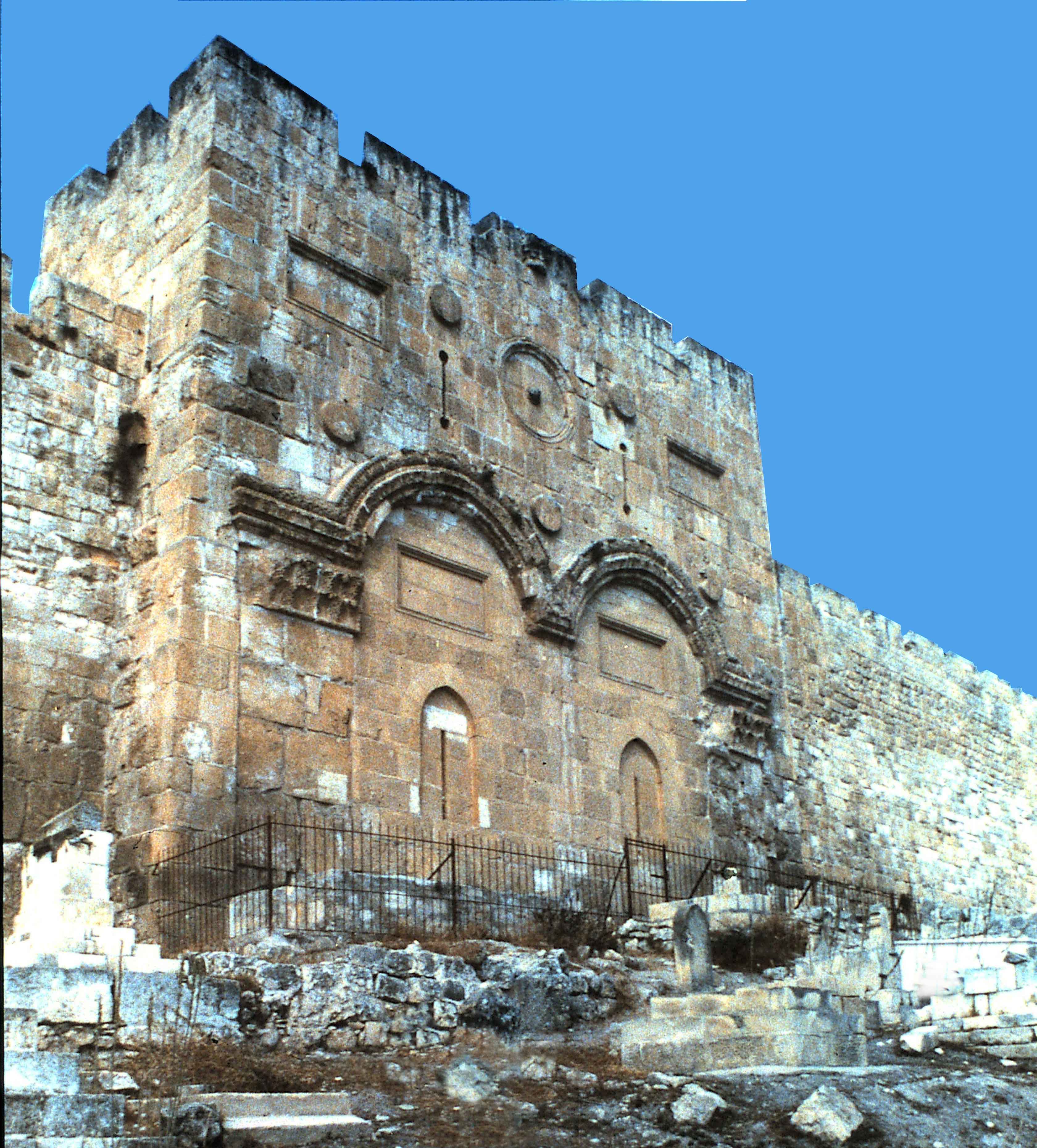
golden gate
The walled-in Gate in Jerusalem's eastern wall facing the Mount of Olives.

When St. John witnesses the new heaven and new earth and the passing away of the first heaven and first earth, he also saw the holy city of the new Jerusalem coming down out of heaven like a Bride and heard the voice of God call from the throne, "Look, here God lives among human beings. He will make his home among them, they will be his people, and he will be their God, God-with-them (Rev 21:4). This is the classic formula of covenant formation (Gen 17:8Ex 25:8Lev 26:11-12Jer 31:33Ez 37:27; and cf. 2 Cor 6:16). The intimate presence of God among His people is the mark of His covenant relationship. It will reach its climax at the end with His Church, filling the lives of all His Baptized faithful washed with His Spirit and nourishing them with the Eucharist on their journey through life to His home in Heaven.


Ezekiel's last vision from Chapters 40-48 generates many unanswered questions:

  1. What is the huge, walled, fortress-like Temple so unlike previous Temples?
  2. Why is there no Ark of the Covenant or High Priest?
  3. Who is the nasi who functions as more of a religious leader than a civil leader?
  4. Why the elaborate list of sacrifices that do not match the commands in Mosaic Law?
  5. What is the purpose of the angelic guide who was continually setting boundaries and making judgments?
  6. What is the significance of the wooden table-altar?
  7. Why does the east gate remain closed?
  8. What is the significance of the waters flowing out of the Temple?

Perhaps it is easier to discern what the visionary Temple isn't as opposed to what it is:

    Rev 21:4
). In the meantime, God "is there" cc; break-inside: avoid; font-family: Arial, sans-serif; margin-left: 0.5in;">
  • It cannot be the heavenly Sanctuary nor does it fit the description of the future Temple in the Book of Revelation. Those Temples do not need guard rooms and walls for protection nor animal sacrifices.
  • It cannot be the Second Temple the exiles will rebuild upon their return because the description and dimensions are entirely different.
  • It cannot be the Temple Herod expanded and renovated because it did not conform to the description of Ezekiel's visionary Temple.
  • The answer to the question why there is no Ark probably lies in Jeremiah's prophecy in Jeremiah 3:16 that one day the Ark will no longer have importance. Jeremiah hid the Ark and the Altar of Incense before the destruction of the Temple, and it was never recovered (2 Mac 2:4-6). But why is there no High Priest and why does the nasi seem to assume his role?

    In 1 Corinthians 13:12, St. Paul wrote: Now we see only reflections in a mirror, mere riddles, but then we shall be seeing face to face. Now, I can know only imperfectly; but then I shall know just as fully as I am myself known. It is possible that the closed eastern gate, the wooden altar-table, and the stream under the Temple are the keys to this metaphorical riddle? The Fathers of the Church believed the closed gate referred to the womb and birth canal of the Virgin Mary. Once God enfleshed had passed through, no other mortal could use the same entrance to the world of man (Ez 44:1-2). Does this mean everything in the vision points to the New Covenant in Christ Jesus? Is it possible that:

    1. Is the fortress-Temple the walled citadel of the Vatican, the home of the Universal Church of the New Israel? The Vatican is a walled religious fortress covering 110 acres or 4,736,121 square feet.
    2. Is there is no High Priest because Jesus Christ is the New Covenant High Priest, and He resides in the heavenly Temple offering His sacrifice forever until the end of the age (Heb 3:14:14-157:20-218:1-39:11-14).
    3. Is the nasi and are his successors Christ's earthly representative, the Vicars of Christ?
    4. Do differences between Ezekiel's list of sacrifices and the Mosaic sacrifices indicate the end of animal sacrifice because the Christ will fulfill all sacrifices? Is it His nasi/chief that is responsible for seeing that His single but on-going sacrifice is offered on the altars of all Catholic churches in the sacrifice of the Eucharist? Is this why the text only mentions one Tamid lamb? St. John sees Jesus in heaven and describes Him as a lamb standing that seemed to have been sacrificed (Rev 5:6). The Greek word is Arion Hestekos that means "lamb standing." The Hebrew word "tamid" means "standing" as in continual or perpetual. When Ezekiel saw a wooden table as an altar in Ezekiel 41:21-22, was he discerning the future table of the Last Supper that became the first New Covenant altar of sacrifice where "the bread of the Presence of God" became the Body, Blood, Soul, and Divinity of Jesus Christ?
    5. It is possible that the angelic guide and the River of Life represent God the Holy Spirit? It is God the Holy Spirit who gives the Church of the new Israel the judgments and boundaries for the New Covenant people of God to live holy lives in imitation of their Lord and Savior, Jesus Christ.

    The wooden altar-table (Ez 41:22), the closed gate that God passed through to return to His people (44:1-2), and the River of Life flowing from the Temple (47:1-12) are all significant clues to understanding Ezekiel's vision:

    • The closed gate may represent Mary's closed womb in her perpetual virginity, or the promise that in the newly established order God will never leave His people again, or the closing of the eastern gate of Jerusalem until Christ's return in glory. Or do all of these apply to the closed eastern outer gate?
    • Jesus' table of the Last Supper was a wooden table that became an altar. The consecrated altar in every Catholic church represents the table of the Last Supper, Christ's altar of sacrifice that is the wooden Cross, and the empty tomb. As for the wooden altar-table, what is its significance unless it points to the foreshadowing of Jesus' Passion as He offered Himself in His Body, Blood, Soul, and Divinity at the wooden table of the Last Supper?
    • The River of Life that is reminiscent of the life-giving river in the first creation is the strongest symbol in Ezekiel's last vision that points to the New Covenant, a new creation in Christ Jesus, and the new, healing tree of life that is the Cross that made possible the outpouring of the Holy Spirit upon the earth.


    "And behold, I am with you always, until the end of the age" (Mt 28:20 NAB).

    +++
    A Daily Defense
    DAY 237: Constantine and the Catholic Church

    CHALLENGE: “The Catholic Church was created by the Emperor Constantine when he made Christianity the official religion of the Roman Empire.”

    DEFENSE: Both of these claims are historically false.

    Although Constantine is often credited with being the first Christian emperor, he didn’t make Christianity the official religion. What he did, together with his colleague and rival, Licinius, was issue the Edict of Milan in A.D. 313, which proclaimed religious toleration for Christianity among the other religions in the empire.

    He also didn’t create the Catholic Church, which already existed in his day. Indeed, it had already been known by that name for more than 200 years. Thus, writing around A.D. 110, St. Ignatius of Antioch stated: “Wherever the bishop shall appear, there let the multitude also be; even as, wherever Jesus Christ is, there is the Catholic Church” (Letter to the Smyrneans 8).

    The fact that Ignatius introduces the phrase “Catholic Church” without stopping to explain it indicates it was already in use, and he could expect people in the distant church of Smyrna to understand what it meant. This wide circulation therefore must have begun in the second half of the first century.

    The meaning of the Greek term for “Catholic” (katholikos) is “universal” (from kata holos, “according to the whole”). It was introduced as a way of identifying the universal Church established by Christ (Matt. 16:18), as distinct from local congregations. “Very quickly, however, in the latter half of the second century at latest, we find it conveying the suggestion that the Catholic is the true Church as distinct from the heretical congregations” (J.N.D. Kelly, Early Christian Doctrines, 5th ed., 190).

    “The Catholic Church” was thus simply the common way of referring to the original Church established by Christ, not Constantine.

    Those who make this objection frequently claim that, at the time of Constantine, various doctrinal changes were introduced that are characteristic of the Catholic Church and that separate it from apostolic Christianity. However, no doctrinal changes were introduced. Even the definition of the divinity of Christ, which occurred during Constantine’s reign at the First Council of Nicaea (A.D. 325), was an affirmation of previous Church teaching.


    Jimmy Akin, A Daily Defense: 365 Days (Plus One) to Becoming a Better Apologist

    Tuesday, August 24, 2021

    Bible In One Year Day 236 (Jeremiah 16-17, Ezekiel 45-46, Proverbs 15:17-20)

       You may subscribe yourself at the Ascension site here and receive notifications in your email, or just follow along on my blog.  Bible in One Year Readings Index 


    Day 236: Rich In Love

    Agape Bible Study 
    Jeremiah
    16 - 17 

    Chapter 16: The Symbolic Nature of Jeremiah's Life and the Reason for the Exile

    Yahweh's prophets often spoke symbolically and performed symbolic actions to reinforce their preaching (see Is 8:18Ez 24:15-24Hos 1:3). In Jeremiah's case, his very life became a symbol and a sign.

    Jeremiah 16:1-9 ~ Yahweh Commands Jeremiah to Remain Celibate and Separate from the Normal Life of the People

    Chapter 16 begins a collection of Jeremiah's oracles that continues through 17:18. Chapter 16:1-18 is in prose, and 16:19-17:18 is in the poetic form. Chapter 16:1-9 is divided into three oracles preceded by divine commands telling Jeremiah what he may not do:

    1. No wife, no children (verses 1-4)
    2. No mourning feasts (verses 5-7)
    3. No other feasts (verses 8-9)

    These are three symbolic non-actions Jeremiah is commanded to observe. Each command is followed by a divine oracle giving the absence of the action an interpretation. The first is that he must not marry or have children in verse 1 and the reason for the command is given in verses 2-4.
    Question: What is the reason for the first command?
    Answer: Sons and daughters and their parents who are born in Jerusalem and Judah are destined for death from war, famine, and the diseases of war.

    Disease and famine suggest Jerusalem is under a prolonged siege, while the sword symbolizes death as a direct result of war in the country of Judah. The large numbers of the dead described in the oracle that will not be lamented or buried but left as carrion suggests the ravages of war. Under such conditions, God tells his prophet, he must not marry or have children and face such sorrows. 

    The second command prohibits Jeremiah from attending mourning feasts. He is not to lament the dead or console the bereaved families.
    Question: What reason is given for this prohibition?
    Answer: God has taken away His peace/shalom from His people and also His covenant love and compassion. As a result, all the people are under the covenant curse-judgment that predicts they will die unburied and unlamented.

    Funeral rites that offered respect for the dead were very important, and the absence of a proper burial was regarded as a frightful curse (Jer 22:18-191 Kng 14:11Ez 29:5). The shocking nature of this command will undoubtedly make people ask why Jeremiah is behaving in this disrespectful manner, giving Jeremiah another reason to share his oracle.

    6b there will be no gashing, no shaving of the head for them.
    Such funeral rites as cutting the flesh and shaving off one's hair were pagan and forbidden by the Law (Lev 19:27-28Dt 14:1). However, this prohibition suggests that, along with other pagan rituals, these funeral rites were practiced in Judah (Jer 7:2941:5).

    No bread will be broken for the mourner to comfort him for the dead; no cup of consolation will be offered him for his father or his mother.
    This verse refers to the customary communal meal eaten by family and friends after the burial.

    The third command prohibits Jeremiah from entering houses where feasting is taking place.
    Question: What is the reason given for this prohibition?
    Answer: Yahweh is bringing an end to all joy for a people who rejected Yahweh and His gift of joy and well-being.

    At the end we are reminded of the joy Jeremiah will not experience as the bridegroom of the bride denied him; there will be no joyful wedding sounds or feasts for him either (verse 9).

    Siege of Jerusalem 


    Jeremiah 16:10-13 ~ The Explanation Jeremiah is to give for the Disaster of the Invasion

    King Josiah gave the answer to the people's question in 16:10 at the covenant renewal ceremony in 622 BC when he read from the Book of the Law in the section of the covenant curse-judgments for apostasy from the Sinai Covenant: And all the nations will exclaim, "Why has Yahweh treated this country like this? Why this great blaze of anger?" And people will say, "Because they deserted the covenant of Yahweh, God of their ancestors, the covenant which he made with them when he brought them out of Egypt; because they went and served other gods and worshipped them, gods hitherto unknown to them, gods that were no part of their heritage from him: this is why Yahweh's anger has blazed against this country, afflicting it with all the curses written in this book (Dt 29:24-26).

    Question: What list of wrongs is Jeremiah to use in 16:11-13 in answering the question in verse 10 that repeats the curse-judgment in Deuteronomy 29:24-26? Into what two parts is his answer divided? What is Yahweh's final judgment and how is it related to the curse-judgment in Deuteronomy 28:47-48.
    Answer:

    Part I lists the accumulation of the sins of their ancestors:

    1. The ancestors of the Judahites abandoned their belief in Yahweh.
    2. They taught the people to follow other gods and to serve and worship them.
    3. They abandoned Yahweh's covenant and therefore His Law.

    Part II summarizes the sins of the current generation in which each person follows his own inclinations regardless of the Law, repeating all the sins of their ancestors.
    The judgment is exactly what Yahweh warned would happen for apostasy from the covenant: the withdrawal of His divine protection and exile into a foreign land.

    Question: What does Jesus pronounce as a generational curse-judgment against the citizens of Jerusalem in Matthew 24:33-36, during His last week in Jerusalem?
    Answer: During His last week in Jerusalem, Jesus pronounced a curse-judgment against the citizens of Jerusalem that His generation will reap for all the righteous prophets killed by their ancestors. The judgment extends from the murder of Abel, son of Adam, to the prophet Zechariah. And, as inferred, to include their unjust condemnation and death of Jesus, God's Supreme Prophet.

    The judgment Jesus pronounced will be the same judgment that Yahweh pronounced on the Jerusalem of Jeremiah's day: the destruction of the city and its Temple by a foreign army followed by captivity and exile. The historical fulfillment of Jesus' prophecy took place on the 9th of Ab, 70 AD, when Jerusalem and the Temple were destroyed by the Romans. It was the same day when the Babylonians destroyed Jerusalem and Solomon's Temple on the 9th of Ab in 587 BC.

    Jeremiah 16:14-15 ~ The New Exodus

    Jeremiah 16:14-21 contains three prophetic oracles:

    1. The new Exodus and new oath (16:14-15)
    2. No refuge for the wicked (16:16-18)
    3. Jeremiah professes his faith in Yahweh (16:19-20) and the conversion of the Gentile nations (16:21)

    Question: The first oracle is delivered to an audience facing exile. What do these people no longer acknowledge concerning their relationship with Yahweh?
    Answer: They no longer acknowledge Yahweh as the God who delivered them from bondage in Egypt.

    The seven annual feasts of the covenant people's entire liturgical calendar were based on reliving the greatest event in their history that was their ancestors' deliverance from bondage in Egypt and their creation as a free people and God's holy nation at Mt. Sinai (i.e., Ex 13:3-16). When a people forget their history, they lose their national identity, their moral compass, and their unity as a nation.

    Jeremiah is told to use the Exodus liberation as an example of a historical precedent for God's promise of restoration to the land of Israel after their exile. Notice that "As Yahweh lives" is an oath formula that is repeated twice in verses 14 and 15. "As Yahweh lives" is an oath formula containing the central confession of Israel's faith in remembering Yahweh's deliverance of Israel from Egypt (verse 14). It will be replaced by a new oath confessing the covenant people's belief in Yahweh in verse 15.

    15 but, As Yahweh lives who brought the Israelites back from the land of the north and all the countries to which he had driven them.' I shall bring them back to the very soil I gave their ancestors."
    The people will profess a new oath of allegiance to Yahweh in a promised restoration to their ancestral Promised Land when God delivers them from their captivity and exile from "the land of the north." The reference to deliverance probably refers to the return of the Israelite exiles from Assyria and Babylon.

    Once again in Scripture, there is the promise of salvation and restoration in the midst of divine judgment and destruction.

    Jeremiah 16:16-18 ~ No Refuge for the Wicked

    Horrors and Abominations refer to pagan gods. The fishing metaphor is used to describe catching people as a fisherman uses hooks and nets to catch fish (see the same imagery in Amos 4:2Hab 1:14-15Eccl 9:12). Jesus will use the same metaphor for His Galilean disciples who He says will become "fishers of men/people" (Mk 1:1720Lk 5:10). The hunter metaphor comes from an organized hunt where hunters drive the game into traps (see Lam 4:19Ez 19:1-9), just as the army of the Babylonians will hunt down and trap the citizens of Judah.

    In verses 16b-18, the warning is that there will be no place to hide from the enemy just as there is no way to hide their guilt from Yahweh. The double payment for their sins in verse 18 recalls Isaiah 40:2, and in 17:18 Jeremiah calls for a "twice over" destruction upon his enemies. There is a judgment of a double payment in Exodus 22:8/9 where the guilty party must make a double reimbursement to the one who suffers loss. Revelation 18:6 also calls for "double the amount" of judgment.

    Jeremiah 16:19-21 ~ Jeremiah's Profession of Faith in Yahweh and the Conversions of the Nations

    The third oracle is more an antiphonal hymn in which Jeremiah sings the praise of Yahweh in verses 19-20, and Yahweh responds in verse 21. Jeremiah professes his belief that Yahweh is his personal strength and refuge in times of trouble. His profession of faith in verse 19 recalls Davidic Psalm 37, verses 39-40. His confession of faith and trust shows that he has repented his accusation against Yahweh in 15:18. Jeremiah also confesses the sins of Judah's ancestors who worshipped false gods without life or power.

    Yahweh and His name are one. Yahweh means "I AM who I AM" (Ex 3:14), and the expression "Yahweh is my name" is the same as saying "I AM Yahweh!" The prophecy is that all nations of the earth will acknowledge Yahweh as the One True God and will petition Him by His divine Name, as God told Moses in Exodus 3:15bThis is my name for all time, and thus I am to be invoked for all generations to come.

    Chapter 17

    The collection of Jeremiah's oracles that began in Chapter 16 continues through 17:18. The oracles in 17:1-18 are poetic, with the exception of verses 1c-3a that are in prose. The sin of Judah's citizens is indelible, written with an iron pen with a diamond point (verse 1), and their downfall due to their sins is inevitable. Yet the promise is made again: if only they will return to Yahweh and their covenant obligations, Jerusalem will remain forever (17:24-25).

    Jeremiah 17:1-4 ~ Judah Forfeits her Heritage because of Idol Worship

    17:1-4 are missing from the Septuagint text. There is a link between 16:18I shall requite their guilt and their sin twice over, since they have polluted my country with the carcasses of their Horrors, and filled my heritage with their Abominations (underlining added) and 17:1 and 4The sin of Judah is written with an iron pen, engraved with a diamond point on the tablet of their heart ... and, You will relinquish your heritage which I gave you ...


    Question: What does the condition of the people's communal heart tell us if this kind of tool is needed to record their sins? What does their condition have to do with their reception of Jeremiah's oracles?
    Answer: That a tool of this description is needed to write the people's collective sin on the "tablet of their heart" indicates the extreme hardness of the people of Judah's communal heart. It is the reason they will not listen to Jeremiah's oracles that warn to repent before the day of Yahweh's wrathful judgment.

    The covenant people are to observe God's commandments and continually teach them to their children at all times!

    Question: If the covenant people had kept the commands in Deuteronomy 6:5-7 and 11:18-19 to love Yahweh with all their heart and to teach their children, what would have been the result?
    Answer: Their hearts wouldn't have become hardened by sin, they would have taught their children to love God, and their children wouldn't be worshipping false gods on the hills.

    Jeremiah 17:5-11 ~ Curses, Blessings, and Wisdom Sayings

    Jeremiah 17:5-18 is composed of a number of brief teachings/sayings all of which are in the poetic form. Together with verse 1, these verses are linked by the key words "heart" and "fruit." Notice the underlined words in the passage above.

    Question: What two kinds of people are contrasted in verses 5-8?
    Answer: The contrast is between the cursed and the blessed:

    1. The cursed in verses 5-6 are those who:
      • trust in human beings
      • turn their heart from Yahweh
      • possess a spiritually parched soul that cannot continue in faith during hardship
    2. The blessed in verses 7-8 are those who:
      • trust in Yahweh
      • are protected in times of distress
      • bear the good fruit of righteousness


    Jeremiah 17:12-13 ~ Praise for the Temple

    "Our Holy Place" refers to the Jerusalem Temple. Jeremiah uses two honorific names for the Temple and two for Yahweh. He calls the Jerusalem Temple:

    1. "a glorious throne"
    2. "our Holy Place"

    Notice the contrast between God's throne "on high" and those who abandon Yahweh who are consigned to the underworld where their names are written in Sheol, the abode of the dead. The reference to "glorious throne" and "on high from the beginning" probably refers not only to the Ark of the Covenant in the Temple's Holy of Holies that is God's earthly throne and sometimes referred to as "God's footstool," but to God's heavenly throne from the "beginning" as a focus of worship in humanity's relationship with Yahweh.

    The two honorific titles Jeremiah gives Yahweh are:

    1. "hope of Israel" and
    2. "fountain of living waters."

    Jeremiah 17:14-18 ~ Jeremiah's Third Confession

    This poetic passage is the third of Jeremiah's five confessions (see the previous two confessions in 11:18-12:6 and 15:10-21) and contains two prayers: one for personal healing and salvation (verse 14-16a) and the second for protection from Yahweh's divine anger but to unleash a full measure of His anger on Jeremiah's enemies (verses 16b-18). In his second confession, a sorrowful and bitter Jeremiah poured out his heart to Yahweh (especially in 15:15-18), and he received Yahweh's answer, promising him protection and deliverance if he repented/"turned back" and continued his mission (15:19-21). Here, in his third confession, Jeremiah once again pours out his heart, but this time it is in faith and confidence of Yahweh's protection and the justness of God's indictment against Judah.


    Jeremiah 17:19-27 ~ Salvation in the Sabbath Observance

    The key word in this passage is "Sabbath," repeated seven times. The Hebrew word is from the root "to cease" or "to rest" that is first found in Scripture in Genesis 2:3God blessed the seventh day and made it holy, because on that day he rested after all his work of creating.


    Agape Bible Study 
    Ezekiel
    45 - 46 

    Chapter 45: The Division of the Land

    The regulations in 44:28-48:20 define the patrimony of the chief priests:

    1. The chief priests have no land that they can call their own; their patrimony is Yahweh Himself (44:28).
    2. The chief priests may build their houses on the land reserved for Yahweh in an area set apart as sacred (45:1-5).
    3. The allotments of the chief priests will surround the Sanctuary, and the Levitical lesser ministers' allotments will surround those of the chief priests. However, ownership of all this territory remains Yahweh's (48:8-20).

    Ezekiel 45:1-6 ~ Yahweh's Instructions Concerning the Division of the Land after the Return from Exile

    When the conquest of Canaan was complete, Yahweh commanded the division of the land among the tribes of Israel according to the drawing of lots (Num 26:53-5633:5434:1336:2-3). Joshua fulfilled the command (Josh 18:6-10). The use of lots reflects the conviction that God controls events, and, as the owner of the land, He has the authority to distribute it as He desires. Unlike the lot drawings after the conquest, God sets aside an allotment for Himself that is reserved in advance, the location of which will remain undisclosed until Chapter 48.

    The allocation of land set aside for Yahweh is cut in half lengthwise to form two strips 25.000 cubits long by 10,000 cubits wide. There was a strip of land reserved for the Sanctuary and the homes of the chief priests.

    The second strip of land in verses 5-6 will be reserved for the lesser Levitical ministers. The regulation anticipates that the Levitical tract of land will have cities (Ezra 2:70).

    Ezekiel 45:7-12 ~ The Portion for the Prince

    Verses 7-8 focus on the Davidic prince who will receive a special grant: two large tracts of land on either side (east and west) of the sacred reserved portion for Yahweh. With this gift of land, Yahweh challenges the future rulers to no longer oppress His people who will occupy the rest of the land (verses 8-9).

    In verses 9-12, Yahweh commands fair treatment for His people concerning taxation and setting standard measurements associated with trade. Merchants were tempted to cheat their customers by falsifying balances and measurements by using improper weights (shekels) or adding false bottoms and other ways of altering the size of vessels. An ephah is a solid measure (1.25 bushels or 45 liters). A bat is a liquid measure (12 gallons US and 10 gallons UK or 45 liters. The homer (omer) and kor (45:14) are the same. They are the largest of dry measures, containing about 8 bushels or 10 ephah (Lev 27:16Num 11:32).

    Ezekiel 45:13-17 ~ Offerings for Worship

    Levies on produce and animals, and a Temple tax helped to support the Levitical priests, lesser ministers, and the Temple. Rich and poor alike from the age of twenty and over made a contribution ( Ex 13:1230:13-1634:19Lev 1:12:13:1Num 18:8-32). Under Mosaic Law, everyone twenty years and above must pay half a shekel, reckoning by the Sanctuary shekel: twenty gerah to the shekel. This half-shekel will be set aside for Yahweh (Num 30:13; also see Jesus' payment of the Temple tax in Mt 17:24-27).

    Verses 16 to 17 make the prince responsible for collecting and distributing the resources to support the priests and Levites and the all the communal sacrifices for the Temple like the twice daily Tamid whole burnt offering, the annual, monthly, and Sabbath feast sacrifices (Num 28-29).


    Ezekiel 45:18-25 ~Expiation for the Temple and the Feasts of the Passover and the Shelters

    Yahweh's reference is obviously to the Liturgical Calendar that ordains the Feast of Passover in the first month. This reference suggests that the disputed date when Ezekiel's fourth vision began was also the beginning of the year in the first month of the Liturgical Calendar (Ez 40:1).

    To prepare the Temple for the celebration of the annual feasts, on the first day of the first month, the priests must offer a sacrifice of expiation to cleanse the Temple:

    • a young, unblemished bull offered in sacrifice followed by a blood ritual
    • the blood of sacrifice applied to the doorposts of the Temple, the four horns of the altar, and the doorposts of the gate to the inner court
    • the ritual repeats in the seventh month

    This new command is not in the Mosaic laws associated with the annual feasts. However, the ritual is reminiscent of when Moses erected and consecrated the desert Sanctuary on the first day of the first month in Exodus 40:1, and when he consecrated Aaron and his sons to serve at the altar with the sin sacrifice of a bull after which he took the blood and put some of it on the horns of the corners of the altar to purify the altar. He then poured the rest of the blood at the foot of the altar, which he consecrated by performing the rite of expiation over it (Lev 8:15).

    Verse 14 commands the observance of the Feasts of Passover on the 14th and Unleavened Bread from the 15th to the 21st (see Lev 23:5-8Num 28:16-25). The prescribed sacrifices for the feast commemorating the first Passover on the 14th of the first month was a single lamb or goat-kid for every group of Israelites numbering from ten to twenty people (Ex 12:3-7; Josephus, Wars of the Jews, 6.9.3 [423]). The Feast of Unleavened Bread lasted for seven days with prescribed sacrifices (Num 28:18-25). It is extremely odd that it is the prince and not the high priest who offers the sacrifices for the Feast of Unleavened Bread and for other feasts:

    Sacrifices for Unleavened Bread
    Numbers 28:18-23
    The Prince's Sacrifices for Unleavened Bread and the Feast of Shelters
    Ezekiel 45:8-24
     A bull as a sin sacrifice for himself and the people
    Two unblemished young bull as a burnt offeringSeven unblemished bulls each day for a week
    One unblemished ram as a burnt offeringSeven unblemished rams each day for a week
    Seven unblemished yearling lambs as a burnt offeringSeven he-goats, one each day for a week as a sin sacrifice
    Three-tenths of an ephah of flour mixed with oil with the bullOne ephah (flour?) with a hin of oil with each bull
    Two-tenths of flour mixed with oil for the ramOne ephah (flour?) with a hin of oil with each ram
    One-tenth of flour mixed with oil for each of the seven lambs


    One goat as a sin sacrifice 


    The Feast of Shelters according to Mosaic Law required eight days of sacrifices in Numbers 29:12-39, and none of those sacrifices are like those listed in Ezekiel 45:18-24.

    Whole burnt offerings were completely consumed in the altar fire. However, for sin sacrifices, only the fat was burned and the blood poured out on the altar. The priests ate the animal's boiled flesh in a sacred meal (Lev 6:17-22). The required sin sacrifice for the community was an unblemished young bull, and for a ruler, it was an unblemished he-goat (Lev 4:22-23). The requirements listed in this passage are completely different from Mosaic Law and apparently were not initiated after the return from exile when the exiles returned to the normal pattern (Ezra 6:19-22).

    Notice that verse 20 limits expiation to anyone who has sinned through inadvertence or ignorance. At that point in salvation history, there wasn't a sacrifice holy enough to offer expiation for intentional sin (also see Num 15:22-31). It is the great gift of God's grace that Jesus' unblemished sacrifice atones for intentional and unintentional sin.

    For Christians, Ezekiel's Torah foreshadows a glorious Gospel of God's grace:

    1. Yahweh did not return to enjoy a magnificent sanctuary fortress. The days of His wrath are forgotten, and He returned to expiate sins and to have fellowship with His people.
    2. Yahweh provides a way to fellowship through liturgical worship. The Torah of Moses provided guidance for a relationship with the Divine through a system of moral, civil, and cultic laws. Through the New Covenant in Jesus Christ, it isn't just the people reaching out to God but God reaching out to His people who are sinners in need of divine grace.
    3. Even in the new order, defilement and moral impurity threatened fellowship with God. If the sacred precincts must receive cleansing, how much more do sinful mortals need cleaning to have a continuing relationship with God?

    Chapter 46: Miscellaneous Regulations

    These last three chapters address:

    Ezekiel 46:1-7 ~ Liturgical Obligations of the People and the Prince

    This passage proposes Sabbath and New Moon regulations of sacrifices and grain offerings required by the prince. These rules are different from those prescribed according to Mosaic Law that did not require the ruler to offer Sabbath sacrifices in addition to the regular Sabbath sacrifice of two lambs (one in the morning liturgical service and the second in the afternoon) in addition to the Tamid sacrifice in Numbers 28:9-10. They are also different from the New Moon sacrifices in Numbers 28:11-15. The Feast of the New Moon marked the beginning of a new lunar month.

    Ezekiel 46:8-12 ~ Entering and Exiting the Temple and Prescribed Sacrifices

    Verse 8 refers to the inner east gate and not the outer east gate that must remain closed (Ez 44:1-2). The regulation concerning entering and leaving by different gates may be because of crowd control, but it was not in Mosaic Law concerning the liturgical services on feast days. The commands for sacrifices on feast days are also different. See the list of sacrifices for the annual liturgical feasts in Numbers 28:16-29:39.

    Ezekiel 46:13-15 ~ The Continual Sacrifice of the Tamid

    That the nasi has assumed the duties of a high priest is evident in this passage since he is responsible for the most important sacrifice of the covenant people in the offering of the unblemished Tamid lamb. 

    The single sacrifice of two lambs in a morning and afternoon (evening for the Jews) liturgical worship service was the most important sacrifice offered for the atonement of sin and sanctification of the covenant people. 

    Tamid Regulations in Exodus 29:38-42Ezekiel's Regulations in Ezekiel 46:13-15
    Two yearling lambs each day in perpetuity. The first lamb you will offer at dawn, and the second at twilight* (Ex 29:34-39).Every day he must offer an unblemished lamb one year old as a burnt offering to Yahweh; he must offer this every morning (Ez 46:13).
    ...and with the first lamb, one-tenth of a measure of fine flour mixed with one quarter a hin of pounded olive oil... (Ex 29:40a)Every morning in addition he must offer an oblation of one-sixth of an ephah and one-third of a hin of oil, for mixing with the flour Ez 46:14a).
    ...and for a libation, one-quarter of a hin of wine (Ex 29:40b). 
    The second lamb you will offer at twilight*, and do it with a similar cereal offering and libation as at dawn... (Ex 29:41) 
    ... a perpetual burnt offering for all your generations to come... (Ex 29:42)This is the oblation to Yahweh, a perpetual decree, fixed forever. The lamb, the oblation and the oil must be offered morning after morning forever (Ez 46:14b-15).
    Michal E. Hunt Copyright ©2018


    Ezekiel 46:16-18 ~ The Prince's Hereditary Portion

    The "year of liberation" in verse 17 refers to the 50th year Jubilee (Lev 25:8-22) and the redemption of the ancestral land when all land previously purchased or controlled by someone else returned to the original tribal family (Lev 25:23-34). This passage identifies the nasi as not a descendant of Aaron since priests and Levites did not receive ancestral property. Verse 18 warns that the nasi must not abuse his office by taking advantage of the common people.

    Ezekiel 46:19-24 ~ The Rooms where the Priests ate Their Sacred Meals and the Kitchens

    The "he" is the angelic guide. The boiled meat of slaughtered animals is the meat for the sacred meals of the sin sacrifices eaten by the priests and the communion sacrifices that the people consumed with a portion of the communion sacrifice that went to the priests (Lev 6:17-22/24-30; 7:1-8/6:31-3611-15/7:1-528-34/18-24; some translations have slightly different verse assignments).


    +++
    A Daily Defense
    DAY 236 The Witness of the Holy Spirit and Scripture

    CHALLENGE: “We don’t need the Church to identify Scripture. The Holy Spirit witnesses to it.”

    DEFENSE: The Holy Spirit does witness to Scripture, but it does this through the instrumentality of the Church.

    Although some have argued that Scripture is “self-authenticating” (see Day 229), they don’t usually mean this and instead appeal to another form of authentication.

    Thus, after proposing the Bible’s literary qualities as evidence of divine authorship, the Westminster Confession of Faith goes on to say, “notwithstanding, our full persuasion and assurance of the infallible truth, and divine authority thereof, is from the inward work of the Holy Spirit, bearing witness by and with the Word in our hearts” (1:5). It is true that the Holy Spirit provides guidance about the canon of Scripture. The question is how this guidance is manifest to individuals or through the Church?

    If we had a promise that the Holy Spirit would enable individuals to recognize the canon, then Mormons would be correct when they invite people to pray about whether the Book of Mormon is Scripture, promising them a “burning in the bosom” or similar “witness of the Holy Ghost” that it is true.

    Most in the Protestant community have recognized that this is an unacceptably subjective and spiritually dangerous practice. It can easily cause a person to be led by his emotions rather than the Holy Spirit and invites the possibility of self-deception (cf. Jer. 17:9). The reason it is dangerous is that the Holy Spirit has not promised to guide individuals in this way.

    Mormons may appeal to James 1:5 (“If any of you lack wisdom, let him ask of God, that giveth to all men liberally, and upbraideth not; and it shall be given him,” KJV), but this is a general promise that God will help people gain wisdom, not a promise to give them a private revelation concerning the canon of Scripture.

    Thus Protestants do not typically encourage people to seek such a revelation but to rely on the Holy Spirit’s guidance of the Church in recognizing the canon of Scripture. 

    The fact that Scripture does not promise us this kind of personal revelation is a theological claim, which makes it a problem for the view that we should get all of our theology from Scripture alone (sola scriptura).

    Jimmy Akin, A Daily Defense: 365 Days (Plus One) to Becoming a Better Apologist