Total Pageviews

Showing posts with label Ezra. Show all posts

Tuesday, September 28, 2021

Bible In One Year Day 271 (Ezra 9-10, Zechariah 9-11, Proverbs 20: 16-19)

   You may subscribe yourself at the Ascension site here and receive notifications in your email, or just follow along on my blog.  Bible in One Year Readings Index 


Day 271 Israel's Foreign Wife's

Agape Bible Study 
Ezra
9 - 10 

Chapter 9: Ezra's Denunciation of Mixed Marriages

Ezra 9:1-4 ~ The Elders Reveal the Marriages of Some Jews to Pagans

In Chapter 9, the book returns to Ezra's first-person narrative. Once this was done, or "after these things," either refers to an account of the reading of the Law in Nehemiah Chapter 8 or the penitential service in Nehemiah 9 that came between Ezra's arrival in Jerusalem and the events of Ezra Chapters 9-10. As you will recall, the letter to King Artaxerxes in Ezra Chapter 4 and his response happened after the royal governor's letter to King Darius and the king's letter in Chapter 5. The collection of the events in Ezra and Nehemiah are not always in historical order.

The despised mixed marriages the officials complained about to Ezra cannot be referring to Gentile converts to the faith since the complaint is that the Gentiles who married "the people of Israel" did not renounce their "disgusting practices," a reference to pagan worship and immoral practices associated with their pagan rituals (verse 1). This unclean behavior has contaminated the covenant people, leaving them ritually "unclean" and unfit for worship. The complaint may refer to the problem the prophet Haggai identified when he told the Jews they could not offer "clean" sacrifices if they were themselves "unclean" (Hag 2:14).

The eight pagan groups mentioned in verse 1 were the inhabitants of Canaan before the Israelite conquest. The same pagan peoples are mentioned to invoke the memory of the ancient law as relevant to the current situation in the Jews' return to the Promised Land. 

Ezra 9:5-15 ~ Ezra's Prayer and Confession of His People's Sin to Yahweh

Question: In what two ways does Ezra respond to the news of the Jews' infidelity to the Law? See 9:3-15.
Answer: He responds with mourning (9:3-5) and by offering a prayer of repentance on behalf of his people (9:5-15).


Chapter 10: The People's Response

Ezra 10:1-6 ~ The People Respond to Ezra's Grief

Chapter 10 returns to a third-person narrative. In 10:1-5, a group of elders propose the action Ezra should take to resolve the problem of intermarriage with foreigners. The people who have not engaged in marriage with pagans identify with Ezra's grief.


Ezra 10:7-17 ~ The Proclamation and the Commission

Ezra calls for a Sacred Assembly that every exile throughout Judah and Jerusalem must attend. Anyone who refused to appear in Jerusalem within three days was to forfeit all his property and suffer the penalty of being excommunicated from the community.


Ezra 10:18-44 ~ The List of the Guilty

Ezra 10:18-44 is a list of the 113 men who married pagan women but submitted to Ezra's ruling and sent their wives and children away, probably back to their communities in Babylon. That is 113 men out of c. 29,000 families of returned exiles. Notice that the problem even existed in the family of the High Priest Jeshua (verse 18). The four priestly families are the same as the families listed in Ezra 2:36-39, and seven of the lay families listed in 2:3-35 and 8:3-14.


Zechariah 9 - 11 

The focus of Chapters 9-11:

Chapter 9 is a poetic prophecy that promises Yahweh the Divine Warrior's judgment on Israel/Judah's enemies and describes the arrival of a humble royal Savior to Jerusalem, riding a donkey, and inaugurating an era of peace.

  • Chapter 10 is a poetic prophecy that describes Yahweh the Divine Shepherd coming to visit His "flock" and bringing the blessings of restoration to His people.
  • Chapter 11 begins as a poetic prophecy and condemnation against Judah's Gentile neighbors and then continues in a prose condemnation against the failed shepherds of the covenant people in Zechariah's times in a poetic prophecy of disaster for those leaders who abuse God's people.

Historical dates relevant to this lesson:
Persian King Cyrus the Great conquered the Greek Ionian cities of Asia Minor in 547 BC
Zechariah's last dated vision and series of oracles was in 518 BC
Ionian Revolt against Persia in 499-493 BC
Greco-Persian Wars from 499 to 449 BC
Conquest of the Persian Empire by Alexander the Great began in 334 BC
Death of Alexander the Great and division of his kingdom in 323 BC
Maccabean Revolt against Greek Seleucid Kingdom in 167-160 BC
Judah's independence and rule by Hasmonean priest-kings 160-63 BC

Zechariah 9:1-8 ~ Yahweh the Divine Warrior Brings Judgment on Judah's Enemies

The oracles of Zechariah Part II in 9:1 and 12:1 and Malachi 1:1 begin with the Hebrew word massa, derived from the Hebrew root ns' meaning "to bear," "to carry," or "lift up," suggesting a "burden" but which can also be translated as "proclamation" or "oracle" as the New Jerusalem Bible translates the word in 9:1 and 12:1 but as "message" in Malachi 1:1. These three examples are the only places where this word appears in Scripture associated with the word of Yahweh. The use of massa in these three places causes some Biblical scholars to view the Book of Malachi as an appendix to the Book of Zechariah Part II.

The oracle in 9:1-11:3 is in poetic form and describes Yahweh the Divine Warrior King coming to bring judgment against Israel's enemies and to restore His covenant people. The oracle concerns Aramaean, Phoenician, and Philistine cities and alludes to a future conquest interpreted as an act of Yahweh's judgment in advance of the Messianic Age.


Zechariah 9:9-10 ~ The Arrival of the Messianic Royal Savior

This part of the oracle describes Yahweh as the Divine Messiah, entering Jerusalem as a humble king who will banish war and establish peace for not only His people but "peace to the nations" in an "empire" that will stretch from sea to sea," from the River Euphrates "to the limits of the earth." In verse 9, the Hebrew has "upright" or "just" [tzaddyik] in the sense that the Messianic king is the receiver of God's saving justice in his vindication of his people and his protection of them.

"Daughter of Zion" refers to the faithful of Jerusalem and the Old Covenant Church (also see Zec 2:10Is 12:652:262:4Mic 4:8Zeph 3:14-15). The triumphant Savior King arrives "humble and riding on a donkey," an entry demonstrating his peaceful intentions. On Palm Sunday when Jesus rode into Jerusalem in the 1st century AD, the crowds would have recalled three passages in Sacred Scripture: Jacob-Israel's blessing for this son, Judah, Solomon riding into Jerusalem as his father, David's, successor, and Zechariah's prophecy of the humble royal Savior.

.

Zechariah 9:11-17 ~ The Restoration of Israel

The "blood of your covenant" refers to the sacrificial seal of God's covenant relationships that began with the animals God sacrificed to cloth Adam and Eve after they fell from grace in the Garden Sanctuary of Eden. It was a covenant ritual that continued in every covenant God formed with individuals and in the corporate covenant with Israel at Sinai and into the New Covenant in Christ Jesus (see the connections between blood and covenant in Ex 24:4-8Mt 26:28Lk 22:201 Cor 11:25Heb 9:17-2210:2913:20).

Question: How does the New Covenant in Christ Jesus continue under the "sign of the blood of the covenant"? See Mt 26:28Lk 22:20; and 1 Cor 11:25.
Answer: The New Covenant is sealed in the blood of Jesus on the altar of the Cross and in the Cup of His Blood in the Eucharist.


Zechariah 10:1-2 ~ An Invitation to Ask for Yahweh's Blessings

When the covenant people return to Him in obedience, and He gives them victory over their enemies, then they can ask Him to reinstate the covenant blessings stated in Leviticus 26:3-13 and Deuteronomy 11:13-14 and 28:1-14.


Zechariah 10:3-12 ~ The Divine Shepherd's Visitation to Bring About Judah's Deliverance

In the Bible and the writings of other cultures in the ancient Near East, "shepherds" are the civil rather than religious leaders (2 Sam 5:2Is 44:28). However, after the Jews returned from exile, there was no Davidic king to govern them, and the role of the high priest and the senior chief priests was expanded to fulfill religious as well as civil judgments. For example, instead of a king, the reigning high priest became the presiding judge over the highest court in the land, as High Priest Joseph Caiaphas was at Jesus' trial before the Sanhedrin (Mt 26:57-66).

In Scripture, Yahweh is the "Divine Shepherd" (Ps 22:180:1), Jesus the "Good Shepherd" (Jn 10:11-16), and the Resurrected Christ the "Divine" and "Chief Shepherd" (1 Pt 2:255:4). The "shepherds" and "he-goats" abusing His people are the foreign kings and their governors (see Is 44:28Jer 25:34ff; Nah 3:18; see Dan 8:5-8 where a prophecy that refers to Alexander the Great calls him a "he-goat" and his four generals who divide his empire the "four little horns" of the he-goat (Dan 8:8b-12). A he-goat is also the sin sacrifice for a ruler, and Jesus will judge between the sheep and the goats in the Last Judgment in Matthew 25:31-46.


Zechariah 11:4-16 ~ The Wicked Shepherds

This section on the shepherds ends with a Messianic prophecy in Zechariah 13:7-9 in the second oracle of Zechariah Part II. In verses 4-14, events are reviewed allegorically, and God's providence is vindicated. Returning to events in Zechariah's present, God gives him pastoral charge over a people who have not appreciated the covenant blessings Yahweh wanted to confer on them and have not practiced the good behavior He instructed them to observe.

Since they have failed in the call to live in righteousness, God will, therefore, impose a wicked shepherd over them in punishment for the people's return to their former injustices. 


+++ 
A Daily Defense 

DAY 271 Jesus the Rock

CHALLENGE: “Peter can’t be the rock in Matthew 16:18 because Scripture says God is the rock (Isa. 51:1). Further, Peter describes Jesus as a stone (1 Pet. 2:4–8). Therefore, Jesus must be the rock.”

DEFENSE: This challenge does not understand the way metaphors work.

Although Isaiah does refer to God as “the rock from which you were hewn,” there is nothing about this passage indicating that only God can be described as a rock.

If only God could be described as a rock then Jesus could not have given Simon bar-Jonah the nickname Cephas/Peter/Rock (John 1:42; Matt. 16:18). The fact that Jesus bestows this nickname means that the metaphor of a rock can be used to refer to non-divine individuals, so we must ask what metaphor is being used in any given passage. 

When Peter refers to Jesus as a living stone, he uses the normal Greek word for stone: lithos. The fact that he uses this rather than petra or petros (see Day 282) indicates a different metaphor is being used than when he gave Peter his nickname.

Metaphors are not just used in a single way. Protestant scholar D.A. Carson notes: The objection that Peter considers Jesus the rock is insubstantial because metaphors are commonly used variously, till they become stereotyped, and sometimes even then. 

Here [in Matt. 16:18] Jesus builds his church; in 1 Corinthians 3:10, Paul is “an expert builder.” In 1 Corinthians 3:11, Jesus is the church’s foundation; in Ephesians 2:19–20, the apostles and prophets are the foundation (cf. also Rev 21:14), and Jesus is the “cornerstone.” Here Peter has the keys; in Revelation 1:18; 3:7, Jesus has the keys. In John 9:5, Jesus is “the light of the world”; in Matthew 5:14, his disciples are. None of these pairs threatens Jesus’ uniqueness. They simply show how metaphors must be interpreted primarily with reference to their immediate contexts (The Expositor’s Bible Commentary on Matt. 16:18).

Carson also notes: “In this passage Jesus is the builder of the church and it would be a strange mixture of metaphors that also sees him within the same clauses as its foundation” (ibid.).

The challenge thus uses a simplistic understanding of how metaphors work and forces metaphors used elsewhere in Scripture into the text of Matthew 16:18.

Jimmy Akin, A Daily Defense: 365 Days (Plus One) to Becoming a Better Apologist 

Monday, September 27, 2021

Bible In One Year Day 270 (Ezra 7-8, Zechariah 7-8, Proverbs 20: 12-15)

  You may subscribe yourself at the Ascension site here and receive notifications in your email, or just follow along on my blog.  Bible in One Year Readings Index 


Day 270: God's Favor with Ezra 

Agape Bible Study 
Ezra
7 -8 

The events recorded in the Book of Esther took place between Ezra Chapter 6 and Chapter 7. Esther's Jewish name was Hadassah, but she received the Persian name Esther when she became the wife of Persian King Xerxes I (called Ahasuerus in the Book of Esther), the son of King Darius I who permitted the rebuilding of the Jerusalem Temple. Esther is one of several heroines in the Bible chosen by Yahweh to move forward His divine plan for the salvation of His covenant people. She stands in the company of Miriam, the first prophetess and the sister of Moses and Aaron, Rahab the Canaanite heroine of Jericho, Jael, and Judith who killed a wicked enemy, Hannah the mother of the prophet Samuel, and Mary of Nazareth, the mother of the Messiah. Esther was a Jewish maiden who courageously saved her people from the destruction planned by Haman, a wicked Persian courtier who conspired to issue a royal decree to massacre the Jews living in the Persian empire. The city where she lived, Susa in Persia, was the city where Nehemiah served in the court of Esther's stepson, King Artaxerxes I.

Ezra 7:1-10 ~ The Pedigree and Mission of Ezra

"After these events" refers to the previous chapter and the rebuilding and dedication of the Jerusalem Temple. Ezra was moved by God to travel to the community of returnees in Jerusalem and teach the Law. With the permission of Persian King Ahasuerus, he assembled a group of people willing to make the journey with him. Twice we are told that the hand of Yahweh his God was over him (verses 6 and 9). God gave Ezra His help because his heart was right with God: For Ezra had devoted himself [set his heart] to studying the Law of Yahweh so as to put into practice and teach its statutes and rulings (verse 10). 

Ezra's qualifications for the mission:

  1. He has an excellent pedigree in the Aaronide and the Zadokite line of chief priests.
  2. As an expert in the teaching of the Law of Moses, he possesses the necessary authority and enough preparation as a chief priest to properly conduct Temple liturgical services.
  3. His expert understanding of the Law of Moses provides an authoritative link to the pre-exile past and for interpreting, explaining, and applying the ancient laws to a new context in which there is no Davidic king but instead, it is a Persian king they must obey.


Ezra 7:11-20 ~ The Order of Artaxerxes Commissioning Ezra's Mission

Chief priests generally did not become trained scribes. Their duties were leading Temple worship, teaching the Sacred Scriptures, instructing the people on the precepts of the Law, judging conditions that might be contagious diseases requiring quarantine from the general population like leprosy (Lev 13-14Num 5:1-4Mt 8:4Lk 17:14), and overseeing ritual purification for contamination from that which made a covenant member ritually impure and unable to attend worship (Num 19:11-22). However, chief priests living in pagan lands without Temple duties were often employed by their overlords in other professions since they were educated in reading and writing. Ezra probably held an official position as a scribe of Persian King Artaxerxes in the Persian province of Babylon, advising the Persian government on how to work with the Jewish communities (verses 6 and 11).


Ezra 7:21-24 ~ The King's Orders to the Royal Treasurers of the Province of Transeuphrates

This order repeats the previous command of Artaxerxes' grandfather, Darius I, in Ezra 6:8-10. The king commands the royal governor of the province of Transeuphrates ("Beyond the River") to fully cooperate with Ezra and his mission. Verse 23 suggests the Persian kings believed their generosity would result in blessings on their family and their empire. 

Ezra 7:24-26 ~ The King's Final Instructions to Ezra

Question: In verses 25-26, what additional powers did the king gave Ezra?
Answer:

  1. Ezra will have the authority to appoint magistrates and scribes in all the Jewish communities in the extended province of Transeuphrates.
  2. He is to enforce that everyone must obey Persian law and the law of Yahweh.

The "law of the king" refers to imperial law of Persia, which all Persian subjects had to obey. The Persian legal system permitted the observance of both local law and imperial law.


Ezra 7:27-28 ~ Ezra's Prayer

From verse 27 to the end of Chapter 9, there is a change of narrator with Ezra speaking in the first person. In Ezra's prayer, he gives credit for his mission to Yahweh, "who moved the king's heart" just as He "roused the spirit" of Cyrus (Ezra 1:1). He would have seen leading the return as a fulfillment of the prophecies of Isaiah and Jeremiah (Is 40:3-5Jer 31:8-9).

As a faithful member of the covenant, Ezra praises Yahweh. He sees the good things God has done for him and his people. He blesses God, acknowledging that God, the source of all blessing, has once again intervened in the lives of His people. Ezra, in his restoration of the covenant people, prefigures Jesus. Jesus' mission was also to restore the covenant people. 

The Catechism teaches: "Blessing expresses the basic movement of Christian prayer: it is an encounter between God and man. In blessing, God's gift and man's acceptance of it are united in dialogue with each other. The prayer of blessing is man's response to God's gifts: because God blesses, the human heart can in return bless the One who is the source of every blessing (CCC 2626). The two fundamental forms express this movement: our prayer ascends in the Holy Spirit through Christ to the Father; we bless him for having blessed us; it implores the grace of the Holy Spirit that descends through Christ from the Father; he blesses us" (Catechism of the Catholic Church, 2626-2627).

Ezra 8:1-14 ~ Ezra's Register of the Returnees

The list begins with the two priestly families who are the descendants of Aaron: Phinehas, the grandson of Aaron, and Ithamar, the fourth son of Aaron and the father of eight of the twenty-four priestly classes (1 Chr 24:4). The descendants of Phinehas belonged to the Zadokite line and the only line represented in the list of chapter 2 and Nehemiah 7. The descendant of Ithamar belonged to the dispossessed line of the traitor Abiathar who did not support Solomon as David's choice to succeed him as King of Israel and was, therefore, excluded from the Temple (1 Kng 2:27). The name of his descendant on the list indicates the reconciliation of the two rival priestly families which, in the Second Temple, shared the priesthood of the "sons of Aaron." The Zadokites, however, maintained their preponderance with sixteen orders compared to the Ithamarites with their eight orders (1 Chron 24:4).

Ezra 8:15-20 ~ Ezra's Examination and Instruction to the Returnees

The covenant people living in pagan lands had made homes for themselves, had married pagan women and were hesitant to return to Judah. The people of the ten northern tribes had settled in Assyrian lands for three centuries. In his book, Antiquities of the Jews, the first-century AD Jewish priest/historian, Flavius Josephus, wrote that the ten northern tribes of Israel, deported by the Assyrians in 732 (from the Galilee) and 722 BC were still living beyond the Euphrates and did not return with Ezra (Antiquities of the Jews, 11.5.2). Biblical evidence of their continued existence appears in the Book of Tobit.


Ezra 8:21-23 ~ Ezra Proclaims a Fast


After the destruction of the First Temple, fasting became an important religious observance that continued in the Second Temple period. It was generally accompanied by prayer and confession (see Esther 4:15-16Dan 9:3-4Neh 9:1Zech 7:1-78:18-19Mt 6:16-189:14-15Mk 2:18Lk 18:12).

Ezra 8:24-30 ~ Ezra Appoints the Priests and Entrusts Them With the Temple Vessels

Ezra appoints the priests and entrusts them with the Temple's vessels. In verse 28, he reminds the priests that they, like the sacred vessels, are consecrated to Yahweh. Also, the consecrated status of these vessels entails the responsibility to take special care of them and to ensure that they do not lose their sacred status by becoming contaminated by the profane to make them ritually unclean.


Ezra 8:31-36 ~ Ezra Leads the Return to Jerusalem

Ezra ordered the departure from Babylon on the first day of the first month of Abib/Aviv (7:8). But they didn't start for Jerusalem until the twelfth, after recruiting Levites to accompany them (8:31). The twelfth day of Abib was just before the Feasts of Passover and Unleavened Bread (Abib 14th and 15th- 21st); they started on their journey confident that the hand of God was over them, protecting them from enemies. Ezra and the caravan arrived in Jerusalem on the first day of the fifth month of Ab/Av, in the seventh year of King Ahasuerus' reign in 458 BC (7:7-9)It is the same month the Babylonians destroyed Solomon's Temple in 587/6 BC, and the returnees would have seen their return on this month as part of Yahweh's divine plan.


Agape Bible Study 
Zechariah
7 - 8 

Zechariah 7:1-3 ~ Prelude to the Fifth Oracle: A Question and Answer about Fasting

The oracles in 7:1-8:23 were two years later in November of 518 BC. The oracle in 7:1-14 is in three parts with each section beginning with "the word of Yahweh Sabaoth was addressed"

  1. a prelude setting the year and the event that initiated the oracle (verses 1-3)
  2. a condemnation of the insincere fasts and feasts of a people unwilling to listen to the voice of God through His prophets (verses 4-8)
  3. an exhortation to practice mercy and justice and a reminder of the exile that was the result of their failure to obey God's commandments.


Zechariah 7:4-14 ~ The Fifth Oracle: An Answer to the Delegation and a Survey of the Past Seventy Years

In parts 2 and 3 of the oracle, Yahweh gives a review of the past seventy years as He begins to answer the question of the delegation from Bethel in 7:3. The fasts in verse 5 were in memory the destruction of the Solomon's Temple (2 Kng 25:8-10) and the assassination of Gedaliah, the Jewish appointed Persian governor and friend of Jeremiah (2 Kng 25:22-25Jer 39:1440:5-1641:1-1843:6).


The Oracles of Zechariah in Chapter 8:1-8
Zechariah 8:1-17 contains seven oracles Yahweh addresses to the covenant people. The five poetic oracles in 8:1-8 and the two prose oracles in verses 9-17 concern the restoration of Zion (verses numbered according to the NJB but may be numbered differently in other translations). The words "Yahweh Sabaoth says this" introduces each oracle (verses 2, 4, 6, 7, 9, 14) except for the second oracle that is introduced by "Yahweh says this" (verse 3): Oracle #1 = 8:2; #2 = 8:3; #3 = 8:4-5; #4 = 8:6; #5 = 8:7-8; #6 = 8:9-13; #7 = 8:14-17. Oracles 1-5 are a collection of prophecies focused on what Yahweh describes as an age of peace and happiness because His Divine Presence is in Zion, dwelling among His faithful covenant people. Oracles 6-7 present a warning and an exhortation in verses 16-17 concerning pleasing Yahweh by living in righteousness.

Zechariah 8:1-8 ~ A Hymn of the Restoration and Salvation of Zion
The word of Yahweh Sabaoth came as follows:
Oracle #1: Yahweh Sabaoth says this: I have been burning with jealousy for Zion, with furious jealousy for her sake.

Oracle #2: Yahweh says this: I am coming back to Zion and shall live in the heart of Jerusalem. Jerusalem will be called Faithful City and the mountain of Yahweh Sabaoth, the Holy Mountain.

Oracle #3: Yahweh Sabaoth says this: Aged men and women once again will sit in the squares of Jerusalem, each with a stick to lean on because of their great age. And the squares of the city will be full of boys and girls playing there.

Oracle #4: Yahweh Sabaoth says this: If this seems a miracle to the remnant of this people (in those days), will it seem one to me? Declares Yahweh.

Oracle #5: Yahweh Sabaoth says this: Look, I shall rescue my people from the countries of the east and from the countries of the west. I shall bring them back to love in the heart of Jerusalem, and they will be my people and I shall be their God, faithful and just.

Zechariah 8:9-17 ~ Continuing Oracles for Zechariah's People in the Present

Oracle #6: Yahweh Sabaoth says this, "Take heart, you who today hear these promises uttered by the prophets since the day when the foundations of the Temple of Yahweh Sabaoth were laid, that the sanctuary would indeed be rebuilt. 

The last series of oracles are in prose. The prophets the people "today" are Haggai, Zechariah, and Malachi, the prophets of the return from exile and the last prophets until the mission of St. John the Baptist, the last of the Old Covenant prophets.

Oracle #7: 14 For Yahweh Sabaoth says this, "Just as I resolved to ill-treat you when your ancestors provoked me to anger and did not relent, says Yahweh Sabaoth, 15 so now I have changed my mind and intend to treat Jerusalem and the House of Judah well. Do not be afraid! 16 These things are what you must do. Speak the truth to one another; at your gates, administer fair judgment conducive to peace; 17 do not secretly plot evil against one another; do not love perjury; since I hate all this, Yahweh declares."

Yahweh continues to focus on covenant traditions, stressing truth and justice as the basis of a newly restored faith community to avoid the covenant curse-judgments and to reap the benefits of covenant blessings (see Zec 7:9-10Mic 6:12Eph 4:25). He warns them a second time (see 8:13) in verse 15 not to be afraid but to trust in their God and Divine Father so long as they live in righteousness. The city gates in verse 16 were where the community gathered to hear grievances, where elders made judicial decisions and pronounced punishments for crimes against individuals and the community (see Ruth 4:1-2). In 8:17, God warns against sins that could damage the covenant people's relationship with Him again, listing the same wrongdoings mentioned in 5:3.

Zechariah 8:18-19 ~ An Oracle Answering the Question of Fasting
This passage is the first of three oracles (verses 18-23) promising a joyous future for Judah in her restored relationship with Yahweh. He now answers the question of the Bethel delegation in the prelude to the fifth oracle in 7:1-3. The answer is "no," they do not need to keep the fasts associated with Judah's national disasters and the Babylonian exile. They need to be joyful in their return from exile, their repentance of the sins of their ancestors resulting in Yahweh's forgiveness, and the restoration of their covenant with Yahweh, and the rebuilding of the Temple which is God's dwelling place among His covenant people.

Zechariah 8:20-23 ~ Two Oracles on the Prospect of Salvation in the Messianic Age

These oracles point to a future time when worshiping the One, true God will spread beyond Judah/Israel. At that time, many peoples and nations will seek Yahweh and want to hear the testimony of His covenant people as they search for a relationship with God.


+++
A Daily Defense 

DAY 270 The Concept of Sola Scriptura

CHALLENGE: "Catholic apologists misrepresent the Protestant doctrine of sola scriptura ('Scripture alone'). It merely means that Scripture contains everything necessary for salvation."

DEFENSE: This is not how the teaching is understood by most Protestants, who apply it to all Christian doctrine.

Salvation-based explanations of sola scriptura are sometimes found in popular-level writings of Protestant apologetics, but they are also found elsewhere. For example, the Anglican Articles of Religion state: “Holy Scripture containeth all things necessary to salvation: so that whatsoever is not read therein, nor may be proved thereby, is not to be required of any man, that it should be believed as an article of the Faith, or be thought requisite or necessary to salvation” (art. 6).

Those who define sola scriptura in terms of what is needed for salvation presumably mean Scripture contains all truths of soteriology (the doctrine of salvation), which is a subset of theology in general. Saying we should be able to prove all truths of soteriology by Scripture alone is a more modest claim than that we should be able to prove all theology this way. It is thus a more defensible claim, and one with which Catholics could potentially agree.

However, this is not how sola scriptura is generally understood or applied. Even the Articles of Religion indicate a broader application, for they say that nothing that can’t be proved by Scripture is an article of faith—the faith as a whole being broader than the subject of salvation.

A more typical formulation is found in the Westminster Confession of Faith: “The whole counsel of God concerning all things necessary for His own glory, man’s salvation, faith, and life, is either expressly set down in Scripture, or by good and necessary consequence may be deduced from Scripture” (1:6).

Here sola scriptura is said to cover everything necessary for “salvation, faith, and life”—with faith and life including doctrinal and moral theology. 

The broader use of the concept is also confirmed by experience, which shows Protestants regularly ask the question “Where is that in the Bible?” on theological subjects in general, not just on soteriological ones. 

This broader understanding, however, is a more expansive and thus less defensible claim (see Days 5 and 16).

Jimmy Akin, A Daily Defense: 365 Days (Plus One) to Becoming a Better Apologist 

Sunday, September 26, 2021

Bible In One Year Day 269 (Ezra 5-6, Zechariah 4-6, Proverbs 20: 8-11)

   You may subscribe yourself at the Ascension site here and receive notifications in your email, or just follow along on my blog.  Bible in One Year Readings Index 


Day 269: Day of Small Things 

Agape Bible Study 
Ezra 5-6 

Chapters 5-6: The Rebuilding of the Temple (520 "515 BC)

The events in Chapters 5-6 took place before the events in Chapter 4:6-23 that concerned the protests of Judah's neighbors on the rebuilding of Jerusalem as a fortified city after the completion of the Second Temple.


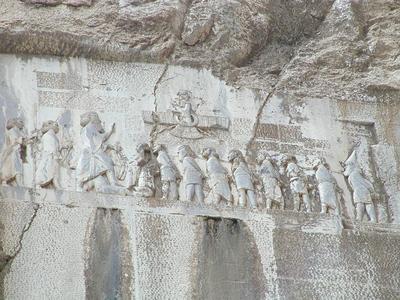
Darius I, the Great, ruled from 522-486 BC.His accession year was 522 and his first year was 521; therefore, his second year was 520 BC.He was a successful and accomplished military commander, a gifted administrator who continued Cyrus' generous policies toward non-Persian peoples, and a builder of monuments.The most famous monument from his reign is the Behistun Inscription that Darius had carved on a cliff face in what is today western Iran.Written in three languages: Old Persian, Elamite, and Akkadian, the inscription described Darius' rise to power and provided the key for deciphering the ancient Akkadian language of Mesopotamia, a western Semitic language spoken in both Assyria and Babylon before Aramaic became the language of the region.

Ezra 5:1-2 ~ God Intervenes

The events in the Book of Ezra are related to the work of the prophet Haggai who was one of the three post-exile prophets along with the prophets Zechariah and Malachi. The dates of Haggai's prophetic ministry are according to the Liturgical lunar calendar (Hag 1:1152:11020).He refers to events in Judah between August the 29th, 520 BC to December the 18th of the same year; a period of about 3 ½ months (as we count) during the second year of the reign of King Darius I of Persia and a decade after the death of King Cyrus I. Ezra Chapters 5-6 continue in Aramaic until returning to Hebrew in 6:19. The focus of Haggai's mission is on the rebuilding of the Temple as a sign of the peoples' spiritual restoration and the Messianic hope.

The Book of the prophet Zechariah compliments Haggai. His first oracle concerns the rebuilding of the Temple connected to the prophecy of Jeremiah 25:11-12 and 29:10 about the restoration after seventy years of exile that would be the start of a new stage in the history of salvation.

Haggai presents the rebuilding of the Temple as not just a physical reconstruction of the First Temple, but he as proof of the people's faith in Yahweh promises of His Divine presence among his covenant people and His absolute sovereignty over their lives and the lives of all men and women.

After the Jews rebuilt the altar of Yahweh and began offering sacrifice, all work on the Temple had stopped in 538/7 BC after the Samarians lodged an official protest with the Persian government.However, in 520 BC, in the second year of the reign of King Darius of Persia, God intervened. He called upon the prophets Haggai and Zechariah to encourage the people and their leaders.

Oracle #1: Haggai 1-15 ~ The Summons to Rebuild the Temple

Haggai 1:1-11 ~ The Prophet's Call and His Message
The focus of the Book of Haggai is the rebuilding of the Jerusalem Temple and Yahweh's dwelling place among His covenant people and the hope of a Messianic David.Work on the Temple had stopped for about seventeen years (c. 537-520 BC), and so God intervened to move forward His divine plan by sending His prophet Haggai whose first prophecy dates to the month of Elul that is our August/September of 520 BC.

God appoints His prophets Haggai and Zechariah to deliver His divine message to Zerubbabel (the Davidic prince who is the Persian appointed governor) and Jeshua/Joshua (the Jewish high priest) who are the leaders of the community. Haggai's first oracle is in two parts:

  1. Haggai's message to Zerubbabel and Jeshua/Joshua (Hag 1:2-11).
  2. The positive response of his Jewish audience (Hag 1:12-15).

In his first oracle, Haggai presents three images:

  1. "the time" (verses 2 and 3)
  2. "the house" (verses 2 and 3)
  3. the invitation to "think" (verse 7).

The standard Biblical covenant had five parts:

  1. Preamble: Identifying the Lordship of the Great King and stressing his greatness, dominance, and immanence.
  2. Historical Prologue:Recounting the Great King's previous relationship to his vassal with emphasis on the benefits of that relationship.
  3. Ethical Stipulations: Enumerating the vassal's obligations to the Great King (the guide to maintaining the covenant relationship).
  4. Sanctions:A list of the blessings for obedience and the curses/judgments that will fall on the vassals if they break the covenant.
  5. Succession:Arrangements and provisions for the continuity of the covenant relationship over future generations.

Pagan covenant treaties had a sixth part calling on the pagan gods of both nations to witness the document.Covenant treaties are not contracts. Contracts concern tangibles like material possessions and land ownership while covenants are concerning with the non-material and intangibles like honor, loyalty, service, and obedience.

Haggai's message reminds the people of Judah that the conditions of the Sinai Covenant Treaty are still in place.

Haggai 1:12-15 ~ The Authorities and the Peoples' Positive Response

Hearing the prophet's message in August 520 BC, filled the people with "fear before Yahweh."It was a reverent fear that came from God speaking to them through His prophet and knowledge that they had failed Him by stopping work on the Temple.Yahweh had "roused the spirit" of King Cyrus to issue the edict of return (Ezra 1:1) and "roused the spirits" of the faithful remnant of the people from the tribes of Judah and Benjamin and the chief priests and Levites to return to Judah from their exile (Ezra 1:5).Now, He "rouses the spirits" of Zerubbabel, Jeshua/Joshua, and the people to continue the work to rebuild the Temple.The began work 24 days after Haggai received his first oracle' perhaps the time it took to gather the supplies.


Oracle #2: Haggai 2:1-9 ~ The Future Glory of the Temple

It was the God-ordained annual feast held in the early fall at the time of the harvest when the covenant people gathered the fruits of their labors. Scripture mentions the feast during the reigns of King Solomon (2 Chron 8:13), Hezekiah (2 Chron 31:3), and after the exile (in Ezra 3:4Hag 2:1, and Zech 14:16-19). Jesus attended the Feast of Shelters where He announced His Messianic mission to fill God's people with His Spirit on the last day of the feast (Jn 7:2-31437-41). The Feast of Shelters remembered the deliverance from bondage in Egypt and the dedication of the desert Sanctuary at Mt. Sinai as God told the people at Sinai when He said, "You will keep this feast in the seventh month. For seven days you will live in shelters: all the citizens of Israel will live in shelters, so that your descendants may know that I made the Israelites live in shelters when I brought them out of Egypt, I, Yahweh your God." (Lev 23:42-43).

Haggai 2:15-19 ~ A Promise of Agricultural Prosperity

The warning is to "think" and not to repeat the mistakes of their fathers in refusing to heed the signs of God's judgments and therefore refusing to repent their sins.

Oracle # 4: Haggai 2:20-23 ~ Messianic Oracles for Davidic Prince Zerubbabel

This oracle is on the same day as the one in 2:10, the twenty-fourth day of the ninth month.The tone is Messianic and repeats the imagery in 2:6-9 by suggesting the dawn of a new phase in God's divine plan for salvation history. The Davidic prince Zerubbabel will have a central role, like "a signet ring," in that plan. A signet ring was a seal of authenticity of its owner. Yahweh is the owner and Zerubbabel will be the "mark" God will place upon history as the ancestor of the Davidic Messiah, Jesus of Nazareth.

Zechariah 4:6-10 ~ Yahweh Commands Three Sayings About Zerubbabel

In this oracle, Zechariah reveals that the rebuilt Temple on Mt. Moriah is not as significant as Zerubbabel who is the central figure in God's continuing plan for humanity's salvation.
Ezra 5:3-5 ~ The Governors of the Other Provinces Attempt to Stop the Jews from Rebuilding the Temple

During the reign of King Darius, Tattenai was the governor of the province of Beyond the River. Shethar-Bozenai's name always appears just after Tattenai and is perhaps his official scribe.He led a delegation to Judah and threatened the Judahite leaders, demanding to know by what authority they have resumed work on the Temple.

Royal officials who sent reports to the king and his ministers were known as "the king's eye" and "the king's ear."Texts found in the Persian royal city of Persepolis confirm that reports and inquiries were sent directly to the king for his review and action.However, for the Jews, "the eye of their God was on the elders of the Jews," His covenant people, and they were not forced to stop until they received a decision from Darius (verse 5).


Ezra 5:6-17 ~ The Governors' Letter to King Darius
In verses 6-17, Tattenai writes to King Darius questioned the authenticity of the claims of the Judahites that they have permission to rebuild the Jerusalem Temple.Sheshbazzar (verse 14) was the Davidic prince and uncle of Zerubbabel who led the returning exiles back to Judah and served as the first governor of the province under Cyrus.Tattenai writes that in answer to his challenge to their rebuilding the Temple, the Jews gave him a summary of their history concerning the destruction of the first Temple, beginning with the claim that they "are the servants of God of heaven and earth":

  1. They are rebuilding a temple built many years ago.
  2. Their God allowed the Babylonians to destroy it because of their sins.
  3. King Cyrus of Persia issued an order for the rebuilding their Temple.

Ezra 6:1-12 ~ King Darius Replies


King Darius sends a letter confirming the claim of the Jews that they have permission from the Persian government to rebuild their Temple.

  1. The letter gives the approved dimensions of the structure as sixty cubits by sixty cubits, built of stone and timber.
  2. The royal treasury will subsidize the building costs of the Jerusalem Temple from the taxes of the Beyond the River Province to provide whatever is necessary for the Jews to resume their worship and sacrifice and to pray for the prosperity of the Persian king and his family.
  3. They must return the sacred items looted by the Babylonians to the Temple.
  4. Tattenai and his associates must assist them and not prevent them from rebuilding the Temple.
  5. Anyone who disobeys Darius' orders concerning the Jerusalem Temple will be executed.

Ezra 6:13-18 ~ The Completion of the Temple


Verses 13-18 describe the completion and dedication of the Temple on March 12, 516/515 BC, almost 70 years after its destruction. While some translations list the date in verse 15 as the 3rd of Adar, the NJB, 1 Esdras 7:5, and Josephus record it as the 23rd of Adar (Antiquities of the Jews, 11.4.7).The renewed work began on September 21, 520 BC (Hag 1:15) and a sustained effort continued for about 3 ½ years.


Ezra 6:19-22 ~ Celebrating the Passover and Feast of Unleavened Bread of 515 BC

The text returns to Hebrew from 6:19-7:11. The Passover was on the 14th day of the first month in the Liturgical calendar which was the month of Aviv/Abib or Nisan (the Babylonian name for the month that the Jews will use after their return); see Exodus 12:113:4.They ate the Passover sacrifices in a sacred meal on the first night of Unleavened Bread that began at sundown after the Passover sacrifices, on the 15th, and the feast continued for seven days (Lev 23:5-8Num 28:16-25).These two annual remembrance feasts celebrated God's action in Israel's history, freeing them from captivity and bondage in Egypt as a free people.Now, once again, they are celebrating God's activity in their lives by freeing them from captivity in Babylon and spiritually renewing them as His covenant people.


Agape Bible Study 
Zechariah 4 - 6 

Zechariah 4:6b-10a ~ The Third Oracle: Three Sayings About Zerubbabel

This passage is Zechariah's third oracle that concerns Davidic prince Zerubbabel, the Persian governor of Judah and the grandson of Davidic King Jehoiachin who the Babylonians deposed and took into exile in Babylon (1 Chron 3:17-192 Kng 24:8-12). The Third Oracle is in three parts and concerns Zerubbabel:

  1. He will succeed but only by the power of Yahweh’s spirit (verse 6a).
  2. God will defeat his enemy and Zerubbabel will bring out the keystone of Solomon’s Temple to rebuild the new Temple (verse 7).
  3. He will lay the foundation of the Temple and will finish building it (verses 8-10a).

Verse 6 is significant to Rabbinic Judaism with its message that it is not human power that moves forward the history of humanity, but the power of God. Its message was inscribed on the front of many rebuilt Synagogues after World War II, including the Synagogue in Cologne, Germany.

Zechariah 5:1-4 ~ The Sixth Vision: The Flying Scroll

Both the prophet Ezekiel in the 6th century BC and St. John in the 1st century AD saw visions of scrolls (Ez 2:1-10 and Rev 10:8-11). Ezekiel's scroll also had writing on the front and back like Zechariah's scroll and both contained curse judgments. John's scroll was small and not large like Zechariah's, but it also contained judgments against nations, and like Ezekiel, he was told to eat his scroll.

The flying scroll was immense; its measurements equated to 30 feet long and 15 feet wide or about 9 meters long by 4.5 meters wide. Its size is equal to the portico of Solomon's Temple (1 Kng 6:3). The angel explains that it represents God's judgment on the land of Judah to purify it from wickedness when the people complete the rebuilding of the Temple, and God's law is again taught and practiced. The judgment against perjury in verse 4 is what initiated the practice for those giving testimony in a court of law being required to place their right hands on a Bible and to swear an oath in God's name to tell the truth or fall under His divine judgment. Although the passage only mentions theft and perjury (violations of the 8th and 9th commandments), they are probably intended to be representative of the sins of the people.

Zechariah 5:5-11 ~ The Seventh Vision: The Woman in the Barrel

In the reoccurring symbolic images of the Old Testament prophets, the prophets presented Israel in covenant union with Yahweh, her Divine Spouse, as a chaste Bride while they depicted a sinful and unrepentant Israel as a wicked, adulterous wife or harlot (see the document The Symbolic Images of the Old Testament Prophets).

In the seventh vision, the woman in the barrel or basket, literally an ephah, represents the collective sins/wickedness of Israel/Judah and impiety personified, as the angel explains to Zechariah in verse 6. Zechariah sees the image of wickedness contained in an ephah, a standard dry measure equal in size of 1.25 bushels, but here the vessel is larger than the standard ephah. The names of capacity measurements were derived from what was used to hold the measurements, so what holds the image of the woman of wickedness must look like the vessels that contained an ephah of dry goods.

The "two women" with wings in verse 9 could be agents of God or agents of the pagan goddess figure who are removing pagan influence from a land purified by Yahweh. The Northern Kingdom of Israel (722 BC) and the Southern Kingdom of Judah (587 BC) fell under Divine Judgment for their apostasy in turning away from Yahweh, worshipping pagan gods by building altars for them and making sacrifices to them, including the sacrifice of children.

Zechariah 6:1-8 ~ The Eighth Vision: The Four Chariots


In Zechariah's eighth vision on a night in mid-February, 520 BC, he looked up and saw four chariots coming out from between two mountains described as looking as though they were made of bronze, suggesting their permanence or indestructibility. He sees the chariots setting out from divine headquarters (Heaven) drawn by teams of horses of various colors. Their mission is to protect God's people, even those living in foreign lands, confirming God's promise of divine protection. Zechariah's eighth vision returns to the subject of the first vision that concerned four angels mounted on different colored horses who patrolled the world as His agents. Perhaps God sends forth different teams of four angels on missions across the face of the earth.


Zechariah 6:9-15 ~ The Fourth Oracle of the Votive Crown and Second Prophecy of the Branch


In this passage, Zechariah receives a second oracle referring to a person with the title "Branch" (see 3:8-10). God directs His prophet to collect silver and gold from three wealthy members of the Jerusalem community. He is to take the precious metals to a goldsmith named Josiah son of Zephaniah and directs him to make crowns. Josiah may be the great-grandson of the prophet Zephaniah, the ninth of the twelve minor prophets. Most scholars suggest the name Joshua in verse 11 should be Zerubbabel since the oracle is likely referring to Davidic prince Zerubbabel and not to Joshua. His branching out" refers to the continuation of his hereditary line that will end in Jesus of Nazareth (Lk 3:23-27Mt 1:12-16) and will fulfill the previous prophetic promises of the Davidic heir called the Branch (i.e., Jer 23:5-6) who will bring blessings of salvation and justice.

+++

A Daily Defense 

DAY 269 Judging Others

CHALLENGE: “Christians shouldn’t criticize others’ lifestyles or actions. Didn’t Jesus say not to judge?”

DEFENSE: Jesus didn’t tell us that we should close our eyes to moral evil in the world.

The exhortation not to judge is found in Jesus’ major ethical discourse (Matt. 5:1–7:29, Luke 6:17–49). The point of the discourse is to give moral instruction. In it, Jesus discusses what conduct counts as good and bad, and he expects his followers to acknowledge the difference.

Not only does he expect them to distinguish between good and evil in their own behavior, he also expects them to do so with others’ conduct, telling them, “You will know them by their fruits” (Matt. 7:20). Thus, whatever Jesus meant, it was not that we should pretend that nobody does evil.

What he did mean is not difficult to discern if we read the statement itself: “Judge not, that you be not judged. For with the judgment you pronounce you will be judged, and the measure you give will be the measure you get” (Matt. 7:1–2); “Judge not, and you will not be judged; condemn not, and you will not be condemned; forgive, and you will be forgiven” (Luke 6:37).

Jesus is saying we should take a generous, forgiving attitude with others so God will take a generous, forgiving attitude with us. We should treat others as we want to be treated. This is a prominent theme in his teaching (cf. Matt. 5:43–48, 6:12–15, 7:12, 18:21–35).

Although we are to be forgiving and merciful to others, this does not mean ignoring, much less approving, immoral behavior. Neither does it mean we should not try to help others. Admonishing the sinner is a spiritual work of mercy. Scripture elsewhere says: “Let him know that whoever brings back a sinner from the error of his way will save his soul from death and will cover a multitude of sins” (James 5:20).

Often the exhortation not to judge is used as a conversation stopper to shut down discussions of immoral behavior. Sometimes it carries the insinuation that the one “judging” is doing something morally wrong. When this is the case, the person making the accusation is himself judging, and thus risks being a hypocrite (cf. Matt. 7:3–5).

Jimmy Akin, A Daily Defense: 365 Days (Plus One) to Becoming a Better Apologist 

Saturday, September 25, 2021

Bible In One Year Day 268 (Ezra 3-4, Zechariah 1-3, Proverbs 20: 4-7)

  You may subscribe yourself at the Ascension site here and receive notifications in your email, or just follow along on my blog.  Bible in One Year Readings Index 

Day 268:  Rebuilding the Temple 

Agape Bible Study 
Ezra
3 -4 

Chapter 3: Resumption of the Sacrificial Liturgy of Worship

Ezra 3:1-7 ~ Rebuilding the Altar and Resumption of the Twice Daily Tamid and the Sacrificial Liturgy at the Festival of Tabernacles

The rebuilding began under Davidic prince and Persian governor Sheshbazzar (1:85:14-16), but after an interruption, the building resumed under the governorship of his nephew, Zerubbabel, and the priestly instruction of Jeshua. The combined leadership of Zerubbabel the Davidic prince and Jeshua, the chief priest, establishes an authoritative link to the era before the exile. 


Ezra 3:8-13 ~ Laying Stones on the Foundation of Solomon's Temple


The second month in the Liturgical Calendar was Ziv (Iyyar), our March/April. King Solomon also laid the foundations of the first Temple in the month of Ziv (1 Kng 6:1). The ancients counted the first in any series as #1, whether day or week or year, and even included part of a day or week or year in the count. This method of counting without the concept of a zero place-value is the reason the Bible records that Jesus was in the tomb three days from Friday to Sunday instead of less than two days as we would count. Therefore, if they arrived in 538 BC, the second year is 537 BC. Notice that verse 8 again gives precedence to Zerubbabel over Jeshua in his role as the civil authority for the rebuilding the Temple.

Chapter 4: Opposition from the Samaritans

The Persian Kings mentioned in Chapter 4 (in bold):

  1. Cyrus II the Great ruled from 559-530 BC and conquered Babylon in 539 BC
  2. Cambyses II, son of Cyrus the Great, ruled from 530-522 BC
  3. Bardiya, son of Cyrus the Great or imposter, ruled 522 BC but assassinated by Persian nobles
  4. Darius I, son of Hystaspes (a kinsman of Cyrus), ruled 522-486 BC
  5. Xerxes I, son of Darius I, ruled 486-465 BC
  6. Artaxerxes I, son of Darius I, ruled 465-424 BC

Ezra 1:1-4:7 is in Hebrew, but 4:8-6:18 is in Aramaic. Unfortunately for the Judahites, their friend and protector, King Cyrus the Great of Persia, died in battle on December 530 BC. His friends and adversaries remembered him as a wise and magnanimous ruler who respected the religions and customs of the peoples he conquered.

Ezra 4:1-5 ~ The Samaritans Contrive to Stop the Work on the Temple

The Samaritans sent emissaries to offer to help rebuild the Temple, reminding the Jews that they had worshipped Yahweh since the Assyrians first transplanted them into Samaria in the eighth century BC (see 2 Kng 17:24-41). The Jewish leadership sent a letter refusing their offer and cited the Decree of Cyrus (verse 3) to support their legal claim to rebuilding the Temple and the city of Jerusalem. They did not want foreign interference especially from the Samaritans who they viewed as heretics, nor the contamination of the Samaritans' false religious practices. 

Outraged at their refusal, the Samaritans set about trying to intimate the citizens of Judah and bribed Persian officials into delaying work on the Jerusalem Temple. Their tactics were successful, and work on the Temple project stopped from 537 to 520 BC.

In Jesus' time, the Samaritans continued to offer illicit worship to Yahweh, officiated by a non-Aaronic priesthood in a temple they built on Mt. Gerizim. When the Samaritan woman questioned Jesus about their differences, He told her "You worship what you do not know; we worship what we do know; for salvation comes from the Jews" (Jn 4:22).

Ezra 4:6-10 ~ The Anti-Jewish Tactics of Judah's Gentiles Neighbors During the Reigns of Xerxes and Artaxerxes

In Hebrew, this king is Ahasuerus but Xerxes in Greek. Osnappar is the name in the Hebrew text which is assumed to be Assyrian king Ashurbanipal."Beyond the River" from the perspective of Israel and the other nations of the Levant to beyond the great Mesopotamian River Euphrates (Jos 24:2-314-152 Sam 10:16). However, from the Mesopotamian perspective it included the regions of Aram, Phoenicia, Syria, and Israel (1 Kng 4:24). The Persians also called this region Athura.

"Beyond the River" refers to the Persian Province southwest of the Euphrates River that included Judah and her neighbors; The narrative shifts forward in time to the period after the reign of King Darius I but before Ezra's mission. Section 4:8-6:18 incorporates several official Aramaic documents, the international language of this period. Verses 4:6-23 has nothing to do with the rebuilding of the Temple but with the rebuilding of Jerusalem.

Verse 6 moves forward to the reign of Xerxes I (485-465 BC) while verses 7-23 concern events under Artaxerxes I (465-424 BC). The appeal to Artaxerxes took place many years after the completion of the Temple rebuilding (completed in c. 517/16 BC), and pertained to the rebuilding of the walls of Jerusalem which is the concern of the Book of Nehemiah. The narrative then reverts in verse 24 to the reign of Darius I the Great (522-486 BC, the father of Xerxes I) in the second year of his reign, when the Jews, encouraged by God's prophets Haggai and Zechariah, renewed work on the Temple.

The anti-Jerusalem and its Temple tactics of Judah's neighbors continued into the reigns of Xerxes I and Artaxerxes I. 

Ezra 4:11-16 ~ The Letter Sent by Judah's Opponents

The letter is from the leaders of Persian Provinces in Mesopotamia as well as from the Phoenicians and Samaritans living in the Levant (verse 17) and perhaps even from the Persian province in the Trans-Jordan (east of the Jordan River). These people continually occupied the Levant and Northern Mesopotamia during the period of the Jewish exile and are concerned that the return of the Judahites will upset the balance of power in the region.

Question: What is the accusation they make against the citizens of Judah?
Answer: The accuse them of a nationalistic temperament that led to rebellion against their overlords the Assyrians and Babylonians in the past, a pattern they are sure to repeat.

Question: Is their accusation concerning Judah's history of rebellion unfounded? See 2 Kng 18:7-824:120.
Answer: No; it is a well-established accusation historically. However, there is no evidence that the Judahites had ambitions to tempt their neighbors to revolt against the Persians.


Ezra 4:17-24 ~ King Artaxerxes' Reply to the Samaritans and the Citizens of the Trans-Euphrates Provinces

Verse 18 suggests the senders wrote their letter not in Aramaic but in the dialect of their regions or in a cuneiform transcription that needed a translation. King Artaxerxes writes that he has verified the claims they made in their letter. "Powerful kings" who governed the whole of Trans-Euphrates and exacted tribute could only refer to Kings David and Solomon (who died in 930 BC). King Artaxerxes orders that all work on rebuilding the city is to cease for the time being, and the order will be carried out by military force if necessary.


This verse continues from 4:5 and the narrative about the Temple. Work on the Temple ended until the reign of Darius I (522-486 BC). During the first two years of his reign, Darius had to fight for his right to the throne (as recorded in the Behistun Inscription). It was only after he stabilized the Empire that efforts to rebuild the Jerusalem Temple were permitted in year two of Darius' reign (accession year = 522, year #1 = 521, year #2 = 520 BC). The prophet Haggai, at God's command, exhorted Zerubbabel to resume rebuilding the Temple on August 29, 519 BC (Hag 1:1-5), and work began on September 21 (Hag 1:15).

Zechariah 1 - 3 

Introduction

Zechariah is the eleventh of the twelve minor prophets. The Book of Zechariah in the Old Testament Christian canon comes after the Book of Haggai and before the Book of Malachi, the last of the Old Testament books in the Christian Bible. Haggai, Zechariah, and Malachi were Yahweh's holy prophets to the Jewish people during the years after their return from the Babylonian exile and before the first advent of the Christ. The priest Zechariah was the younger associate of the prophet Haggai.

In 539 BC, King Cyrus the Great of Persia issued an Edict of Return, allowing the people displaced by the Babylonians to return to their homelands. Within the next year after the issuing his decree, the first group of citizens of the former Southern Kingdom of Judah returned to what had become the Persian province of Judah. The young priest, Zechariah son of Berechiah son of Iddo returned with this first group of exiles when he was a child. Zechariah's name means "Yahweh remembers." It is one of the most frequently used names in the Bible shared by thirty different men including the priestly father of St. John the Baptist.

He is called the son of Berechiah in 1:1 and 7 but the son of Iddo in Ezra 5:1 and 6:11. Most Biblical scholars identify Zechariah with the priestly family of Iddo mentioned in Nehemiah 12:16. He was, therefore, a descendant of Moses' brother, the first High Priest Aaron, and a member of one of the priestly families born in Babylon during the exile. 

The Book of Zechariah divides into two parts:
Part I: Chapters 1-8 are in the same period as the ministry of the prophet Haggai (520-517 BC). Zechariah's ministry began two months after Haggai's, and like the Book of Haggai, the Book of Zechariah dates his prophecies in Chapters 1-8 that relate to crucial events impacting specific individuals in the time frame between 520 to 518 BC. During this period, with Haggai's urging, the Jews resumed work on the Temple, trusting God to protect them from the Samaritans and their other belligerent neighbors. The covenant people completed the Temple in 517 BC, seventy years after its destruction by the Babylonians. Part I of Zechariah's prophecies end before the Temple dedication in 518 BC.

Part II: Chapters 9-14 are not dated because, unlike Chapters 1-8, these prophecies do not relate to current history but are eschatological (focused on the end times) in nature and oriented toward the distant future. References to Greece (9:13) suggest a date between 480 and 470 BC, after the death of Cyrus' son and successor, King Darius I (521-486 BC) and during the reign of his son, King Ahasuerus/Xerxes I, the husband of Esther (486-464 BC) when Esther's uncle Mordecai was Ahasuerus/Xerxes' prime minister.


Zechariah's Eight VisionsSymbolic Significance
1.  The man on a red horse among myrtle trees (1:8)God will again extend His mercy to Jerusalem (1:1416-17)
2.  Four horns and four smiths (2:1-3)Enemies who scatter Judah are cast out by angelic powers (2:4)
3.  The man with a measuring line (2:1)God will provide a protective wall of holy fire around Jerusalem (2:3-5)
4.  The cleansing of the High Priest Joshua (3:4)Removing Judah's guilt in preparation for the coming of God's Servant, the Branch, who will save His people (3:8-9)
5.  The golden lampstand and the two olive trees (4:2-3)God empowers His people by His spirit (4:6)
6.  The flying scroll (5:1)Dishonesty is cursed (5:3)
7.  The woman of wickedness in a barrel/basket (5:6-7)Wickedness removed (5:9)
8.  The four chariots (6:1)God's judgment executed on the world (6:5-7)

Seven of Zechariah's eight visions find counterparts in the Book of Revelation:

Zechariah's Eight VisionsThe Link Between Zechariah's Visions and the Book of Revelation
1.  The man on a red horse with three other horses among myrtle trees (1:8)

The four riders on white, red, black, and pale horses (Rev 6:1-9)

2.  Four horns and four smiths (1:18-20) 
3.  The man/angel with a measuring line (2:1)John receives a measuring line and is told to measure God's Sanctuary (Rev 11:1). An angel measures the walls and gates of the Messianic Jerusalem (21:15).
4.  The cleansing of the High Priest Joshua (3:4)The spotless Bride of the lamb (Rev 19:8).
5.  The golden lampstand with seven eyes and the two olive trees (4:2-3)The seven golden lampstands (Rev 1:1220) and the two olive trees (Rev 11:4)
6.  The flying scroll (5:1)The small scroll (Rev 11:8-11)
7.  The woman of wickedness in a barrel/basket (5:6-7)The wicked woman riding a scarlet beast (Rev 17:3-7)
8.  The four chariots (6:1)The four horsemen (Rev 6:2-8)

Zechariah's Oracles in Part I
The five oracles in Chapters 1-6:

  1. The first oracle in 1:1-6
  2. The second oracle in 2:10-17 *
  3. The third oracle in 4:6b-10a
  4. The fourth oracle in 6:9-15
  5. The fifth oracle in 7:1-14


  • 587/6 BC         Babylonians destroyed Jerusalem and the Temple and deported the surviving Judahites to Babylon.
  • 585 BC            Jewish rebels assassinated the Persian governor Gedaliah.
  • 561 BC            Babylonian king Evil-Merodach released Judean King Jehoiachin from prison.
  • 559 BC            Cyrus the Great became the king of the Medo-Persian Empire.
  • 539 BC            Cyrus conquered Babylon and issued an Edict of Return.
  • 538 BC            The first group of exiles returned to Judah.
  • 530 BC            Cambyses succeeded Cyrus as king but died in c. 522 BC.
  • 522 BC            Darius I succeeded Cambyses as King of Persia and made Davidic descendant Zerubbabel the Persian governor of Judah.
  • 520 BC            Haggai began his ministry in August, and the work on the Temple resumed.
  •                         Zechariah began his ministry in October/November (Zech 1:1).
  • 519 BC            February is the second date in Zechariah 1:7.*
  • 518 BC            December is the third date in Zechariah 7:1.
  • 517 BC            The Jerusalem Temple was completed and dedicated.
  • 479 BC            Xerxes/Ahasuerus I (486-465 BC) made Esther Queen of Persia.
  • 465 BC            Artaxerxes I succeeded his father, Xerxes, as King of Persia (465-424 BC).
  • 458 BC            Persian governor Ezra led the second return of the exiles to Judah.
  • 444 BC            Persian governor Nehemiah led the third return of the exiles to Judah.


Chapter I: The Summons to Repentance and Conversion and the First Vision

Zechariah 1:1-6 ~ The Summons to Repentance and Conversion

King Darius I of Persia came to the throne in 522 BC in what was his "accession year" until the Persian turn of the year on the spring equinox at which time 521 became the first year of his reign. Therefore, the second year of Darius was 520 BC, and the date of Zechariah's call to his prophetic ministry is the eighth month, the month of Heshvan in the Jewish liturgical calendar, (our October/November) and two months after the first prophecy of his contemporary prophet, Haggai (Hag 1:1).

The dates in the ministries of Haggai and Zechariah in the second year of the reign of King Darius of Persia that corresponds to 520 BC:

HaggaiZechariah
Haggai's calling and first oracle were on the 1st day of the sixth month in the second year of Darius or August 520 BC. 
Haggai's second oracle was on the 21st day of the seventh month in the second year of Darius or October 520 BC. 
 Zechariah's calling and first oracle were in the 8th month in the second year of Darius or October/November 520 BC.
Haggai's third oracle was on the 24th day of the ninth month in the second year of Darius or December 520 BC. 
Haggai's fourth oracle was also on the 24th day of the ninth month in the second year of Darius or in December 520 BC. 
 Zechariah's four visions all occurred on the 24th day of the eleventh month in the second year of Darius or mid-February 520 BC.*
Michal Hunt, Copyright © 2019 Agape Bible Study. Permissions All Rights Reserved.


Zechariah's eight visions take place during the night of the twenty-fourth day of Shebat (mid-February) in 520 BC, in the second year in the reign of King Darius I of Persia. However, he is not dreaming; he is fully awake and engaged. All of Zechariah's visions date to 520 BC, two months after the prophet Haggai received God's command to call the returned exiles to continue rebuilding the Temple (Hag 1:1). The interpreter of Zechariah's visions is the "Angel of Yahweh." The Hebrew phrase, ha-mak'ak-YHWH (the messenger of Yahweh) is the most frequently used designation of an angelic figure in the Old Testament, and the prophet Haggai is also called mal'ak-YHWH in Haggai 1:13Ha-mak'ak-YHWH mediates the visions for the prophets Ezekiel (Ex 40:3ff) and Zechariah.

The Angel of Yahweh is a familiar Biblical figure who stands at the head of Yahweh's Divine Council in the heavenly Sanctuary and is God's special messenger. Some examples of the missions of the "Angel of Yahweh/Angel of God" in the Old Testament:

  1. He appeared to Moses from the burning bush (Ex 3:2),
  2. led the children of Israel on their exodus (departure) out of Egypt (Ex 14:19)
  3. appeared to counsel the Judges of Israel (Judg 2:145:236:11, etc.),
  4. appeared to David (2 Sam 24:16-172 Chron 21:16),
  5. and God sent the Angel of Yahweh as His special agent over a hundred and fifty times in Old Testament Scripture.The special designation "Angel of Yahweh" appears seven times in the Book of Zechariah (1:11123:125612:8). His mission is to interpret the visions of God's divine plan to Zechariah.


Zechariah 2:1-4 (1:18-21 in some translations) ~ The Second Vision: The Horns and the Smiths

The "horns" symbolize strength as in the use of the word "horn" in the Hebrew translation of Psalm 75:4-5I said to the boastful, "Do not boast!" to the wicked, "Do not flaunt your strength [horn]! Do not flaunt your strength [horn] so proudly, do not talk with that arrogant stance." Also see "horn" for strength in Psalms 18:2b. In this case, the "horns" are the nations hostile to Israel (the Northern and Southern Kingdoms) who took her citizens into exile, and the number four symbolizes their universality.

Yahweh then showed me four smiths.
Zechariah probably identifies these angelic figures as "smiths/blacksmiths" because the iron implements they carry are forged by fire. The four smiths/blacksmiths are the angelic powers God will send to overthrow the power of Judah's enemies who have scattered her citizens across the ancient Near East (cf. Is 54:16-17). Those powers include the Assyrians who conquered the Northern Kingdom in 722 BC and took the Israelites of the ten northern tribes into exile to relocate them in Assyrian lands and the Babylonians who took the citizens of Judah into exile in three waves in 605, 598, and 587/6 BC. The "horn" could not include the Persians because God used them as His instrument of judgment against the Babylonians to conquer that empire and allow the covenant people to return to their homeland.

Zechariah's vision of the four horns and the four smiths assured the citizens of Judah of God's promise to overcome their enemies' plans to defeat them. Therefore, there was no longer any reason to fear interference in rebuilding God's dwelling place in Jerusalem! He will not only stop their neighbors from threatening to invade them, but He will destroy the nations that devastated His holy people in the past.

Zechariah 2:5-9 (2:1-5 in some translations) ~ The Third Vision: The Man with the Measuring Line

Another angel appears holding a measuring line, a tool used in carpentry and in building construction (Is 44:13). In Scripture, a measuring line can be a symbol of judgment (Is 34:11Lam 2:80, and in this case, restoration and judging spiritual perfection. Yahweh told the sixth-century prophet, Jeremiah, that the Babylonians would destroy Jerusalem, but then in Jeremiah 31:38-40, God promised the rebuilding of the city when "once again the measuring line will stretch straight..." God's promise to Jeremiah anticipated the prophet Ezekiel's vision. The sixth-century BC prophet Ezekiel had a similar vision in Ezekiel 41:13. In the books of Zechariah, Jeremiah, and Ezekiel, the measurements symbolically represent the spiritual "rebuilding" of the Temple in preparation for the spiritually restored worshippers.

Revelation 11:1 and 21:15 repeats the vision of the measuring line. In Revelation Chapter 11, John receives a long cane like a measuring rod and is told to measure God's heavenly Sanctuary, the altar, and the people who worship there. And in 21:15, an angel shows John the holy city of Jerusalem coming down out of Heaven from God. He carries a gold measuring rod to measure the city and its gates and wall.


Zechariah 2:10-17 (2:6-13 in some translations) ~ A Song for the Daughter of Zion: Yahweh’s Two Exhortations for the Covenant People

The narrative moves from prose to poetic verses in 14-17. Some verses are missing from some Protestant Bibles but not from the Jewish Tanakh or Catholic Bibles. In these verses, the Angel gives an oracle containing two exhortations:

  1. All the covenant people still living in pagan lands must return to Judah before God brings His divine judgment against those lands.
  2. The citizens of Judah must rejoice since Yahweh will return to make Jerusalem His dwelling place.


The "land of the north" refers to the lands of Assyrian and Babylon into which the covenant people were forcibly taken into exile. Physically, these lands were to the northeast, but since a desert separated the Holy Land from Assyria and Babylon, invading armies from Mesopotamia came from the north to attack Israel/Judah (cf., Jer 6:2210:22). The "four winds of heaven" refer to the four compass points and convey the idea of encompassing all places on the earth (see the same phrase in 6:5 and Ez 37:9 and Jer 49:36).

In Hebrew, hoy, hoy is a characteristic prophetic interjection that appears 51 times in the Old Testament, mostly in the three of the books of the major prophets Isaiah, Jeremiah, and Ezekiel, and in six of the twelve minor prophets in Amos, Micah, Nahum, Zephaniah, and Zechariah. 

However, in verse 10, the angel uses the three times repetition of "hoy" in a slightly different way. Like 7 of the other 51 Biblical occurrences, it is an independent interjection not followed by the standard account of a group's misdeeds and is a warning directed toward the exiles who God will restore to Zion. In this case, the "hoy" could mean "woe" for the exiles, but it also implies "woe" for those who hold the covenant people captive (verses 12-13.8-9). Therefore, it has to be something other than a prophetic lament. Instead, it is calling the people to action, to get up and leave Babylon (verse 11-13). God encourages "Zion," His covenant people, to flee Babylon and return to their ancestral lands before future enemies plunger Persia and the Persian province of Babylon, probably a prophecy relating to the 4th century BC invasion of Alexander the Great.


Zechariah 3:1-9a ~ The Fourth Vision: The Investiture of Joshua

Joshua (called "Jeshua" in Ezra 1:23:84:35:3) was the chief priest who returned with the first group of the exiles led by Sheshbazzar and Zerubbabel (Ezra 1:112:1-2). The name Joshua/Jeshua (Yeshua) was common in ancient times. The exiles selected him as the first High Priest [hakkohen hagadol] of the restored covenant people (Hag 1:112-142:24).1The title hakkohen hagadol designates Joshua here and seven other times in the Books of Haggai and Zechariah (Hag 1:112142:24Zec 3:86:11). He was the son of the chief priest Jehozadak, and his grandfather, Seraiah, was the last High Priest of the Jerusalem Temple and martyred by the Babylonians (see 2 Kngs 25:18-21Jer 52:24-27).

Nehemiah 12:10-11 lists the high priests who served the covenant people from 520 BC, during the reign of Darius I, to about 405 BC during the reign of Persian King Darius II.

  1. Jeshua/Joshua* was the high priest during the time of the first return from exile when Sheshbazzar and Zerubbabel were governors (Ezra 5:2Hag 1:1Zec 6:11).
  2. Joiakim son of Jeshua* was the high priest during the time of Ezra (Neh 12:101226).
  3. Eliashib son of Joiakim was the high priest during the time of Nehemiah (Neh 3:12012:222313:4728).
  4. Joiada succeeded his father, Eliashib.
  5. Johanan succeeded his father, Joiada.
  6. Jaddua succeeded his father, Johanan.

*Jeshua in Hebrew is the same name as the Aramaic form of Joshua (see Hag 2:24), and Joiakim is the shortened form of Jehoiakim. Josephus recorded that both Ezra and Joiakim died before Nehemiah arrived in Jerusalem.

He then showed me the high priest Joshua standing before the angel of Yahweh, with Satan standing on his right to accuse him.
In Hebrew, ha-satan, means "the accuser" or "the adversary."2 The use of the article before the word "satan" indicates it is not a proper name but a title. In the Old Testament, the word satan always appears with the definite article ha; the only exception is in 1 Chronicles 21:1. In the vision, Zechariah sees Satan standing to the right of the Angel of Yahweh. Most Biblical commentators point out that it is odd that Satan should be to the right in the position of authority and therefore Satan must be occupying the highest position in the Divine Council before Yahweh Throne of Judgment. However, they fail to take into account that what Zechariah sees is the reverse of the scene viewed from Yahweh's location. The Angel of Yahweh is to the right of the throne while Satan is standing to the left of the Angel of Yahweh from Yahweh's perspective:

Zechariah's ViewYahweh's View
Yahweh's Throne of Judgment

Angel of Yahweh (left)            Satan (right)

Zechariah
Yahweh's Throne of Judgment

Angel of Yahweh (left)        Satan (right)

Zechariah

The Satan/Accuser is a member of the Divine Counsel in the heavenly court. He fills the role of a prosecuting attorney who spies on, accuses, and indicts malefactors, while the Angel of God acts as the Advocate for Joshua. Satan is an equivocal figure, a fallen supernatural being distinct from the other "sons of God" (Yahweh's messenger/angels), hostile to human beings, anxious to find fault in them and unleashing disaster on them that including enticing them to sin. He is cynical, cold, malicious, and sarcastic, all of which reveals his hostility to human beings based on envy.3


Zechariah 3:8-10 ~ The Coming of "the Branch"

  • The word "branch" or "shoot" is represented by eighteen different Hebrew and four different Greek words in the Bible, but the concept of the person known as the Branch or Shoot in the prophecies is associated with the Hebrew words netzer and tesmach.4 The eighth-century BC prophet Isaiah was the first to prophesy the coming of "the Branch" or "Shoot" in Yahweh's Divine Plan:
    • A shoot [choter = twig] will spring from the stock of Jesse, a new shoot [netzer] will grow from his roots. On him will rest the spirit of Yahweh, the spirit of wisdom and insight, the spirit of counsel and power, the spirit of knowledge and fear of Yahweh: his inspiration will lie in fearing Yahweh. His judgment will not be by appearances, his verdict not given on hearsay. He will judge the weak with integrity and give fair sentence for the humblest in the land. He will strike the country [land] with the rod of his mouth and with the breath of his lips bring death to the wicked. Uprightness will be the belt around his waist, and constancy the belt about his hips (Is 11:1-5).
  • The next prophecy of the individual called "the Branch" is from the 6th-century BC prophet Jeremiah:
    • Look, the days are coming, Yahweh declares, when I shall raise an upright branch [tsemach] for David; he will reign as king and be wise, doing what is just and upright in the country [land]. In his days Judah will triumph and Israel live in safety. And this is the name he will be called, "Yahweh-is-our-Saving-Justice" (Jer 23:5-6).
  • And it is followed by Jeremiah's third prophecy of "the Branch":
    • Look, the days are coming, Yahweh declares, when I shall fulfill the promise of happiness I made to the House of Israel and the House of Judah: In those days and at that time, I shall make an upright Branch [tsemach] grow for David, who will do what is just and upright in the country [land]. In those days Judah will triumph, and Israel live in safety. And this is the name the city will be called: Yahweh-is-our-Saving-Justice (Jer 33:14-16).
  • Zechariah's prophecy is the fourth:
    • [Yahweh Sabaoth declares]"So listen, High Priest Joshua, you and the colleagues over whom you preside, for they are an omen of things to come, for now I shall bring in my servant the Branch [tsemach], 9a and I shall remove this country's guilt in a single day. 10 On that day, Yahweh Sabaoth declares, invite each other to come under your vine and your fig tree" (Zec 3:8-10).
  • And the fifth prophecy is also in the Book of Zechariah:
    • And say this to him, "Yahweh Sabaoth says this: Here is a man whose name is Branch; where he is, there will be a branching out (and he will rebuild Yahweh's sanctuary). Yes, he is the one who will rebuild Yahweh's sanctuary; he will wear the royal insignia and sit on his throne and govern, with a priest on his right [on his throne]. Perfect peace will reign between these two ... Then you will know that Yahweh Sabaoth has sent me to you. It will happen if you diligently obey the voice of Yahweh your God" (Zec 6:1216).

The prophecies in Isaiah and Jeremiah identify "the Branch" as a Messianic descendant of King David of the tribe of Judah and the fulfillment of Yahweh's eternal covenant with David's lineage to establish an everlasting kingdom ruled by an eternal king of David's royal line. Therefore, "the Branch" cannot be the High Priest Joshua who is a descendant of Aaron of the tribe of Levi. Most Biblical scholars suggest Zechariah's "Branch" must point to Davidic prince Zerubbabel who embodied the Messianic hopes of a Davidic descendant (Hag 2:20-23). However, since he does not fulfill the other parts of the prophecies, Zerubbabel probably points to the coming of "the Branch" as a prelude to his coming. Parts of the prophecies concerning "the Branch" are not fulfilled in Zerubbabel as they are in his descendant, Jesus of Nazareth. Both genealogies in Matthew and Luke's Gospels split between David's sons Solomon and Nathan but come back together in Zerubbabel from whom both Joseph and the Virgin Mary are descendants (Mt 1:12-16 and Lk 3:23-27).

9a and I shall remove this country's guilt in a single day.
This is the most significant statement in the passage. When did Yahweh remove the communal sins of the covenant people in a single day? Does the promise refer to the atoning and sanctifying sacrifice of the Tamid lambs in a twice-daily liturgical worship service on God's holy sacrificial altar (Ex 29:38-42) that had to be repeated daily? Or does it point to what the Tamid lambs only represented and was fulfilled in the sacrifice of "the Branch" of David, Jesus of Nazareth, on the altar of the Cross at the same times the Tamid lambs were sacrificed in two daily worship services? See the e-book, "Jesus and the Mystery of the Tamid Sacrifice" or at amazon.com.

10 On that day, Yahweh Sabaoth declares, invite each other to come under your vine and your fig tree.
The prophet Micah, at the end of the 8th-century BC, foretold a time when He (Yahweh) will judge between many peoples and arbitrate between mighty nations. They will hammer their swords into plowshares and their spears into bill-hooks. Nation will not lift sword against nation or ever again be trained to make war. But each man will sit under his vine and fig tree with no one to trouble him. The mouth of Yahweh Sabaoth has spoken (Mic 4:3-4). Micah's prophecy points to a time of perpetual peace in the eschatological future that promised perfect covenant unity with Yahweh.

The prophet Joel also wrote about "that (awesome/terrible) day" as a day of divine judgment in Joel 1:15Cry out to Yahweh: "Alas for the day! For the Day of Yahweh is near, coming as destruction from Shaddai." However, Zechariah's "day" does not forebode judgment but blessings. The fruitful vine and fig tree were symbols of Israel in covenant peace with Yahweh, and that is probably the intention of verse 10. See the chart on the "Symbolic Images of the Prophets" at The Symbolic Images of the Old Testament Prophets.


+++
A Daily Defense 
DAY 268 Praying to the Saints

CHALLENGE: “Catholics shouldn’t pray to the saints. Prayer is an act of worship, which is due only to God.”

DEFENSE: This involves a confusion of terms based on how the English language developed.

In contemporary American English, “pray” indicates an act of worshipping God. However, Catholics do not give divine worship to the saints.

The root of the confusion lies in the fact that the English word “pray” is derived from the Latin word precare, which meant “to ask/implore/entreat.”

By the 1300s , the English phrase “I pray thee” was used as a way to make a polite request—i.e., “I ask you” (equivalent to “please” or “if you will”). “I pray thee” was later contracted to the single word “prithee,” which is rare in American English but more familiar in British English. Because of the Protestant influence on American English, the word “pray” was eventually restricted to acts of worshipping God. However, this was not its original meaning.

The original sense of the term is preserved in settings like law courts (where the phrase “My client prays that the court . . .” still means “My client asks that the court . . .”) or in Catholic circles (where it indicates asking the saints for their prayers).

If you read the Catechism (or other official Catholic documents), you won’t commonly find the phrases “praying to the saints” or “prayer to the saints.” What the Church normally uses instead is the phrase “intercession of the saints” (cf. CCC 956, 1434), which expresses more precisely what Catholics are asking when they “pray to the saints.” They are asking the saints for their intercession—i.e., they are asking them to ask God to grant their prayer requests.

In other words, they are asking the saints to be prayer partners with them. They are not giving the saints the worship that is due to God alone. No matter what respect a created being may be due (cf. Exod. 20:12, Rom. 13:7, 1 Pet. 2:17), God is an infinite, uncreated being who is due the supreme form of worship. Catholics do not violate this when they ask the saints to be their prayer partners.

Jimmy Akin, A Daily Defense: 365 Days (Plus One) to Becoming a Better Apologist