Total Pageviews

Showing posts with label Lamentations. Show all posts

Monday, September 13, 2021

Bible In One Year Day 256 (Jeremiah 51, Lamentations 4-5, Proverbs 18: 9-12)

 You may subscribe yourself at the Ascension site here and receive notifications in your email, or just follow along on my blog.  Bible in One Year Readings Index 


Day 256 Hard Lessons

Agape Bible Study 
Jeremia
h 51 

Chapter 51: Yahweh Makes War on Babylon


Jeremiah 51:1-10 ~ Babylon Drinks Yahweh's Cup of Wrath

The oracle begins with Yahweh's vow to raise a mighty wind of destruction against Babylon. Leb-Kamai in verse 1 is a cryptogram for Caldaea/Babylon. Babylon's "day of disaster" is in payment for Jerusalem's day of disaster inflicted by the Babylonians in the fall of Jerusalem in 587 BC. The Babylonians were God's cup of wrath that the nations under judgment were forced to "drink" (verse 7). However, now Babylon will be forced, in payment for her evil acts, to drink the cup of Yahweh's wrath.

In verse 6, Jeremiah interrupts the oracle to list the judgments just announced. God will carry out the promised judgment, bending His bow and raising up a full coat of mail. Battle commands follow as a holy war is declared! The oracle ends with hope announced for Zion: for the remnant of the covenant people, but also with a reminder of their sin and judgment.

Jeremiah 51:11-14 ~ Yahweh's Plan for Babylon

The oracle begins with Yahweh acting as the commander of the army poised to attack Babylon.
Question: What commands are given?
Answer: Soldiers are given rapid-fire commands to sharpen arrows, fill their quivers, raise their battle flag, set the sentries, and march toward the walls of the city.

Yahweh then addresses "daughter Babylon." The "abundant waters" in verse 13 include the Euphrates River that passed through the middle of the city of Babylon and a system of irrigation canals. In verse 14, Yahweh swears by His own name to destroy the city with an army as thick as locusts gorging on a field of grain.

Jeremiah 51:15-19 ~ Yahweh's Power over the Earth and Cosmos

Babylon's destruction will be brought about by the God of all Creation. That Yahweh is the heritage of the covenant people in verse 19 is a repeat of Jeremiah 50:11 and Deuteronomy 32:9but Yahweh's portion was his people, Jacob was to be the measure of his inheritance.

Jeremiah 51:20-26 ~ Yahweh's War-mace and Mountain

Babylon was God's instrument against the nations (verses 20-23) but no longer!
Question: What reason is given in verse 24 for the judgment against Babylon?
Answer: They will be punished for all the suffering they have caused the covenant people.

The "mountain of destruction" that destroyed the "whole world" conquered by their armies is, of course, Babylon. Yahweh has stretched out His hand of judgment, against this powerful nation (symbolized as a "mountain") that he will leave like a "burned out" mountain. Never again will Babylon threaten or demolish other nations.

Jeremiah 51:27-32 ~ Calling Nations to Rise Up Against Babylon

In verse 27, Ararat is a mountain range in northern Mesopotamia in the territory of the Assyrian kingdom of Urartu that is east of modern Turkey. Minni is a region named in Assyrian inscriptions and located somewhere in Armenia. Ashkenaz refers to what will become the territory of the Scythians in the region of the Upper Euphrates.

This oracle is not a description of the battle like the last oracles, but is instead what will accompany the battle. The Medes and Persians are God's instruments of judgment. The land will quake in its own rising against Babylon, and the warriors of Babylon will withdraw from fighting to seek shelter within the city. "The fords" in verse 32 refer to the common river crossings and perhaps bridges across the Euphrates River. Even the marshes were set on fire so not cover could be provided for those trying to escape capture.

Jeremiah 51:33-35 ~ Babylon's Judgment For Jerusalem's Suffering

In verses 34-35, Jerusalem is the speaker. The threshing-floor is an image of divine judgment where the righteous are separated from the wicked like the good grain is separated from the unusable chaff. The Temple in Jerusalem was built upon a threshing-floor (2 Sam 24:18-251 Chr 21:18-28). Verses 34-35 are a lament by Lady Jerusalem. Verse 34 can also be translated "he has driven me out of my Eden," referring to the Promised Land of Israel. Jerusalem personified cries out that King Nebuchadnezzar of Babylon consumed her and then set her down like an empty dish. In 35b, Jerusalem ("the daughter of Zion") then pronounces a curse against Babylon for spilling the blood of Judah and Jerusalem: "On the inhabitants of Chaldaea be my blood!" It is similar to the curse the people of Jerusalem pronounce on themselves at Jesus' trial in Matthew 27:25.

Jeremiah 51:36-40 ~ Justice for Jerusalem and Zion

Yahweh speaks in verse 36. He has heard the charges and says He will plead Jerusalem's case (riv) as the prosecuting attorney. Then, as the divine Judge, He will avenge Jerusalem. Yahweh will do this because He is Israel's go'el: Israel's "Redeemer" and the punishment will suit the crime. Proud Babylon was like a "lion," but drunken/defeated Babylon will be like a lamb.

Jeremiah 51:41-43 ~ Dirge for Babylon

In Jeremiah 51:41, Sheshach is a cypher for Chaldaea/Chaldaeans (also see the same term in 25:26). Once again there is the imagery of a desolate land of drought and desert.

Jeremiah 51:44-46 ~ Be Prepared to Escape

Verses 45-58 call for the Jews to escape from Babylon before Yahweh condemns the city to divine judgment (also see Is 48:20-21). This may seem to be a contradiction to Jeremiah's letter urging the Judaean exiles to make a life in Babylon, but they are to watch for the signs of judgment and then prepare for their departure after the prescribed seventy years of exile (see 2 Chr 38:21Jer 25:10-1329:10). Verses 44-5 are in the poetic form and verse 46 is prose.

Jeremiah 51:47-57 ~Yahweh Will Punish the False Gods of Babylon

Yahweh says that in the future He will bring judgment on Babylon's false gods. "Her entire country will be humbled" by the numbers of the dead, and all creation will rejoice over the fall of Babylon.
Question: What is the irony in verse 48 concerning Babylon? See Jer 25:9.
Answer: Babylon, the nation from the north who punished Judah (25:9), will be punished from the north.


Jeremiah 51:58 ~ The Final Oracle of Babylon's Destruction

In the final oracle, Yahweh says the great walls of the mighty city of Babylon will be razed to the ground, and her high gates will be burned down. The result is that all their accumulated wealth from other nations will come to nothing except to be fuel for the flames.


The Babylonians Capture Jerusalem by Francesco Hayes
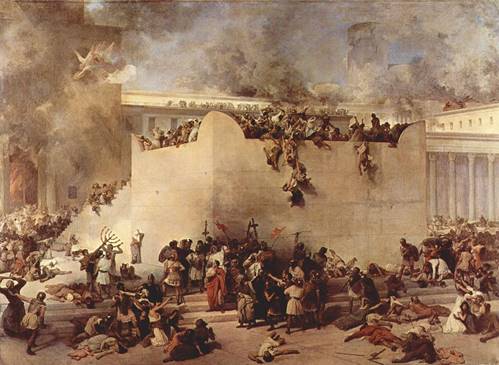
Francesco Hayez.jpg

Our lesson concerns the final chapters of the Book of Jeremiah and includes Jeremiah's instructions to Seraiah son of Neriah, to perform a prophetic ot (the tenth object lesson) when he accompanies King Zechariah to Babylon. This mission took place before the king rebelled against the Babylonians. The prophetic ot prefigures the destruction of the Babylonian Empire, ending with the words "Thus far the words of Jeremiah" that was probably the original ending of the book.

Chapter 51:59-64

Jeremiah 51:59-64 ~ Jeremiah's Instructions to Seraiah Son of Neriah: The Tenth Object Lesson

This passage shifts from the poetry of the previous verses to prose in verses 59-64. It is placed in Chapter 28 in the Septuagint, just after the oracles against Egypt and Babylon (the first two oracles against the nations in the Septuagint) and just before the oracle against the Philistines. Just as Jeremiah "commanded" Baruch to read aloud a newly written scroll in the Temple (36:58), and "commanded" Baruch to keep safe the deeds for the property Jeremiah purchased (32:13), he now "commands" Seraiah to read aloud a message and to perform a prophetic act for the exiles in Babylon.

Question: Who was Seraiah son of Neriah son of Mahseiah? See Jer 32:12.
Answer: Seraiah was the brother of Baruch and a member of an important scribal family serving King Zedekiah.

Seraiah was a high-ranking official in Zedekiah's government. It is a fact confirmed by a late 7th century BC seal impression with the inscription "Belonging to Seraiah (ben) Neriah" without the title "scribe," perhaps suggesting that, although a trained scribe, he served the king in another capacity (see 51:59).

At Yahweh's command, Jeremiah performed nine object lessons, but the tenth and final object lesson became the mission of Seraiah son of Neriah, Baruch's brother. The passage does not say that Jeremiah copied the oracle from the scroll of the Book of Jeremiah, but it can be assumed since this passage is part of the complete book. The "one sheet," perhaps written on the front and the back, probably contained part or all of the prophecies of destruction against Babylon in 51:31-58, but the exact content cannot be known (the prophecies against Babylon also precede this passage in the Septuagint).

Seraiah took Jeremiah's scroll with him when he accompanied King Zedekiah on a diplomatic mission to Babylon in the fourth year of Zedekiah's reign in about the year 595 BC (counting as the Judaeans counted with the first year of his reign in 598 counting as year 1, or perhaps 593 BC as the Babylonians would have counted the fourth year beginning in the first full year of his reign in 597 BC). Seraiah attended the king on the mission as a royal chamberlain or literally "prince of the resting place." The title suggests that he was the royal official in charge of the caravan and responsible for providing the king and the troops with clothing, food, and transportation. The visit was probably the payment of Judah's annual tribute and for Zedekiah to reaffirm his loyalty to his Babylonian overlord, Nebuchadnezzar. This would have been Zedekiah's last tribute payment since it was after this visit to Babylon in 595 BC, according to the Babylonian Chronicles, that Zedekiah decided to rebel against the Babylonians. He committed himself to a rebellion when he invited his neighbor nations to a conference in Jerusalem to discuss forming an alliance against the Babylonians and seeking the protection of the Egyptians.

Seraiah obediently took the copy of Jeremiah's oracle to Babylon. Upon his arrival in Babylon, Jeremiah commanded him to perform a prophetic act in four parts:

  1. He must read the scroll aloud.
  2. He must also address Yahweh, confirming that it is Israel's God who will punish Babylon.
  3. After reading the scroll, he must perform a prophetic act by tying a stone around the scroll and casting it into the Euphrates River.
  4. Finally, he is to speak a curse on Babylon, using the divine "I," meaning the curse is in Yahweh's name.

Thus far the words of Jeremiah. With the words "Thus far the words of Jeremiah," Seraiah ties the end of the Book of Jeremiah to the beginning in a repeat of Jeremiah 1:1a. Many Biblical scholars suggest that the book should end with Seraiah's summary statement in 51:54.

+++
A Daily Defense 

DAY 256 Peter the Rock

CHALLENGE: “Peter is not the rock Jesus is referring to in Matthew 16:18.”

DEFENSE: The structure of the passage clearly indicates that he is.

In Matthew 16:15–16, Jesus asks the disciples who they say he is, and Peter replies, “You are the Christ, the Son of the living God.” In answer, Jesus gives a threefold response (Matt. 16:17 19), which may be diagrammed as follows:

1. Blessed are you, Simon Bar-Jona!

1a. For flesh and blood has not revealed this to you, 

1b. But my Father who is in heaven.

2. And I tell you, you are Peter, 

2a. And on this rock I will build my Church, 

2b. And the gates of hades shall not prevail against it.

3. I will give you the keys of the kingdom of heaven, 

3a. And whatever you bind on earth shall be bound in heaven, 

3b. And whatever you loose on earth shall be loosed in heaven.

The parallelism among these statements indicates that Peter is the rock that Jesus is discussing. First, there are the root statements: (1) “Blessed are you, Simon Bar-Jona!” (2) “And I tell you, you are Peter,” (3) “I will give you the keys of the kingdom of heaven.” Each of these is a blessing pronounced on Peter. They would make no sense if the middle statement was read as a way of diminishing Peter as an insignificant stone (see Day 282) in contrast to the much greater rock on which Jesus would build his Church. In that case, the passage would scan as, “Blessed are you Simon Bar-Jona! You are very insignificant. Here are the keys to the kingdom of heaven!”

Second, each of the root statements is explained by a pair of follow-up statements (labeled a and b).

 Thus statement (1) is explained by statements (1a) and (1b), and statement (3) is explained by statements (3a) and (3b). Similarly, statement (2) is explained by statements (2a) and (2b).

Thus, the meaning of “You are Peter” is explained by “On this rock I will build my Church” and “the gates of hades shall not prevail against it.” This means that Peter is the rock on which Jesus will build his Church, and it is indicated by the parallelism displayed even in the English translation.

Jimmy Akin, A Daily Defense: 365 Days (Plus One) to Becoming a Better Apologist 

Sunday, September 12, 2021

Bible In One Year Day 255 (Jeremiah 49-50, Lamentations 3, Proverbs 18: 5-8)

 You may subscribe yourself at the Ascension site here and receive notifications in your email, or just follow along on my blog.  Bible in One Year Readings Index


Day 255: God is Good 

Agape Bible Study 
Jeremiah
49-50 

Chapter 49: The Prophecies Against Ammon, Edom, Syria, and the Arab Tribes

Jeremiah 49:1-6 ~ Oracle Against the Ammonites

Question: According to Genesis, what was the origin of the Ammonites? 

Answer: They are the descendants of Abraham's nephew Lot from his incestuous union with his younger daughter.

The question in verse 1b refers to the Ammonites who took over the lands of the Israelite tribe of Gad when the Assyrians deported the tribe into exile in 734 BC and then the remainder in 721 BC. By taking away land awarded to the tribe of Gad, Yahweh accuses the Ammonites and their nation god, Milcom, of acting as unjust usurpers. Yahweh declares that the time for them to pay a penalty for their wrong is coming when the "war cry" will be sounded in the Ammonite capital. Rabbah/Rabbath-of-the-Ammonites means "capital of the Ammonites. Today it is called Amman and is the capital of the nation of Jordan.

Jeremiah 49:7-11 ~ Oracle Against Edom

This is the first of two oracles. The first is in the poetic form. Edom was apparently well-known for its sages. In verse 7, Teman is probably modern Tawilan near Petra, and Dedan in verse 8 is an oasis (El-Ela) in Arabia. In other words, the destruction will come from the north and progress to the south of Edom. Yahweh warns the people of Edom to have the good sense to run and hide because the time of judgment is coming (verse 8). Unfortunately, even if they do hide, their hiding places will be discovered, and they will be destroyed. Unlike grape-pickers and robbers who do not strip the vines or houses completely bare, Yahweh will find all who try to evade judgment. They are urged to leave their children behind; God will take care of their orphans who will be safely led away into exile.

Jeremiah 49:12-13 ~ Oracle 2 for Edom

Edom was the nation bordered by the Dead Sea to the north, the Sinai to the west, Moab to the northeast, and the Arabian Desert to the south and west. In the second oracle, Yahweh asks the rhetorical question: "Why should Edom go unpunished?" Then He answers His own question with the statement that Edom will not go unpunished. The oracle refers to one of the symbolic images of the Old Testament prophets dealing with the covenant people's relationship or lack of a relationship with Yahweh. In this case, the Edomites are not a covenant people, but the symbolic imagery for drinking Yahweh's "cup of wrath" is also used for judgment on any wicked people. References to drinking the cup of God's wrath are found in Psalm 75:9Isaiah 51:17-2363:2-3Ezekiel 23:31-34Joel 4:13; and Habakkuk 2:16. In the Book of Jeremiah the link between drinking and judgment is found in five different passages: see 13:12-1425:15-3148:2649:1251:6-7.

Jeremiah 49:14-16 ~ Edom Condemned

These verses are in prose. The Rock in verse 16 is the city of Joktheel in 2 Kings 14:7, and it may be the city later called Petra by the Nabateans. The city and its monuments are literally carved out the limestone rocks.

Jeremiah 49:17-22 ~ Edom's Destruction Compared to Sodom and Gomorrah

Verses 17-18 are in prose and then verses 19-22 return to the poetic form. In verses 14-22, a dialog passes back and forth between Jeremiah and Yahweh. Verse 14 must be Jeremiah speaking, having heard Yahweh's message, but the speaker in verses 15-16 is Yahweh. The speaker in verses 17-18 is Jeremiah again but returns to Yahweh in verses 19-22. The destruction of the cities of Edom will be like the total destruction of Sodom and Gomorrah and the cities of the plain in Genesis 19:23-29a. The sound of the destruction will be heard as far away as the Red Sea.

Jeremiah 49:23-27 ~ Oracle Against Damascus (Syria)

Verses 23-25 and 27 are in the poetic form, but verse 26 is in prose. Damascus, the capital of Syria (Is 7:8), represents the entire nation. The city is one of the oldest continuous inhabited cities in the world. From the time of King Solomon (970-930 BC) until the rise of the Neo-Assyrian Empire in the mid-eighth century BC, the Aramaeans of Damascus were Israel's greatest enemy. Damascus, like the other nations and city-states in the Levant became a vassal of the Babylonians. In 599-598 BC, the Syrians joined a Babylonian campaign to harass the towns of Judah (2 Kng 24:2).

Jeremiah laments over an already fallen Damascus. The Damascus sister cities of Hamath and Arpad heard the tragic news and are struck with terror.

Jeremiah 49:28-33 ~ Oracle Against Kedar-Hazor (Arab Tribes)

The oracle is against a group of North Arabian tribes recorded in Genesis as descending from "the sons of Ishmael" (Gen 25:131 Chr 1:29). The Kedarites lived in the Syrian-Arabian Desert east of Edom in northern Arabia. They were a nation with no gates because they were pastoral nomads who lived in tents and towns without walls. They were known for their flocks, tents, and tent curtains woven from black goat hair (Ez 27:21).

Jeremiah 49:34-39 ~ Oracle Against Elam

The oracle is in the poetic form except for verses 34-35 and 39. During the 7th century BC, the Elamites and Medes occupied land that later became the Persian Empire and is present-day southern Iran. In the Table of Nations in Genesis Chapter 10, Elam is listed as one of the sons of Noah's righteous firstborn son, Shem (Gen 10:22). Shem is also an ancestor of Abram/Abraham (Gen 11:10-26). The kings of Elam and Media are listed among those destined to receive Yahweh's "cup of wrath" (Jer 25:25).

John Rettig, The Fall of Babylon


Chapter 50: Oracles Against Babylon

There are two major themes in the oracles against Babylon:

  1. The destruction of Babylon.
  2. The restoration of Israel and Judah in their return from exile.

Jeremiah 50:1-3 ~ The Fall of Babylon

Question: What is ironic about the prophecy of the enemy from the north marching on Babylon?
Answer: In Jeremiah's previous prophecies, the enemy from the north was Babylon marching against Judah, but now the tables are turned and another enemy from the north is marching on Babylon.

Bel and Marduk (Merodach) are Babylon's chief national gods who will be broken and shamed in the same way the Babylonians broke and shamed the idols of other peoples.

Jeremiah 50:4-5 ~ Promise of the Everlasting Covenant

Yahweh links Babylon's fall to Israel/Judah's return. God will bring the covenant people back and bind them to Him by an everlasting covenant that will never be forgotten. It is a promise that recalls and repeats the covenant promises by the prophets Isaiah, Jeremiah, and Ezekiel:

  1. The promise of the new covenant in Jeremiah 31:31.
  2. The promise of the everlasting covenant in Jeremiah 32:40.
  3. The promise of an eternal covenant in fulfillment of the Davidic covenant in Isaiah 55:3.
  4. The promise to make a covenant that will last forever in Ezekiel 16:60.
  5. The promise that David will be their prince forever when God makes a covenant of peace with them, an eternal covenant when God will set His Sanctuary among them forever in Ezekiel 37:25b-28.

Question: When are the promises of a New and Eternal Covenant and an everlasting kingdom fulfilled?
Answer: They are fulfilled in the death and resurrection of Jesus Christ and the establishment of His eternal Kingdom that is the Church.

Jeremiah 50:6-10 ~ The Lost Sheep of Israel and Babylon Punished

Chaldaea and Babylonia are synonymous. The covenant people of Israel and Judah were led astray by their rulers like sheep led astray by negligent shepherds. They abandoned God, and so they had no protection against their enemies. The mountains and hills that "misled them" are the high places where they offered sacrifices to idols.

Question: In verse 7, Babylonians claim they are not to blame for the suffering of the Judaeans; why? Does God accept their excuse?
Answer: They claim the Judaeans brought their suffering on themselves because they sinned against Yahweh. No, He does not accept their excuse. If they know He is the "Home of Justice" they should know that He will judge them for their lack of mercy for the weak and vulnerable.

Jeremiah 50:11-16 ~ Babylon Has Sinned Against Yahweh

Israel is Yahweh's heritage (51:19Dt 32:9), and Yahweh is addressing those who plundered His heritage. He ridicules them for enjoying their triumph like "playful heifers" enjoying the pasture and neighing stallions. However, their joy will be short-lived. He brings an indictment against these unnamed destroyers who will become "the least of nations." The oracle leaves the audience to surmise that the nation in question is Babylon until verse 13 when Yahweh identifies the nation who will be the recipient of his fury.

Jeremiah 50:17-20 ~ Yahweh's Pardon for the Remnant of Israel

Israel and Judah were the straying sheep and Assyrian and Babylon the lions. Lions were the symbolic images of both Assyria and Babylon. The Assyrians destroyed the Northern Kingdom of Israel "first" in 722 BC, and the Babylonians destroyed Judah "last" in 587 BC. God used Babylon as His instrument of judgment to destroy the Assyrians, and He will punish the Babylonians in the same way (verse 18). In verse 19, God promises to return His people to the areas of Carmel, Bashan, Ephraim, and Gilead, all known for their rich pasturelands. When the restoration takes place, God will pardon the returning remnant of the covenant people who will have atoned for their sins.

Jeremiah 50:21-28 ~ The Fall of Babylon Proclaimed to Jerusalem

Merathaim in verse 21 is likely a play on the Babylonian word "marratu," a reference to a region in southern Babylonia that was known for its salty waters. Pekod is a pun on Puqudu, the Babylonian name for an Aramaean tribe on the eastern bank of the lower Tigris River. The "hammer of the whole world" is Babylon, and the "snare" that will trap Babylon in verse 24 takes place in 539 BC when the Persians take the city of Babylon by surprise.

Jeremiah 50:29-32 ~ The Sin of Babylon's Arrogance

The oracle begins with Yahweh summoning a might army to make war against Babylon. He calls up in particular expert archers to surround the city. The passage envisions a siege in which escape is impossible. The speaker of the oracle (probably Jeremiah) calls for judgment according to the ancient law of Lex Talionis: the law of reciprocal punishment that limited punishment to fit the crime. The Babylonians must receive punishment in like measure to what she delivered against other nations. In the Law of the Sinai Covenant this law is referred to as "an eye for an eye and a tooth for a tooth" (Ex 21:24Lev 24:20Dt 19:21). It is a law that called for just punishment and was part of the Hammurabi Code of ancient Babylon.

Jeremiah 50:33-40 ~ Yahweh, the Redeemer of Israel

In this oracle, Yahweh delivers a series of curses upon Babylon, first naming the proud and arrogant ruling class of the Chaldaeans in the south who were the nation's elite war machine. The oracle also calls a curse against Babylon's beautiful canals, it's "many waters", the national treasure that made the city famous in the ancient world (verse 38). In verse 40 is comparison is made to God's judgment on the cities of Sodom and Gomorrah in Genesis chapter 19, two cities whose names came to symbolize God's judgment of the wicked.

Jeremiah 50:41-46 ~ The Enemy from the North and the Lion of Jordan
Yahweh will bring an enemy from the north against Babylon, a nation that was itself an enemy from the north against Judah. The King of Babylon will find himself helpless, like a woman in labor (a repeated theme in the oracles). The audience must have appreciated the irony that what Babylon did to others will now be done to her.

+++

A Daily Defense 

DAY 255 The Old Testament Canon in Jesus’ Day

CHALLENGE: “There were two Old Testament canons in Jesus’ day—the Palestinian canon and the Alexandrian canon. As Palestinian Jews, Jesus and his disciples would have accepted the Palestinian canon, which excluded the deuterocanonical books. Therefore, they are not Scripture.”

DEFENSE: This claim is based on outdated scholarship and is false.

In Jesus’ day different groups of Jews held that different collections of books were canonical, and some of these collections had fuzzy boundaries. It is more accurate to speak of there being different canonical traditions rather than different canons. There were four prominent traditions:

1. The Sadducee/Samaritan tradition: This included the Torah or Pentateuch (Gen.-Deut.) and only those books. Thus the Sadducees rejected doctrines like the resurrection of the dead (Matt. 22:23; Acts 23:8), which are clearly attested outside the Torah (Dan. 12:2; 2 Macc. 12:43–45). This is why Jesus only quoted from the Torah when refuting them (Matt. 22:31–32; cf. Exod. 3:6). The Samaritan tradition was identical except for using the Samaritan edition of the Torah.

2. The Pharisee tradition: This canonical tradition was still being formed in Jesus’ day. It was broadly similar to the canon later adopted by rabbinic Judaism (used in Protestant Old Testaments), but precisely which books belonged to it was debated until at least the third century.

3. The Septuagint tradition: This tradition also was still being formed in Jesus’ day. It was broadly similar to the canon later used in the Christian church (including the deuterocanonical books), though precisely which books belong to it was also debated. (Note: We may refer to this tradition by the name of the major Greek translation of the Old Testament, but virtually all its books were written in Hebrew or Aramaic; see Day 27).

4. The Qumran tradition: This tradition was used by the Qumran sect (commonly identified as the Essenes). We do not know whether it was closed. It was similar to the Pharisee tradition but also included certain other books, including 1 Enoch, Jubilees, and the Temple Scroll (James VanderKam, The Dead Sea Scrolls Today, 149–57).

All four traditions were used in first-century Palestine, and many individuals undoubtedly held to further variations that are no longer identifiable. The New Testament reveals that Jesus and his followers used the Septuagint tradition, which they passed on to the Church (see Days 273 and 305).

Jimmy Akin, A Daily Defense: 365 Days (Plus One) to Becoming a Better Apologist 

Saturday, September 11, 2021

Bible In One Year Day 254 (Jeremiah 47-48, Lamentations 2, Proverbs 18: 1-4)

 You may subscribe yourself at the Ascension site here and receive notifications in your email, or just follow along on my blog.  Bible in One Year Readings Index 


Day 254:  Judgement of Nations 

Agape Bible Study 
Jeremiah
47 - 48 

Chapter 47: Prophecy Against the Philistines

Jeremiah 47:1-7 ~ Jeremiah's Oracle for the Philistines

The oracles in 47:248:4049:1712283550:183351:13336, and 58 all begin with the familiar oracle announcement: "Yahweh says this" (with some variations). The first oracle is dated to before the Egyptians attacked Gaza, possibly referring to Pharaoh Necho II's campaign when he came up the coast and fought King Josiah at Megiddo in 609 BC (2 Kng 23:29-30.

The Philistines were in Canaan before the Israelite conquest of the Promised Land (Gen 21:3226:18141518). However, they didn't arrive in great numbers until about the time of the conquest when catastrophic events (natural and political) forced a great migration out of the islands of the Aegean and Greece. The Philistines established the four independent city-states of Gaza, Ashkelon, Ekron, and Ashdod along the coast of the Levant. These city-states were a continual threat and a "thorn in the side" of Israel. All four cities are named in Chapter 25:20 in the introduction to the prophecies against the nations (Chapter 25:1-38).

The oracle vividly describes the sounds of the cries of the people and the rumbling "thunder" of hoof-beats of the advancing chariot horses and the grinding of the chariot wheels. The people are so weak with fear that they fail to protect their children. In the pagan practice, they shave their heads and gash themselves as signs of mourning and lamentation (verse 5).

In verse 4, the "Isle of Caphtor" is the traditional place of origin for the Philistines (Amos 9:7). It is usually identified as the island of Crete and the other islands of the Aegean Sea. Tyre and Sidon were Phoenician city-states and allies of the Philistines that were trading centers on the coast to the north of Philistia.

Chapter 48: Prophecy Against Moab

Jeremiah 48:1-2 ~ Oracle of Destruction for Moab

The territory of Moab was on a high plateau on the east side of the Jordan River across from Judah and south of Ammon in what was called the Transjordan. The cities swept up in the invasion covered the entire length and breathe of the country. Nebo likely refers to Mount Nebo, the highest mountain in Moab (Dt 34:1), and its nearby city. Mount Nebo is where Moses viewed the Promised Land just before his death (Dt 32:4934:1). Heshbon was the nation's capital. "Madmen" is a city that deceives itself into thinking it will escape, but no one will escape. The verbs "shamed" and broken," describing the condition of the Moabites, are paired in verses 1, 20, and 39.

Question: According to Genesis, what was the origin of the Moabites? See Gen 19:31-37.
Answer: The people of Moab were descendants of Abraham's nephew Lot through his incestuous union with his elder daughter.

Jeremiah 48:3-10 ~ Moab's Cry

The slope of Luhith is thought to be the road that led from the Moabite highlands down to the Jordan River Valley near the Dead Sea (also see Is 15:5). Horonaim is a Moabite city mentioned again in verses 5 and 34, in Isaiah 15:5, and on the Moabite Stone, a stele set up by King Mesha of Moab in circa 840 BC.

The words in verse 6 are a curse on those running away when capture is inevitable. Chemosh in verse 7 was the national god of the Moabites, and the image of this false god will go into exile in Babylon with the people. The Valley and the Plain are the location of Moabite cities by the Dead Sea and the site of ancient devastation of Sodom and Gomorrah and the cities of the Plain in Genesis 19.

10 Accursed be he who does Yahweh's work negligently! Accursed be he who deprives his sword of blood!
The curse in verse 10 identifies the destruction of Moab as Yahweh's work and recalls the covenant curses for disobedience (Dt 27:15-26 and Jer 11:3). Notice that the oracle of destruction follows a progression: first there is destruction in Moab's northern cities, then farther south, and then there is a return to the northern plateau region, and a judgment on the valley at the north end of the Dead Sea. All of Moab will come to widespread destruction.

Jeremiah 48:11-13 ~ Moab in the Past

Jeremiah builds his assessment of Moab's fortunate past history and Yahweh's promise of divine judgment by using the metaphor of wine-making. Moab was famous for its vineyards and wine (Jer 48:32-33). The basic operations of vinification included harvesting the grapes, crushing the grapes in a vat by treading the grapes, fermentation, filtration, filling and storage in bottles or jugs. Left undisturbed for a time on its lees (sediment that accumulates at the bottom of the container), the wine gains in strength and grows in flavor and fragrance. When fermentation is nearly complete, the wine is separated from its lees (sediment). Then it is filtered through linen, after which it is sealed in wineskins or jars with stoppers and stored. The wine cannot be left exposed to air or it will turn to vinegar, and it cannot be left too long in its lees or it will go bad.


Jeremiah 48:14-20 ~ The Disaster for Moab is Near

The Moabite soldiers make an empty boast, and Yahweh challenges them in verse 14 (also see 29). It is Yahweh of the heavenly host who comes against them and brings their ruin. The city of Dibon, sitting like a royal daughter above the Arnon River, is told to come down from her regal height and stand with daughters of the city of Aroer by the road like a thirsty captive. Verse 20 is the second repeat of the verbs broken and shamed (see verse 1).

Jeremiah 48:21-27 ~ The Strength of Moab is Cut Off

Verses 21-24 are in prose, 25 is poetry, and 26-27 return to prose. Archaeologists have not identified many of the towns named in verses 21-24. "Horn" and "arm" in verse 25 are common Biblical metaphors for strength and power.

"The Plain" refers to the northern plateau region of Moab from the Arnon River nearly to the capital of Heshbon. However, the point is the total devastation of Moab and her people. The Moabites laughed at the Judaeans in their misery, and now they will experience the same humiliations of defeat, captivity, and exile.

Jeremiah 48:28-33 ~ Moab's Arrogance Her Downfall

The Moabites attempt to escape their enemy by hiding in the caves, probably near the Dead Sea. The people's arrogance and pride has not saved them. Yahweh mourns for what they will suffer, but He takes full responsibility for their destruction at the hands of the enemy He sent against them, again using the wine making imagery as in 48:11-13. In verse 32, Kir-Heres, which means "wall of potsherds, is a name the oracle uses for the Moabite capital Kir-Moab that will be smashed like broken pots. Sibah is between Heshbon and Nebo. The sea to which the vineyard extended is probably the Dead Sea on the west.

Jeremiah 48:34-39 ~ The End of Moab's False Worship

This passage is in prose. The cries of the people of Moab are heard in the south at Zoar near the Dead Sea and through all the cities of Moab up to the north at Heshbon and Elealeh (only these cities have been identified). The Waters of Nimrim are probably Wadi Numeria to the south east of the Dead Sea.


Jeremiah 48:40-47 ~ The Final Oracle for Moab

This final oracle is in the poetic form. The people who escape will be hunted down like animals. They will be snared in traps and captured. All that the two oracles have foretold will happen at the time of God's choosing (44b). Sihon, in verse 45, was an Amorite king who had seized territory in a war with the Moabites just before the Israelites entered the Transjordan before the conquest of Canaan. He established a kingdom from the Arnon River to the Jabbok River and from the Arabian Desert to the Jordan River. Heshbon was his capital.

King Sihon went to war against the children of Israel when they came out of the wilderness to prepare for the invasion of Canaan, and he was defeated (Num 21:27-28Dt 2:26-37). After defeating Sihon, Moses gave the city and the land of King Sihon to the tribe of Reuben. At the end of the conquest led by Joshua, Heshbon became a Levitical city and a city of refuge (Josh 13:172621:371 Chr 6:66). Later, the Moabites took over the Reubenite territory and made Heshbon their capital (Is 15:416:8-9Jer 48:2). This probably happened when the Reubenites and Gadites were deported by the Assyrians in 734 and 721 BC. The message in verse 45 is that Moabites who seek refuge in Heshbon will not escape just as the Amorites did not escape in the past.

Question: What is Yahweh's promise of mercy at the conclusion of the oracle?
Answer: After they receive His judgment, God will allow Moabites to return from their captivity "in the final days."


+++
A Daily Defense 

DAY 254 “A Virgin Shall Conceive”

CHALLENGE: "Isaiah’s prophecy of Immanuel (Isa. 7:14) doesn’t apply to Jesus. It doesn’t say ‘a virgin shall conceive.’ The Hebrew word ‘almāh doesn’t mean ‘virgin,’ but ‘young woman.’”

DEFENSE  ; Actually, ‘almāh can mean either.

Its basic meaning is a young woman of marriageable age. In Hebrew society, such women were expected to be and normally were virgins. The term thus was sometimes used to indicate virginity, though not always. After reviewing how the term is used in the Old Testament, John Watts concludes: “It is difficult to find a word in English that is capable of the same range of meaning. ‘Virgin’ is too narrow, while ‘young woman’ is too broad (Word Biblical Commentary, vol. 24: Isaiah 1–33 (rev. ed.), 136).

Translators therefore have to choose how to render it in particular cases. Watts points out (ibid.) that the translators of the Greek Septuagint rendered it parthenos (“virgin”), while other Greek translators used neanis (“young woman”).

We elsewhere discuss the fact that, on the primary, literal level, the Immanuel prophecy was fulfilled in the time of King Ahaz (732–716 B.C.) and that the child was, perhaps, his son Hezekiah (see Day 253). If so, the ’almāh in question would have been Hezekiah’s mother, Abijah (2 Chron. 29:1). Either way, some young woman known to Ahaz conceived the child.

This young woman may still have been a virgin at the time the prophecy was given, in which case the Greek translation parthenos would have applied to her in a precise way. Even if she was not a virgin, prophetic texts operate on more than one level, and this one had a greater fulfillment that occurred long after Ahaz’s time.

When that fulfillment occurred, God chose a woman—Mary—who was not only a virgin but who conceived while remaining a virgin (Matt. 1:18–25; Luke 1:26–35). Also, the child she bore was not simply called “Immanuel” (as Hezekiah may have been called early in life, as a second name; cf. 2 Sam. 12:24–25). Instead, the child was literally “God with us.”

In view of this, the first Christians looked back on Isaiah’s prophecy and naturally saw it fulfilled in Jesus. The connection would have been obvious from the Hebrew text alone, and the fact that, by divine providence, the Septuagint translators had used the term parthenos only underscored the point.

Jimmy Akin, A Daily Defense: 365 Days (Plus One) to Becoming a Better Apologist 

Friday, September 10, 2021

Bible In One Year Day 253 (Jeremiah 45-46, Lamentations 1, Proverbs 17: 21-24)

 You may subscribe yourself at the Ascension site here and receive notifications in your email, or just follow along on my blog.  Bible in One Year Readings Index 


Day 253: Lamentations of Jeremiah 

Agape Bible Study 
Jeremiah
45-46 


Baruch and Jeremiah 


Chapter 45: A Prophecy for Baruch


Jeremiah 45:1-5 ~ Yahweh Gives Baruch Two Oracles

Baruch receives the two oracles close to the time when he wrote out the scroll of Jeremiah and read it to the assembly of Israel in the Temple in 605 BC (see Jer 36:1-32). The writing down and reading of the scroll was the easy part. However, after King Jehoiakim destroyed the scroll, Jeremiah and Baruch had to go into hiding to save their lives. It is at this point that Baruch began to lament his condition in linking his life to Jeremiah's mission. He did not voice his discomfort, but God read his thoughts.

Through Jeremiah God gives the scribe two oracles: mixing an oracle of judgment with an oracle of salvation. The oracle of judgment is for Judah and the nations, but also it contains a rebuke for Baruch.
Question: What is the rebuke?
Answer: God tells Baruch there are greater events taking place than the discomfort, loss of ambitions, and fears of a single scribe. Baruch is being self-centered in thinking he deserves special treatment when all Judaeans are under the curse of divine judgment.

God reminds Baruch in verse 4 that He also suffers in having to "knock down" what He "built" and "uproot" what He "planted" in the land of Israel/Judah. What God tells Baruch reminds us of what Jesus told His disciples during His homily at the Last Supper when He said that they will share in His sufferings: Remember the words I said to you: A servant is not greater than his master. If they persecuted me, they will persecute you too ... (Jn 15:20). However, Jesus also told His disciples to be brave and faithful in the face of persecution: In the world you will have hardship, but be courageous: I have conquered the world (Jn 16:33).

Question: The rebuke is followed by what promise of salvation?
Answer: Yahweh promises to protect him and to preserve his freedom and his life.


Jeremiah 46:1 ~ The words of Yahweh that were addressed to the prophet Jeremiah against the nations.

This verse is the introduction of Chapters 46-51. Jeremiah received these prophecies in a series of visions and oracles, and verse 1 reminds the audience that these oracles fulfill Jeremiah's call as a prophet to the nations. That Jeremiah's mission includes "nations" was made clear in Jeremiah 1:5 and 10 where "nations" (goyim) refers to all nations in the region including Judah.


The oracles are against nine nations: Egypt, Philistia, Moab, Ammon, Edom, Damascus (Syria), Kedar-Hazor (Arab tribes), Elam, and Babylon. In the Septuagint text, the foreign nation oracles are in a different order: Elam, Egypt, Babylon, Philistia, Edom, Ammon, Kedar-Hazor (Arab tribes), Damascus (Syria), and Moab. Another difference is that in the Massoretic translation the superpowers of Egypt and Babylon appear first and last. It is significant that some of the oracles of judgment for the nine nations end in a promise of mercy and restoration, including a reminder of Yahweh's promise of restoration for Israel:

There is a reminder of restoration for Judah and Israel within the other oracles in 46:27-2850:19-20. However, no restoration is promised for Philistia, Edom, Damascus, Kedar-Hazor, or Babylon.

The first oracle comes as a vision of the Egyptian defeat by the Babylonians at the Battle of Carchemish in 605 BC. 46:1 is the introduction (or superscription) to the oracles against the nations. When Yahweh first called Jeremiah to his prophetic ministry, He told him that his ministry was not limited to the nation of Judah: Look, today I have set you over the nations and kingdoms, to uproot and to knock down, to destroy and to overthrow, to build and to plant (Jer 1:10). All the oracles against the nations are delivered by Jeremiah to a Jerusalem audience before the fall of Jerusalem. 

Chapter 46:2-28 ~ The Oracles Against Egypt

Verses 1-2 are in prose and announce both this part of the book and the first prophecy against Egypt. Verses 3-11 are in the poetic form, while verses 12-13 return to prose. The poetry picks up again in verses 14-24 and breaks into prose again in 25-26 before returning to poetry in 27-28.

Jeremiah 46:2 ~ The Egyptian Defeat at Carchemish

Verse 2 sets the stage for the oracle that follows. Notice the spelling of Nebuchadrezzar as opposed to Nebuchadnezzar. Most English translations do not correctly record the alternate spelling. The spelling of Nebuchadrezzar with an "r" instead of an "n" is confirmed in the Babylonians Chronicles where Nabu-kudurri-usur is understood to mean "Nabu, protect the (eldest) son!" Nebuchadnezzar II was the eldest son and heir of Babylonian king Nabopolassar. His father was still alive at the Battle of Carchemish in 605 BC but died in the same year.


Jeremiah 46:3-12 ~ Jeremiah's Vision of the Battle of Carchemish

This passage dates to before the summer of 605 BC when the Babylonians defeated the Egyptians, led by Pharaoh Necho II, at the Battle of Carchemish. Jeremiah not only receives Yahweh's word but he also has a vision of the battle and describes it in detail.


Jeremiah 46:13-18 ~ Oracle of the Invasion of Egypt

The introduction (superscription) in verse 13 is in prose and is followed by the poetic oracle. Notice that the three cities named in verses 14 (also see verse 19) are the same cities where the Judaean refugees settled in 44:1. This oracle probably dates to the Babylonian invasion of Egypt in 582 BC, soon after the Judaeans refugees arrived, or perhaps to the invasion of 568-67 BC when the Judean refugees were living in Egypt during the reign of Pharaoh Amasis who deposed Hophra (see 43:12; Pharaoh Hophra was deposed in 570 BC and was the "sign" of the coming invasion in 44:29-30).


Jeremiah 46:19-24 ~ Oracle Continued: Defeat and Exile for Egypt

The heifer goddess Hathor was one of the major deities of the Egyptians. The "gadfly from the north" is the Babylonian army. A series of metaphors are used for Egypt and the advancing Babylonian soldiers: Egypt hisses like a snake and is like a felled forest while the Babylonians from "the north" are like woodcutters, and locusts.

Jeremiah 47:25-28 ~ Oracle: Yahweh's Divine Judgment for Egypt and Hope for Israel

The verses 25-26 are in prose, but the rest of the oracle is in the poetic form. In this passage, we have the repeating formula of divine judgment followed by a word of mercy and hope. Yahweh will punish the major deity in the Egyptian pantheon, the false god Amon (also called Amon-Ra), the ram-headed god of Thebes (No is the Egyptian name for Thebes; see Ez 30:14-16Nah 3:8).

Question: What are Yahweh's words of mercy and salvation in verses 26b-28?
Answer: Yahweh words of mercy and salvation are that Egypt will be inhabited again and that after Jacob/Israel is disciplined, God will rescue all His people and they will also return their land.

Yahweh also promises to bring judgment to the nations where they were captives who mistreated His covenant people (verse 28). These last verses repeat the prophecy in Jeremiah 30:10-11 that also began "Do not be afraid, my servant Jacob ..."


+++
A Daily Defense 

DAY 253 The Prophecy of Immanuel

CHALLENGE: “Matthew misunderstands Isaiah’s prophecy of Immanuel (Isa. 7:14). It doesn’t point to Jesus.” 

DEFENSE : Matthew understands the prophecy better than you think.

The biblical authors recognized Scripture as operating on multiple levels. For example, Matthew interprets the Holy Family’s flight to Egypt as a fulfillment of the prophetic statement, “Out of Egypt I have called my son.” In its original context, it is obvious the “son” of God being discussed is Israel: “When Israel was a child, I loved him, and out of Egypt, I called my son” (Hos. 11:1). 

Matthew understood this. He had read the first half of the verse and knew that, on the primary, literal level, the statement applied to the nation of Israel. But he recognized that on another level it applied to Christ as the divine Son who recapitulates and fulfills the aspirations of Israel.

In the same way, it is obvious in Isaiah that on the primary, literal level the prophecy of Immanuel applied to the time of King Ahaz (732–716 B.C.). At this point, Syria had forged a military alliance with the northern kingdom of Israel that threatened to conquer Jerusalem (Isa. 7:1–2). God sent Isaiah to reassure Ahaz the alliance would not succeed (Isa. 7:3–9) and told him to name a sign that God would give him as proof (Isa. 7:10–11). 

Ahaz balked and refused to name a sign (Isa. 7:12), so God declared one: “Therefore the Lord himself will give you a sign. Behold, a young woman shall conceive and bear a son, and shall call his name Immanuel. . . . For before the child knows how to refuse the evil and choose the good, the land before whose two kings you are in dread will be deserted” (Isa. 7:14–16).

For this sign to be meaningful to Ahaz, it would have to be fulfilled in his own day—indeed, very quickly. It therefore points, on the primary, literal level, to a child conceived at that time (perhaps Ahaz’s son, the future King Hezekiah).

This was as obvious to Matthew as it is to us, but—like the other New Testament authors—he recognized the biblical text as having multiple dimensions, so the prophecy was not only fulfilled in Ahaz’s day but also pointed to Christ as “Immanuel” (Hebrew, “God with us”).

Jimmy Akin, A Daily Defense: 365 Days (Plus One) to Becoming a Better Apologist