Total Pageviews

Showing posts with label Sirach. Show all posts

Friday, October 29, 2021

Bible In One Year Day 302 (2 Maccabees 5, Sirach 50-51, Proverbs 24: 17-20)

 You may subscribe yourself at the Ascension site here and receive notifications in your email, or just follow along on my blog.  Bible in One Year Readings Index 


Celestial Rider 


Day 302: The Pursuit of Wisdom 

+++ 
A Daily Defense 

DAY 302 Mortal Sin

CHALLENGE: “There is no such thing as mortal sin.”

DEFENSE: The concept of mortal sin is clearly taught in Scripture.

First, the language of the doctrine is drawn from Scripture itself: “If any one sees his brother committing what is not a mortal sin, he will ask, and God will give him life for those whose sin is not mortal. There is sin which is mortal; I do not say that one is to pray for that. All wrongdoing is sin, but there is sin which is not mortal” (1 John 5:16–17).

The phrase here translated “mortal” (Greek, pros thanaton) literally means “unto death.” It can be understood to mean a sin that causes spiritual death, a sin so grave that it causes physical death, or grave sin continued to the point of death. In any case, the text envisions the possibility of a Christian (a “brother”) sinning this way.

A full exegesis of this passage is beyond what we can cover, but the New Testament indicates Christians can commit sins costing them salvation. Paul warns: “Now I would remind you, brethren, in what terms I preached to you the gospel, which you received, in which you stand, by which you are saved, if you hold it fast—unless you believed in vain” (1 Cor. 15:1–2). This indicates it is possible for Christians to believe the gospel in vain. Here Paul names one cause for this—failure to adhere to the gospel. 

Elsewhere he is more specific, saying: “Do not be deceived; neither the immoral, nor idolaters, nor adulterers, nor sexual perverts, nor thieves, nor the greedy, nor drunkards, nor revilers, nor robbers will inherit the kingdom of God” (1 Cor. 6:9–10). The fact that Paul felt the need to warn his Christian audience against deception on this indicates both that Christians can commit sins costing them salvation and that they could deceive themselves on this point.

Many similar New Testament passages could be cited, but we should note that the need to avoid mortal sin is stressed by our Lord: “If you would enter life, keep the commandments. . . . You shall not kill, You shall not commit adultery, You shall not steal, You shall not bear false witness, Honor your father and mother, and, You shall love your neighbor as yourself” (Matt. 19:17–19).


Jimmy Akin, A Daily Defense: 365 Days (Plus One) to Becoming a Better Apologist 

Thursday, October 28, 2021

Bible In One Year Day 301 (2 Maccabees 4, Sirach 47-49, Proverbs 24: 13-16)

  You may subscribe yourself at the Ascension site here and receive notifications in your email, or just follow along on my blog.  Bible in One Year Readings Index 


+++ 

A Daily Defense 

DAY 301 The Church: Visible or Invisible?

CHALLENGE: “Catholics are wrong to believe that Christ’s Church is a visible, hierarchical institution; it is the invisible union of all believers."

DEFENSE: This does not fit the scriptural data.

First, if Jesus wished to found an “invisible” Church, he wouldn’t have instituted baptism. As the Christian equivalent of circumcision (Col. 2:11–12), baptism is the Christian initiation ritual. It thus gives the Church an identifiable membership.

Second, if Jesus didn’t wish to found a hierarchical Church, he wouldn’t have established a hierarchy. Yet he did. He appointed leaders, beginning with the apostles, who then appointed other leaders, resulting in the ministry of bishops, priests (presbyters) and deacons.

What’s more, entrance into these offices was accomplished by ordination through the laying on of hands (Acts 6:6, 13:3; 1 Tim. 4:14; 2 Tim. 1:6), so membership in the hierarchy was objectively verifiable.

Third, the nature of the Church as a “visible” entity is underscored by the duty of obedience that the members have toward their ordained leaders (1 Cor. 16:16; 1 Thess. 5:12; Heb. 13:7, 17).

Fourth, Jesus speaks of his Church—using that term—in only two passages in the Gospels: Matthew 16 and 18. In both, he indicates the visible nature of the institution.

Thus in Matthew 16:18–19, Jesus says he will build his Church on Peter, indicating that Peter is its leader (see Day 256). He also gives Peter “the keys of the kingdom of heaven” and tells him, “whatever you bind on earth shall be bound in heaven, and whatever you loose on earth shall be loosed in heaven,” indicating Peter’s authority in the Church (see Days 30 and 349).

Similarly, in Matthew 18:15–18, Jesus shares the power of binding and loosing with the hierarchy more broadly, in the context of Church discipline. He states that if “your brother” (i .e., a fellow Christian) sins against you then the matter may need to be referred to the Church, “and if he refuses to listen even to the church, let him be to you as a Gentile and a tax collector.” This indicates the authority of the Church to discipline and exclude members who commit offenses.

Far from instituting an invisible Church that is merely the spiritual union of all believers, Jesus instituted a visible one with a definite membership and an authoritative hierarchy.


Jimmy Akin, A Daily Defense: 365 Days (Plus One) to Becoming a Better Apologist 

Wednesday, October 27, 2021

Bible In One Year Day 300 (2 Maccabees 3, Sirach 45-46, Proverbs 24: 8-9)

  You may subscribe yourself at the Ascension site here and receive notifications in your email, or just follow along on my blog.  Bible in One Year Readings Index 

The Expulsion of Heliodorus from the Temple - Raphael


Day 300:  Conversion of Heart

+++
A Daily Defense 

DAY 300 The Dating of Mark

CHALLENGE: “Mark’s Gospel isn’t reliable. It was written long after the events, and by a non-eyewitness.”

DEFENSE: Mark was written within living memory of the events it records, and it’s based on eyewitness testimony.

We elsewhere deal with the fact that Mark wasn’t an eyewitness (see Day 44). Biographies are written all the time by people who aren’t eyewitnesses, and Mark was in an especially good position as a biographer because he based his Gospel on the testimony of an eyewitness: Peter.

Thus the first-century figure John the Presbyter stated: Mark, having become the interpreter of Peter, wrote down accurately, though not in order, whatsoever he remembered of the things said or done by Christ. For he neither heard the Lord nor followed him, but afterward, as I said, he followed Peter, who adapted his teaching to the needs of his hearers, but with no intention of giving a connected account of the Lord’s discourses, so that Mark committed no error while he thus wrote some things as he remembered them. For he was careful of one thing, not to omit any of the things which he had heard, and not to state any of them falsely (Eusebius, Church History 3:39:15).

This is the earliest statement about the composition of Mark, dating from only a few decades after it was written.

It helps us pin down when Mark was written, because there is a literary relationship between Mark and Luke. Enough of Mark is found in Luke, often in the same words, that it is highly probable either Mark used Luke or Luke used Mark.

Since Mark is said to be based on his memories of Peter’s preaching (not on Luke) and since Luke acknowledges prior written sources (Luke 1:1), almost all scholars conclude that Luke used Mark.

Since we have good reason to think that Luke was written in A.D. 59 (see Day 217), Mark would have been written earlier than this.

Mark did not become one of Peter’s traveling companions until after he ceased being one of Paul’s. The latter event, recorded in Acts 15:36–39, took place in A.D. 49. Therefore, Mark was written some time in the A.D. 50s.


Jimmy Akin, A Daily Defense: 365 Days (Plus One) to Becoming a Better Apologist 

Tuesday, October 26, 2021

Bible In One Year Day 299 (2 Maccabees 2, Sirach 42-44, Proverbs 24: 8-9)

 You may subscribe yourself at the Ascension site here and receive notifications in your email, or just follow along on my blog.  Bible in One Year Readings Index 


Jeremiah Hides the Ark

+++ 
A Daily Defense 

DAY 299 The Timing of Christmas

CHALLENGE “Christians are wrong to celebrate Christmas on December 25. Jesus could not have been born then—it would have been too cold for the shepherds to keep their flocks outdoors (Luke 2:8).”

DEFENSE There are several problems with this challenge.

First, the Catholic Church celebrates Jesus’ birth on December 25, but this is a matter of custom rather than doctrine. It is not Church teaching that this is when Jesus was born (note that the matter isn’t even mentioned in the Catechism).

Second, although most Christians today celebrate Christ’s birth on December 25, this was not the only date proposed. Around A.D. 194, Clement of Alexandria stated Christ was born November 18. Other early proposals included January 10, April 19 or 20, and May 20 (Jack Finegan, Handbook of Biblical Chronology, 2nd ed., §488, §553). By far the most common proposals, however, were January 6 (ibid., §§554–61) and December 25 (ibid., §§562–68).

While the last was eventually adopted by the Catholic Church for use in its liturgy, the fact that the Church did not declare alternate proposals heretical shows the matter was not considered essential to the Faith.

Third, the proposals that put Jesus’ birth in the colder part of the year (November 18, December 25, January 6, and January 10) are not ruled out by the fact that there were shepherds keeping watch over their flocks at night.

Ancient Jews did not have large indoor spaces for housing sheep. Flocks were kept outdoors during winter in Judaea, as they are elsewhere in the world today, including in places where snow is common (search for “winter sheep care” on the Internet). Sheep are adapted to life outdoors. That’s why they have wool, which keeps body heat in and moisture out.

Sheep are kept outdoors in winter in Israel today: “William Hendricksen quotes a letter date d Jan. 16, 1967, received from the New Testament scholar Harry Mulder, then teaching in Beirut, in which the latter tells of being in Shepherd Field at Bethlehem on the just-passed Christmas Eve, and says: ‘Right near us a few flocks of sheep were nestled. Even the lambs were not lacking. . . . It is therefore definitely not impossible that the Lord Jesus was born in December’ ”(ibid., §569).


Jimmy Akin, A Daily Defense: 365 Days (Plus One) to Becoming a Better Apologist 

Monday, October 25, 2021

Bible In One Year Day 298 (2 Maccabees 1, Sirach 40-41, Proverbs 24: 1-7)

     You may subscribe yourself at the Ascension site here and receive notifications in your email, or just follow along on my blog.  Bible in One Year Readings Index 


James Tissot - Heaven Consumes the Sacrifice 


Day 298: The Gift of Life 

+++ 
A Daily Defense 

DAY 298 Many Religion 

CHALLENGE: “When you look at all the different religions in world history, the odds of yours being the right one are low. We should conclude that religious truth, even if it exists, is unknowable.”

DEFENSE: This overlooks both the way religious views are structured and the role that evidence plays. Consider a parallel: Throughout history there have been many scientific theories about the way the world works, but they contradict one another and can’t all be true. The odds of a single theory being correct are thus low and we should conclude that, if scientific truth exists, it is  unknowable. There are two major problems with this argument.

First, it ignores how scientific views are structured. Every field has certain basic questions on which there are a limited number of answers. There may be diversity in the details, but the basic options are limited.

In physics, a basic question is whether matter is made of tiny, discrete particles (the atomic theory) or whether it is an infinitely divisible continuum. Similarly, in religion a basic question is whether there is a single Creator God or not. Adherents of the view that matter is made of particles may differ on the details of how particles work, but they are united on the fundamental nature of matter. Similarly, religions such as Judaism, Christianity, and Islam may differ on how they understand the Creator, but they are agreed on the fundamental question of monotheism.

Whether selecting among scientific or religious views, one is not faced with infinite diversity. Both fields are structured around certain basic questions that, once settled, lead to more specific questions involving detail.

Second, the parallel argument given above ignores the role of evidence. The odds of selecting the correct scientific or religious views would be low if one had no evidence as to which are true, but the fact is that we do have evidence. In science, experiments provide that evidence, and in religion, apologetics does. 

Thus the multiplicity of views on science and religion should not lead to despair about finding the truth. What one needs to do is identify the basic questions a field involves, to look at the evidence concerning those questions, and when they are settled to move on to more detailed questions.

The principles are the same, whether one is investigating scientific or religious truth.

Jimmy Akin, A Daily Defense: 365 Days (Plus One) to Becoming a Better Apologist 

Sunday, October 24, 2021

Bible In One Year Day 297 (1 Maccabees 16, Sirach 38-39, Proverbs 23: 29-35)

     You may subscribe yourself at the Ascension site here and receive notifications in your email, or just follow along on my blog.  Bible in One Year Readings Index 

Day 297:  Using Good Things for Evil 


+++ 
A Daily Defense 

DAY 297 Peter in Rome

CHALLENGE: “The pope cannot be the successor of Peter as the bishop of Rome. Peter was never even in Rome.”

DEFENSE: The evidence indicates that Peter was in Rome at the end of his career, and that he was martyred there, along with Paul, around A.D. 67.

In 1 Peter 5:13, Peter writes, “She who is at Babylon, who is likewise chosen, sends you greetings; and so does my son Mark.”

This is commonly understood as a greeting on behalf of the church in Rome to the churches to whom Peter was writing (1 Pet. 1:1). The term “Babylon” is understood as a code word for Rome, based on the fact that Babylon was a great persecutor of God’s people in the Old Testament. This usage also may be reflected in Revelation’s depiction of the Whore of Babylon (see Day 190).

The Church Fathers make it even clearer that Peter was in Rome. Thus St. Ignatius of Antioch, writing around A.D. 110 (a mere forty-three years after Peter’s martyrdom) writes a letter to the church at Rome in which he states: “I do not, as Peter and Paul, issue commandments to you.

They were apostles; I am but a condemned man: They were free, while I am, even until now, a servant” (Letter to the Romans 4).

Around 170, St. Dionysius of Corinth wrote to Pope Soter and stated: “You have thus by such an admonition bound together the planting of Peter and of Paul at Rome and Corinth. For both of them planted and taught us in Corinth. And they taught together in Italy, and suffered martyrdom at the same time” (cited in Eusebius, Church History 2:25:8).

To quote a third source from the second century, St. Irenaeus of Lyons wrote around A.D. 189: “Matthew also issued among the Hebrews a written Gospel in their own language, while Peter and Paul were evangelizing in Rome and laying the foundation of the Church” ( Against Heresies, 3:1:1). 

He also wrote: “The greatest and most ancient church known to all [was] founded and organized at Rome by the two most glorious apostles, Peter and Paul” (ibid., 3:3:2).

Jimmy Akin, A Daily Defense: 365 Days (Plus One) to Becoming a Better Apologist 

Saturday, October 23, 2021

Bible In One Year Day 296 (1 Maccabees 15, Sirach 36-37, Proverbs 23: 26-28)

    You may subscribe yourself at the Ascension site here and receive notifications in your email, or just follow along on my blog.  Bible in One Year Readings Index 


Day 296: Know Your Heart 

+++ 
A Daily Defense 

DAY 296 “Adding” the Deuterocanonicals

CHALLENGE: “Catholics violate the prohibition against adding to Scripture (Rev. 22:18–19) by including the Apocrypha (what Catholics call the deuterocanonicals) in their Bibles.”

DEFENSE: The passage in question does not mean what is supposed, and if it did, it would create a problem for Protestants.

The passage in Revelation states: “I warn everyone who hears the words of the prophecy of this book: if anyone adds to them, God will add to him the plagues described in this book, and if any one takes away from the words of the book of this prophecy, God will take away his share in the tree of life and in the holy city, which are described in this book.”

The term “book” (Greek, biblion) refers to an individual scroll, which was a work much shorter than the Bible. In the ancient world, it was impossible to fit the entire Bible into a single scroll.

Physical constraints limited the size of a scroll to not much longer than an individual Gospel. Therefore, the passage in question refers to deliberately adding or removing words from the book of Revelation, not the Bible as a whole.

Of course, one should not add or subtract books from the Bible, but this is not what the passage is discussing. Even if it was, the Protestant community would have a problem.

The challenge supposes that at an early stage in Christian history the Bible consisted of only the books included in the Protestant canon and that the Apocrypha (i.e., the deuterocanonicals) were added at a later date.

This is false. The early Christians treated the Bible—including the deuterocanonicals—as Scripture, and it was at the time of the Protestant Reformation that a movement began denying their canonicity. Prior to this point, only some individuals did so, but the majority recognized the deuterocanonicals’ place in Scripture.

Thus Protestant church historian J.N.D. Kelly writes that, although some early Christian writers had different views regarding the status of these books, “For the great majority, however, the deuterocanonical writings ranked as Scripture in the fullest sense” (Early Christian Doctrines, 5th ed., 55).

It would therefore have been Protestants who removed these books from Scripture, violating the prohibition on taking away from God’s word.

Jimmy Akin, A Daily Defense: 365 Days (Plus One) to Becoming a Better Apologist 

Friday, October 22, 2021

Bible In One Year Day 295 (1 Maccabees 14, Sirach 34-35, Proverbs 23: 22-25)

   You may subscribe yourself at the Ascension site here and receive notifications in your email, or just follow along on my blog.  Bible in One Year Readings Index 


Day 295 Israel's Expectations


+++
A Daily Defense 

DAY 295 The Time of the Crucifixion

CHALLENGE: “The Gospels contradict each other on the time of the Crucifixion. Mark says Jesus was crucified at ‘the third hour’ (Mark 15:25), and all three synoptics record the darkness from ‘the sixth hour’ to ‘the ninth hour’ while he was on the cross (Matt. 27:45; Mark 15:33; Luke 23:44), but John indicates that Jesus wasn’t yet crucified at ‘the sixth hour’ (John 19:14).”

DEFENSE: John uses a different way of reckoning hours than the synoptics.

There are four natural points where one could begin counting hours: midnight, sunrise, noon, and sunset. Each has been used by different cultures. In America, we use midnight and noon (thus “one o’clock” is the first hour to strike after both).

In first-century Judaea, the custom was to count twelve hours from sunrise, as illustrated in Jesus’ parable in Matthew 20:1–16, where a man hires workers at the third, sixth, ninth, and eleventh hours. The last group are said to work “only one hour,” while those hired earlier bore “the burden of the day and the scorching heat.”

The Roman practice, however, was to reckon the day as beginning at midnight (cf. Pliny the Elder, Natural History 2:79[77]). We can show that John was using this method in his Gospel and counting the hours from midnight: “For example, in John 1:39 a reckoning from the morning would make the ‘tenth hour’ four o’clock in the afternoon, but a reckoning from midnight would make it ten o’clock in the morning, the latter being more appropriate to the fact that the two disciples then stayed with Jesus ‘that day’ ” (Jack Finegan, Handbook of Biblical Chronology, 2nd ed., §19; Finegan also offers additional examples).

The timing of the Crucifixion is thus described in the synoptics using the Jewish system of counting hours and in John by the Roman system. Thus in John, Pilate brings Jesus out to the crowd at “about the sixth hour” after midnight (around 6 a.m.). According to Mark he is then crucified at “the third hour” after dawn (around 9 a.m.). And according to all three synoptics, darkness covered the land from the sixth to the ninth hours after dawn (from around 12 p.m. to 3 p.m.).


Jimmy Akin, A Daily Defense: 365 Days (Plus One) to Becoming a Better Apologist 

Thursday, October 21, 2021

Bible In One Year Day 294 (1 Maccabees 13, Sirach 32-33, Proverbs 23: 17-21)

    You may subscribe yourself at the Ascension site here and receive notifications in your email, or just follow along on my blog.  Bible in One Year Readings Index 


Maccabean Revolt 


Judea Gains Independence

+++
A Daily Defense 

DAY 294 Church Councils

CHALLENGE: “Why should I listen to what a Church council says?”

DEFENSE: “Because Scripture supports the role of Church councils.”

Jesus did not reserve teaching authority to himself, but assigned it to the leaders he put in charge of his Church (see Day 281). He thus created a Magisterium (Latin, “teaching authority”) within his Church.

Usually this Magisterium is exercised personally—by individuals (originally by the apostles and later by the bishops who succeeded them). However, it is also God’s will that, when the occasion calls for it, the Magisterium be exercised in a collective fashion.

We see an example of this in Scripture when a dispute arises in the Christian community in Antioch over whether Gentiles need to be circumcised in order to be saved (Acts 15:1).

Paul was involved in this dispute (Acts 15:2), and, as an apostle, was capable of teaching authoritatively on this point. Nevertheless, it was God’s will that the matter be dealt with in a collective fashion. Thus the Antiochian church sent a delegation, including Paul, to the church in Jerusalem. Paul states that, on this occasion, “I went up by revelation” (Gal. 2:2), suggesting that the impetus for the consultation came directly from the Holy Spirit.

When the delegation arrived, the apostles and elders held a council to consider the question (Acts 15:6–21). After reviewing the matter, including what God had already revealed through Peter’s ministry (Acts 10–11), it was concluded that Gentiles do not need to be circumcised to be saved, an d a pastoral plan was devised for how Jews and Gentiles could live harmoniously in the Church.

They then sent a delegation back to Antioch along with a letter announcing the results of the council (Acts 15:22–31). Particularly noteworthy is this phrase from the letter: “It has seemed good to the Holy Spirit and to us to lay upon you no greater burden than these necessary things” (v. 28).

The fathers of the council thus saw the Holy Spirit as working through their deliberations and validating the results of the council, though Luke gives no indication that any revelations were received during it.

Since Scripture reveals it is God’s will for the Magisterium of the Church to sometimes be exercised this way, the Jerusalem council became the model for all later Church councils.

Jimmy Akin, A Daily Defense: 365 Days (Plus One) to Becoming a Better Apologist 

Wednesday, October 20, 2021

Bible In One Year Day 293 (1 Maccabees 12, Sirach 30-31, Proverbs 23: 13-16)

   You may subscribe yourself at the Ascension site here and receive notifications in your email, or just follow along on my blog.  Bible in One Year Readings Index 


Day 294: Discipline Grounded in Love


Tuesday, October 19, 2021

Bible In One Year Day 292 (1 Maccabees 11, Sirach 28-29, Proverbs 23: 9-12)

    You may subscribe yourself at the Ascension site here and receive notifications in your email, or just follow along on my blog.  Bible in One Year Readings Index 


War Elephants Maccabees 

Day 292: Power of Words

+++
A Daily Defense 

DAY 292 Why Isn’t Everything Infallible?

CHALLENGE: “If the Church can teach infallibly, why doesn’t it go ahead and teach everything infallibly?”

DEFENSE: Because it is not God’s will.

Consider a parallel: The New Testament authors wrote under the charism of inspiration (2 Tim. 3:16), which is greater than and includes infallibility. If it was God’s will, he could’ve had them write a single, systematic theology textbook with every proposition he wished to reveal to man carefully explained, yet he chose not to. We can speculate on why, but it is clear he chose not to or it would have happened. If that was God’s will when he was still divinely inspiring authors, it is hardly likely he would wish the Magisterium to attempt a parallel task today. This is confirmed when we consider the challenges the Magisterium would face if it tried to do so.

First, infallibility is a negative protection. It means God won’t allow the Magisterium to define something false, but it doesn’t mean the Magisterium doesn’t have to do its homework. A large amount of work must be done to prepare for a definition. The subject must be carefully considered from all angles in light of the sources of faith, the arguments examined, God’s guidance prayerfully sought, and so on. Trying to define every point of theology would be a massive undertaking that would consume the Magisterium’s energies and prevent the Church’s pastors from fulfilling their duties.

Second, if the Magisterium tried to circumvent this by defining things in a slapdash manner, the result would be slapdash definitions. Infallibility guarantees that a teaching is not false, not that it’s well phrased or timely in its delivery. The effort to define everything would produce poorly phrased teachings that were not properly introduced to the faithful. The pastoral damage would be enormous.

Third, the Magisterium can’t answer questions that haven’t been asked, and new questions arise constantly. For example, questions about how original sin works could not be considered until the concept of original sin was formulated from the sources of faith. Theologians prior to that time did not have the ability to pose or answer such questions. In the same way, the Magisterium today can’t define the answers to unasked questions (many of which may be prompted by the moral implications of new technologies).


Jimmy Akin, A Daily Defense: 365 Days (Plus One) to Becoming a Better Apologist 

Monday, October 18, 2021

Bible In One Year Day 291 (1 Maccabees 10, Sirach 26-27, Proverbs 23: 5-8)

   You may subscribe yourself at the Ascension site here and receive notifications in your email, or just follow along on my blog.  Bible in One Year Readings Index 


Alexander the Great (Porus Charles)


Day 291 The Rise of King Alexander
/center>

Sunday, October 17, 2021

Bible In One Year Day 290 (1 Maccabees 9, Sirach 24-25, Proverbs 23: 1-4)

       You may subscribe yourself at the Ascension site here and receive notifications in your email, or just follow along on my blog.  Bible in One Year Readings Index 


Death of Judas Maccabeus by José Teófilo de Jesus


Day 290:  Judas Maccabaeus Dies 

+++
A Daily Defense 

DAY 290 The Early Chapters of Genesis

CHALLENGE:“Genesis 1–11 contains many things that don’t correspond to the modern, scientific understanding of the world (such as talking snakes, a universal flood, and so on).”

DEFENSE: These chapters pertain to history in a true sense, but they are written according to a set of literary conventions that conveys truth using more symbolism than later passages.

The Magisterium has indicated this for Genesis 1, stating, “Scripture presents the work of the Creator symbolically as a succession of six days of divine ‘work,’ concluded by the ‘rest’ of the seventh day” (CCC 337). It has said the same for Genesis 3, stating, “The account of the fall in Genesis 3 uses figurative language, but affirms a primeval event, a deed that took place at the beginning of the history of man” (CCC 390).

The Magisterium has not yet similarly commented on other events in Genesis 1–11 (e.g., the Flood, the Tower of Babel), but it likely would take the same approach. Thus in 1950, Pius XII stated:The first eleven chapters of Genesis, although properly speaking not conforming to the historical method used by the best Greek and Latin writers or by competent authors of our time, do nevertheless pertain to history in a true sense, which however must be further studied and determined by exegetes; the same chapters, in simple and metaphorical language adapted to the mentality of a people but little cultured, both state the principal truths which are fundamental for our salvation, and also give a popular description of the origin of the human race and the chosen people (Humani Generis 38).

The reason for the greater use of symbolism in these chapters is because of the remoteness of the events in time. This period is before Israel’s recorded history began, and truth concerning this period cannot be conveyed the same way it can for the period after detailed historical records began to be kept.

A different set of literary conventions were thus used for describing the period before the arrival of Abraham in Genesis 12. From Abraham to the time of Israel’s kings, less symbolism is used. And a more conventional way of recording history begins with the advent of the kings and the keeping of court records.

Jimmy Akin, A Daily Defense: 365 Days (Plus One) to Becoming a Better Apologist 

Saturday, October 16, 2021

Bible In One Year Day 289 (1 Maccabees 8, Sirach 22-23, Proverbs 22: 26-29)

      You may subscribe yourself at the Ascension site here and receive notifications in your email, or just follow along on my blog.  Bible in One Year Readings Index 


Day 289 Wise Influences 

+++
A Daily Defense 

DAY 289 Eternal Life

CHALLENGE: “Christians can’t lose salvation. Scripture says, ‘He who believes in the Son has eternal life’ (John 3:36a), and if life is eternal, it can’t end.”

DEFENSE: This fails to understand both the biblical concept of eternal life and other things Scripture says.

A basic truth of linguistics is that you can’t define a term simply by looking at its parts; you must look at how it’s used in practice. To violate this principle is to commit the etymological fallacy (e.g., the word awful is a combination of awe and full; it originally meant something full of awe and that thus inspired reverence, but now it means something exceedingly bad).

Similarly, you can’t look at the phrase “eternal life” and define it just by looking at its parts. You must look at how it’s used in the New Testament. When you do this, it is clear that eternal life does not refer simply to unending bodily life. That is something even the damned will have after the resurrection of the dead, but it is clear the damned don’t have eternal life in the sense the New Testament is interested in (see, e.g., John 3:36b). Eternal life thus deals not just with a quantity but a quality or kind of life.

Further, while there are verses that speak of eternal life as a present possession of believers, there are also passages that speak of it as something they have not yet achieved. Thus Paul says that on the last day God “will give eternal life” to believers (Rom. 2:7) and “he who sows to the Spirit will from the Spirit reap eternal life . . . if we do not lose heart” (Gal. 6:8–9; cf. 1 Tim. 6:12, Titus 1:2, 3:7).

Thus we don’t yet have eternal life in the final sense. We may have a promise (1 John 2:25) and even a partial experience of it, but we can lose these through mortal sin (see Day 302). Thus John warns his audience: “Any one who hates his brother is a murderer, and you know that no murderer has eternal life abiding in him” (1 John 3:15).

To receive eternal life on the last day, Scripture says to “keep yourselves in the love of God; wait for the mercy of our Lord Jesus Christ unto eternal life” (Jude 21).

Jimmy Akin, A Daily Defense: 365 Days (Plus One) to Becoming a Better Apologist 

Friday, October 15, 2021

Bible In One Year Day 288 (1 Maccabees 7, Sirach 19-21, Proverbs 22: 22-25)

     You may subscribe yourself at the Ascension site here and receive notifications in your email, or just follow along on my blog.  Bible in One Year Readings Index 


Maccabias vs Bacchides 


Day 288:  Battling Against Gossip 

+++ 
A Daily Defense 

DAY 288 Quoting the Deuterocanonicals

CHALLENGE: “Jesus and the authors of the New Testament never quote from the deuterocanonical books, so they do not belong in the Bible.”

DEFENSE: The absence of a quotation does not prove that a book is noncanonical.

Jesus and the authors of the New Testament sometimes introduce quotations in a way that makes it clear they regarded the source as a book of Scripture. This is indicated when they use formulas like “scripture says” (John 19:37; Rom. 9:17, 10:11, 11:2) or “it is written” (Matt. 4:4; Mark 1:2; Luke 7:27, etc.).

When these formulas are not present, it is not always clear they regard the source as Scripture. Indeed, they sometimes quote sources that are not Scripture. Thus Acts 17:28 quotes Epimenides, 1 Corinthians 15:33 quotes Menander, Titus 1:12 quotes Epimenides, Jude 9 quotes The Assumption of Moses, and Jude 14–15 quotes 1 Enoch.

If we restricted ourselves to books of the Old Testament that are quoted with formulas like “scripture says” or “it is written,” many books would have to be cut out of the canon.

However, even if we allow quotations without such formulas to count, twelve of the thirty-nine protocanonical books of the Old Testament—almost a third of the total—remain without quotations in the New.

These twelve are: Judges, Ruth, 2 Kings, Esther, Ezra, Nehemiah, Song of Songs, Ecclesiastes, Lamentations, Obadiah, Jonah, and Zephaniah (cf. Gleason Archer and C.G. Chirichigno, Old Testament Quotations in the New Testament: A Complete Survey, xvii).

In the first century, books of the Bible were combined in ways they are not today. For example, 2 Kings was then part of 1 Kings, and Obadiah, Jonah, and Zephaniah were included with the other minor prophets in a book known as “the Twelve” (Aramaic, Trey ‘Asar).

Taking this into account, there would still be eight protocanonical books not quoted in the New Testament. Unless we are prepared to excise these books from the Old Testament, then we must acknowledge that the test proposed in this challenge does not work: An Old Testament book does not have to be quoted in the New Testament to be canonical.

The proposed test thus does not exclude the deuterocanonical books, and we must be ready to consider the arguments for their inclusion in the canon (see Days 273, 296, and 305).

Jimmy Akin, A Daily Defense: 365 Days (Plus One) to Becoming a Better Apologist 

Thursday, October 14, 2021

Bible In One Year Day 287 (1 Maccabees 6, Sirach 16-18, Proverbs 22: 17-21)

    You may subscribe yourself at the Ascension site here and receive notifications in your email, or just follow along on my blog.  Bible in One Year Readings Index 


Day 287:  Eleazar’s Sacrifice

+++
A Daily Defense 

DAY 287 Being Born Again in the Church Fathers

CHALLENGE: “The idea we’re born again or regenerated in baptism is an invention of men that the early Christians would never have heard of.”

DEFENSE: The writings of the Church Fathers reveal that they believed in baptismal regeneration. We elsewhere cover the scriptural basis for this teaching (see Day 286), and the writings of the Church Fathers confirm that they believed it too. In fact, despite searching, I have been unable to discover any Father who denied that Jesus’ statements regarding being “born again” and “born of water and Spirit” (John 3:3, 5) referred to baptism.

For example, around A.D. 151, St. Justin Martyr wrote:

As many as are persuaded and believe that what we teach and say is true, and undertake to be able to live accordingly . . . are brought by us where there is water, and are regenerated in the same way we were ourselves regenerated. For, in the name of God, the Father and Lord of the universe, and of our Savior Jesus Christ, and of the Holy Spirit, they receive the washing with water. For Christ also said, “Unless you be born again, you shall not enter into the kingdom of heaven” [John 3:3] (First Apology 61).

Around A.D. 190, St. Irenaeus of Lyons wrote:

It was not for nothing that Naaman, when suffering from leprosy, was purified upon being baptized [2 Kings 5:14], but as an indication to us. For as we are lepers in sin, we are made clean of our old transgressions by means of the sacred water and the invocation of the Lord; we are spiritually regenerated as newborn babes, even as the Lord has declared: “Except a man be born again through water and the Spirit, he shall not enter into the kingdom of heaven” [John 3:5] (Fragment 34).

And around A.D. 203, Tertullian wrote:

The prescript is laid down that “without baptism, salvation is attainable by none” chiefly on the ground of that declaration of the Lord, who says, “Unless one be born of water, he has not life” (Baptism 12).

These are just three examples among many.


Jimmy Akin, A Daily Defense: 365 Days (Plus One) to Becoming a Better Apologist 

Wednesday, October 13, 2021

Bible In One Year Day 286 (1 Maccabees 5, Sirach 13-15, Proverbs 22: 13-16)

   You may subscribe yourself at the Ascension site here and receive notifications in your email, or just follow along on my blog.  Bible in One Year Readings Index 


Day 286 The Battle to Choose God 

+++
A Daily Defense 

DAY 286 Being Born Again in Scripture

CHALLENGE: “People don’t need to be baptized, just born again.”

DEFENSE: Scripture teaches people are born again in baptism.

The phrase translated “born again” occurs in John 3:3, where Jesus tells Nicodemus, “Except a man be born again, he cannot see the kingdom of God” (KJV). In Greek the phrase involves a pun.

The word for “again” is anōthen, which can mean either “again” or “from above.” The point is one must receive a second birth and this birth must be from God.

Context reveals how the second birth occurs. Clarifying his initial statement, Jesus tells Nicodemus, “unless one is born of water and the Spirit, he cannot enter the kingdom of God” (John 3:5). The reference to water and the action of the Spirit indicates baptism (John 1:33).

Jesus expects Nicodemus to already be familiar with this concept (John 3:10), suggesting an Old Testament background to his teaching. Thus Ezekiel 36:25–27 says that at the restoration of Israel God will sprinkle clean water on people, give them a new heart, and put his Spirit within them so they may keep his commandments, all of which point to Christian baptism.

Further, in the verse immediately after Jesus ’ discussion with Nicodemus, John tells us: “After this Jesus and his disciples went into the land of Judea; there he remained with them and baptized” (John 3:22). This, in turn, is followed by a controversy sparked by Jesus beginning to baptize (John 3:23–4:3). The conversation with Nicodemus sets up the controversy.

All this indicates being “born again” in baptism. This is confirmed by other passages, which link the reception of new life and regeneration to baptism.

Thus Paul tells the Romans: “Do you not know that all of us who have been baptized into Christ Jesus were baptized into his death? We were buried therefore with him by baptism into death, so that as Christ was raised from the dead by the glory of the Father, we too might walk in newness of life” (Rom. 6:3–4). And Paul tells Titus that “he saved us, not because of deeds done by us in righteousness, but in virtue of his own mercy, by the washing of regeneration and renewal in the Holy Spirit” (Titus 3:5).


Jimmy Akin, A Daily Defense: 365 Days (Plus One) to Becoming a Better Apologist 


Tuesday, October 12, 2021

Bible In One Year Day 285 (1 Maccabees 4, Sirach 10-12, Proverbs 22: 9-12)

  You may subscribe yourself at the Ascension site here and receive notifications in your email, or just follow along on my blog.  Bible in One Year Readings Index 


Day 285: The Story of Hanukkah 

+++
A Daily Defense 

DAY 285 Can Science Eliminate God?

CHALLENGE: “Science has progressively explained more and more of the world, leaving less room for God. Why can’t science one day explain everything, eliminating the need for (and possibility of) God?”

DEFENSE: This objection makes several mistakes.

First, it commits the fallacy of “God of the gaps” thinking by supposing that scientific explanations somehow take something away from God. They don’t. God is the ultimate explanation for the world, including those things that science is capable of investigating (see Day 246).

Second, it assumes that science will continue to explain more and more, with no barriers to its future growth, but this is not to be taken for granted (see Day 97).

Third, while many physicists have harbored the dream of producing a “Theory of Everything”—a single set of formulas describing the behavior of all physical phenomena—there are serious doubts about whether such a theory is possible.

In 1931, the mathematician Kurt Gödel shocked his colleagues by demonstrating that there will always be mathematical truths that cannot be proved. (He did this using two proofs known as Gödel’s Incomple teness Theorems.) Mathematics is closely allied with physics, and some physicists have concluded that the same is true of their field—that there will always be physical truths that cannot be proved. Thus Stephen Hawking wrote:

Some people will be very disappointed if there is not an ultimate theory that can be formulated as a finite number of principles. I used to belong to that camp, but I have changed my mind. I’m now glad that our search for understanding will never come to an end, and that we will always have the challenge of new discovery (“Gödel and the End of the Universe,” available online).

Fourth, even if there was a “Theory of Everything”—a single, master law explaining the behavior of all physical phenomena—it would explain only that and no more. It would not explain why that law exists, why there is something rather than nothing, or what may take place outside the realm of nature.

Fifth, we have very good proofs for the existence of God, and the future growth of science will not change that. The scientific method is only capable of dealing with certain types of questions, and it cannot disprove truths that are established by other methods.

Jimmy Akin, A Daily Defense: 365 Days (Plus One) to Becoming a Better Apologist 


Monday, October 11, 2021

Bible In One Year Day 284 (1 Maccabees 3, Sirach 7-9, Proverbs 22: 5-8)

   You may subscribe yourself at the Ascension site here and receive notifications in your email, or just follow along on my blog.  Bible in One Year Readings Index 


Mattathais 


Day 284:  Near Occasion of Sin 

+++
A Daily Defense 

DAY 284 Justification in James and Paul

CHALLENGE: “James says we’re justified by faith and works (James 2:24), but that contradicts Paul, who says we’re justified by faith without works (Rom. 3:28, Gal. 2:16).”

DEFENSE: A careful examination shows the two are using key terms—faith, works, and justification—in different senses.

James uses faith to refer to intellectual assent to the truths of faith. Thus he says, “You believe that God is one; you do well. Even the demons believe—and shudder” (James 2:19).

But Paul refers to what theologians call “formed faith” or “faith formed by charity.” Thus he says what counts is “faith working through love” (Gal. 5:6).

James uses works to refer to positive actions flowing from belief in God—good works—such as giving food and clothing to the needy (James 2:15–16) or the actions performed by Abraham and Rahab in God’s service (James 2:23, 25).

But Paul refers to “works of the law”—i.e., works done because they’re required by the Law of Moses (see Day 63). He thus sees works of the law as characteristic of Jews but not Gentiles (Rom. 3:28–29; Gal. 2:11–16), and the key work he is concerned with is the Jewish initiation ritual of circumcision (Rom. 2:25–29, 3:30; Gal. 5:6, 6:13–15).

James refers to a different kind of justification than Paul. In addition to the justification that occurs when we first come to God and are forgiven, there is an ongoing growth in righteousness throughout the Christian life. Thus James refers to Abraham as being justified when he offered Isaac on the altar (James 2:21). However, this was in Genesis 22, long after Abraham was initially justified. Indeed, he had been explicitly pronounced righteous as early as Genesis 15:6.

But Paul is principally concerned with initial justification—the kind that occurs when we first come to God. Thus he speaks of justification in the context of Christian conversion (1 Cor. 6:9–11, Gal. 2:16), and he stresses that circumcision does not need to be part of Christian initiation (Gal. 5:4, 6:15).

James thus holds that intellectual faith alone does not save and that our ongoing, postconversion growth in righteousness is furthered by doing good works, while Paul holds that if we have faith working through love, then we have been forgiven and do not need to obey the Jewish law to be justified.

Jimmy Akin, A Daily Defense: 365 Days (Plus One) to Becoming a Better Apologist 
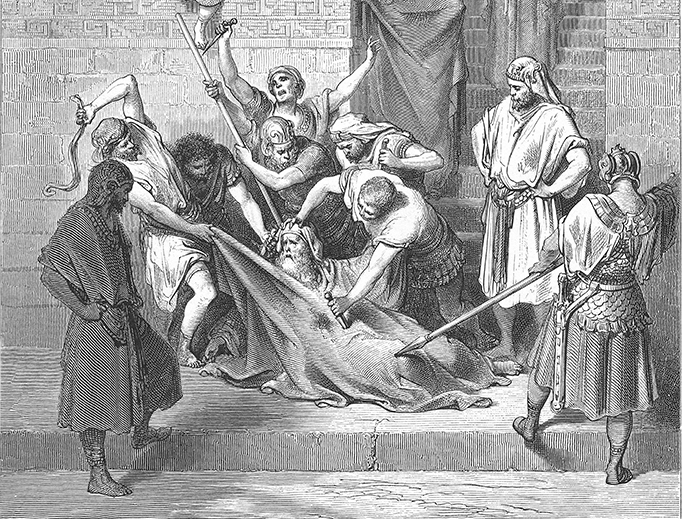

Sunday, October 10, 2021

Bible In One Year Day 283 (1 Maccabees 2, Sirach 4-6, Proverbs 22: 1-4)

   You may subscribe yourself at the Ascension site here and receive notifications in your email, or just follow along on my blog.  Bible in One Year Readings Index 


Day 283:  Mattathias Attacks 

+++
A Daily Defense 

DAY 283

The Benefits of Religion

CHALLENGE: “Religion is a destructive force that harms people.”

DEFENSE: This is not supported by the evidence.

Every institution—churches, hospitals, schools, governments—makes mistakes and harms people on occasion. However, to claim an institution is fundamentally harmful, one needs to provide evidence it does more harm than good.

Further, one would need to show not just that individual examples of an institution do more harm than good (individual churches, hospitals, schools, or governments may, in fact, be destructive).

Instead, one would need to show that the institution itself, conceived generally, is, on balance, harmful. This claim is implausible when applied to major, widespread human institutions. People aren’t stupid, and if an institution were fundamentally harmful then it would not become a major, widespread one. People would abandon it before it ever got that far.

The reason people support and patronize institutions is they perceive the benefits the institutions bring to their lives. Some are so successful that they have become human universals—institutions that appear in every culture in history. Examples include religion, medicine, education, and government.

In particular historical circumstances, the track record of these institutions is decidedly mixed (paleolithic medicine was nowhere near as good as modern medicine), but they still have provided enough benefit that they achieved universal status.

Indeed, it’s hard to see how an institution that did net harm could become a universal, because biological and cultural evolution would select against it (i.e., people who did not practice some form of it would outcompete and out-reproduce those who did, and the institution would die out).

In the case of religion, it’s easy to see how it provides benefits to people even in this life. These include helping individuals find meaning and purpose, helping groups bond together and share resources, and helping societies promote moral behaviors (“Honor thy father and mother”) and discourage immoral ones (“Thou shalt not kill”).

Also, statistically speaking, religious individuals live longer on average than non-religious ones.


Jimmy Akin, A Daily Defense: 365 Days (Plus One) to Becoming a Better Apologist