Total Pageviews

Showing posts with label italy. Show all posts

Wednesday, November 25, 2015

Holy Eucharist - Eucharistic Miracle - Ferrara, Italy 1171


Eucharistic Miracle 
Ferrara, Italy - 1171
Bleeding Host 

Feast Day - Corpus Christi 

Ferrara, Italy, which first appeared in documents around 753 AD, is located about 30 miles north-northeast of Bologna on the main branch of the Po River. During the Italian Renaissance of the 15th and 16th centuries, Ferrara attracted some of the greatest painters, Piero della Francesca, Andrea Mantegna, and Bellini to name a few. Architect and urbanist Biagio Rossetti modernized the design of the city in 1492, the walls built around the city at that time still exist today.  For all of Ferrara's cultural achievements and beauty, the city was qualified by UNESCO in 1995 as a World Heritage Site.  


Eucharistic Miracle 

Yet the occurrence that should bring Ferrara the most attention happened on Easter Sunday, March 28, 1171 during the consecration of the Holy Eucharist by Fr. Pietro da Verona at the Church of Santa Maria in Vado.


During the consecration, as Fr. Pietro broke the Host, Blood gushed out and stained the ceiling above the altar. "The stories tell of the "holy fear of the celebrant and of the immense wonder of the people who crowded the tiny church."  There were many eyewitnesses who told of seeing the Host take on a bloody color and of having seen the figure of a Baby in the Host.  Bishop Amato of Ferrara and Archbishop Gerard of Ravenna were immediately informed of the event.  They witnessed with their own eyes the miracle, namely "the Blood which we saw redden the ceiling.""(1)  


Church of Santa Maria in Vado 


The Church of Santa Maria in Vado is located at Via Borgovado number 3, Ferrara, Italy. The building dates back to the year 1000 and the name comes from a ford (vado in Italian) of the Po River which is nearby. The church as it is seen today is mostly the result of the reconstruction that was begun by urbanist Biagio Rossetti in 1495.

In 1570, Santa Maria in Vado would be hit with its first devastating earthquake. Affecting mostly the upper portion of the structure the church remained open and a popular pilgrimage sight as people came from long distances to view the Eucharistic Miracle of the Blood stained ceiling.   


In 1594 architect Alessandro Balbi created a shrine around the Blood stained ceiling and in the early 1700's sculptor Andrea Ferreri added statues to the front entry portal.  The most significant of them being the "Virgin and Child."

In May of 2012 Ferrara was hit with two earthquakes magnitude 6.1 on May 20 and 5.8 on May 29.  This time the damage forced the church to close. But not for long. 


The "Virgin and Child"  statue that sat on the white marble gable over the front entry of the church fell to the ground. The only piece that remained intact was the face of the Virgin. 

(Interesting Street View by Google shows this view one month after the earthquake and this view in August of 2015.) 

On May 21, 2012 the day after the first jolting earthquake, the parish of Santa Maria in Vado was arriving to celebrate Mass and First Holy Communion for 45 children.  The church (as well as all others in the diocese) was closed.  Mass was moved to the soccer field where Jesus fed the 45 children for the first time with His Body, Blood, Soul and Divinity.  

After Mass the children brought flowers to the head of the Virgin which had crashed to the ground only a few hours earlier.  
                     

Today 

This is not a wealthy parish but by October 13, 2013 part of the church was reopened. Today this beautiful church is fully open with Mass said daily - Thank's be to God!!  Since 2003 this parish has been run by the Missionaries of the Precious Blood from Tanzania. We have them to thank for their persistence in making sure that this pilgrimage sight was available for all.  


Inside the Church of Santa Maria in Vado, the layout is as of a basilica with three aisles divided by columns, an apse and a transept. The ceiling is decorated with five painting frescoes by Carlo Bononi.  One of the five is show earlier depicting the Miracle of the Blood.   


Off the right arm of the transept is the Chapel of the Miracle with the altar shrine created in 1594  by architect Alessandro Balbi, 


The painting shown below, which depicts the moment of the miracle, is found in the lowest portion of the shrine.  


Take the ladder/stairs to the vault in the ceiling to view the Blood stains which after over 800 years are still visible.  You will be one of numerous pilgrims who have made this journey - including Pope Alexander III (1177), Pope Urban III, Pope Pius IX (1857) and Saint Pope John Paul II (1990).  


Why does Our Lord give us these visual Eucharistic Miracles? He doesn't have to, but He knows that we need them sometimes to believe.  At times we are like Saint Thomas and need to see to believe. "Then Jesus told him, because you have seen me, you have believed, blessed are those who have not seen and yet they believed." John 20:29 

For devotional items related to the Catholic Church, please visit Lynn's Timeless Treasures

____
Notes
(1) The Eucharistic Miracles of the World, page 116
Aerial Picture of the Church of Santa Maria in Vado - Geosearch Italy
Picture of walls surrounding Ferrara from Wikipedia
Photo of Bononi's fresco of The Miracle of the Blood painted on the ceiling of the Church of Santa Maria in Vado from Flickr
Close of of Bononi's fresco The Miracle of the Blood from The Eucharistic Miracles of the World page 117
Picture of the destruction of the Andrea Ferreri statue "Virgin and Child" in the 2012 earthquake - Reassembled the fragments of the 'Virgin of the earthquake'
Picture of the head of the "Virgin and Child" - A First Communion in Special Soccer Field
Four photos of the interior of the Church of Santa Maria in Vado by VirtualTourist 

Wednesday, November 18, 2015

Holy Eucharist - Eucharistic Miracle - Saint Anthony - Rimini, Italy 1227


Eucharistic Miracle
Saint Anthony of Padua
Rimini, Italy 1227 

Rimini, Italy founded (originally named Ariminum) by the Romans in 268 BC is located on the Adriatic Sea about 30 miles southeast of Forli and about 100 miles south of Padua. Today, possibly because of its 9 mile sandy beach, Rimini is one of the more famous seaside resort destinations in Europe.  It is also the home of a Eucharistic Miracle performed by Saint Anthony of Padua in 1227. 


Saint Anthony of Padua 

Saint Anthony is one of the most famous disciples of Saint Francis of Assisi.  He was born in 1195 in Lisbon, Portugal. At the age of fifteen he entered the Congregation of Canons Regular of St. Augustine in Coimbra, Portugal.  Around 1219, Saint Anthony joined the Order of Friars Minor (Franciscans) and was sent to Assisi in 1221. From here he was given orders to chaplain hermits in Forli, Italy.  It was here that he was found to be a gifted preacher by by Saint Francis.  Saint Francis commissioned Saint Anthony to preach and teach throughout all of Italy.   

In 1227 Saint Anthony found himself preaching in the central piazza of Rimini. The episode is cited in Vita Benignitas, one of the oldest sources on the life of Saint Anthony, as follows:   


Saint Anthony was having a violent discussion with a heretic about the Holy Eucharist.  After lengthy discussions, the heretic challenged Saint Anthony by saying, "If you, Friar Anthony, can manage to perform a miracle proving publicly that the Body of Christ is really present in the host, I will abjure all heresy and accept your faith.  I'll keep my mule closed up for three days and let it fast.  Then I'll take it out and bring it here before all the people and I will bring it at once to a pile of oats.  You will stand ready in front of the animal carrying in your hands what you affirm to be the Body of Christ.  If the mule, after a total fast, neglects the oats to turn to your God, who according to you must be worshiped by all creatures, I'll firmly believe what the Church affirms." (1)


Saint Anthony accepted the challenge.  Three days later a large crowd came to the central piazza, which today is called Piazza Tre Martiri (Three Martyrs Piazza).  Oats were placed out for the starving mule then Saint Anthony approached the mule holding a consecrated Host.


Saint Anthony called out to the mule, "In the name of your Creator, whom I, unworthy as I am, hold in my hands, command you to move closer immediately in humility." (1) The mule refused the oats and approached Saint Anthony and bent its front legs reverently before the Host.   


In the 1500's a shrine was built on the place of the miracle. The Shrine of Saint Anthony is located at the corner of Via Antonio Battarra and Corso  d'Agusto on the edge of the Piazza Tre Martiri in Rimini, Italy.  


Saint Anthony performed this Eucharistic Miracle in 1227.  But we witness a Eucharistic Miracle during the Consecration every time we attend Mass.

For devotional items related to the Catholic Church, please visit Lynn’s Timeless Treasures.

Index of Eucharistic Miracles 
 ___

Notes:  (1) Gamboso, Virgilio. Fioretti of Saint Anthony, page 17 - 19 siting Vita Benignitas 16, 6-17. 

Picture of the facade of the Shrine of Saint Anthony of Padua (Vincentians) Rimini, Italy - From Diocese website

Painting of the Miracle of the Mule by Joseph Heintz the Younger

Painting of the Miracle of Saint Anthony in the Museum of Milan

Fresco of the Miracle of the Mule by Girolamo Tessari in the Basilica of Saint Anthony, Padua

Painting of the Miracle of the Mule by Jean Bourdichon

Picture of Shrine of Saint Anthony from Gallery Italy


Wednesday, November 11, 2015

Holy Eucharist - Eucharistic Miracle - San Mauro la Bruca, Italy - 1969


Eucharistic Miracle
I am the Living Bread Come Down From Heaven
San Mauro la Bruca, Italy - 1969

Feast Day:  July 25


San Mauro la Bruca is a small town in the Campania region of southwest Italy. The town name derives from the patron saint of the town, Saint Maurus who was the first disciple of Saint Benedict. 


The ancient town of San Mauro likely developed around a church dedicated to Saint Maurus around 1044.  Only a few ruins of this church remains.

In 1511 a new church was completed and dedicated to Saint Euphemia.  The years took their toll of this church and presently the current parish church of San Mauro which was finished in 1885 resides over the ruins of the older churches. 


Eucharistic Miracle 

On July 25, 1969, thieves broke into the parish church of San Mauro la Bruca and stole relics and sacred objects including the golden ciborium that contained consecrated Hosts.   

The thieves sacrilegiously emptied the ciborium disposing of the Hosts in the street.  The following day a child by the name of Gerald Amato found the Hosts and took Them to his pastor Don Pasquale Allegro.  

63 Hosts were recovered.  A decree made July 25, 1970 ordered that the Hosts be kept under perpetual adoration at the church of San Mauro. 


In 1994 the Hosts underwent scientific evaluation. Bishop Biagio D'Agostino of Vallo della Lucania determined from the evaluation that the Hosts were miraculous.  Under normal circumstances the unleavened wheat flour in a host deteriorates significantly after six months.  After a few years ordinary hosts would be mostly dust.  These Hosts have remained incorrupt since 1969. 


Today they may be viewed at the Church of San Mauro, Via Roma 1 San Mauro la Bruca, Italy.

God in His mercy physically shows us at times that He is really truly present in the Holy Eucharist.  Know that even when we do not "see" the transformation of the Holy Eucharist, He is there - Body, Blood, Soul and Divinity. 

For devotional items related to the Catholic Church, please visit Lynn's Timeless Treasures. 

Index of Eucharistic Miracles 

___
Pictures
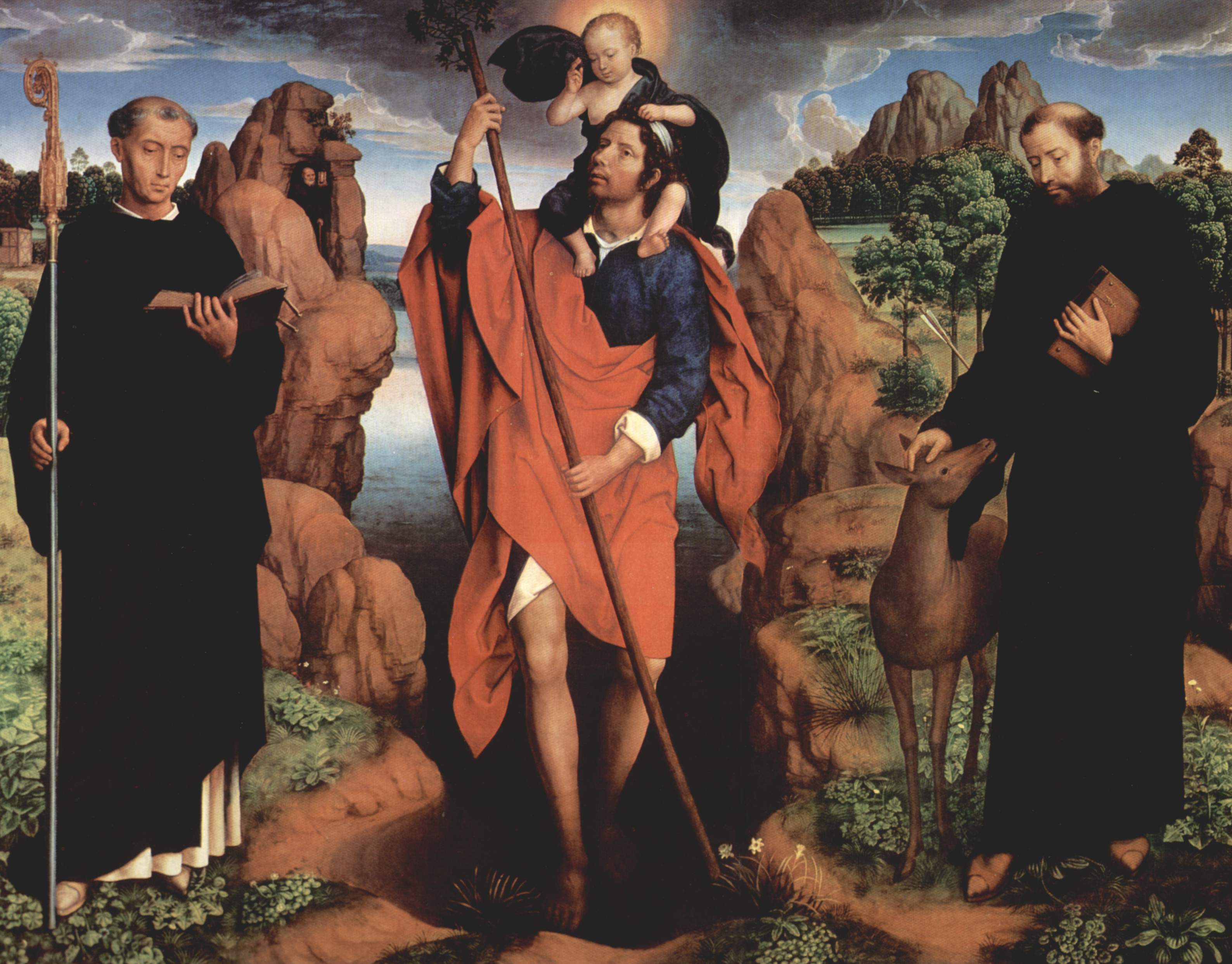
Middle triptych by Willem Moreel of Saint Christopher with Saint Maurus and Saint Giles
Picture of facade of Church of San Mauro, the relequary holding the miraculous Hosts and the interior of San Mauro - From Parish Website

Wednesday, November 4, 2015

Holy Eucharist - Eucharistic Miracle - Florence, Italy

Sant'Ambrogio.JPG

Eucharistic Miracle
Florence, Italy
AD 1230 and 1595

Florence was established as a settlement for soldiers in 80 BC, nearly 2100 years later, Florence is the capital city of the Italian region of Tuscany as well as Tuscany's most populous city. Considered the birthplace of the Renaissance, Florence is famous for its history.  It is also the home of two Eucharistic Miracles which took place in Saint Ambrose Church. 

The church is said to have been built where Saint Ambrose would have stayed when he visited Florence in 393.

The first recorded date of the church building is from 998. Originally built as a monastery for nuns, the church has been much rebuilt and restored over the years. 

Ambrogio_Colour_02

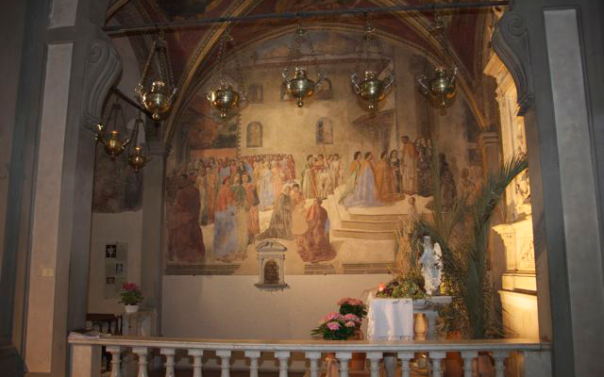
Inside there are four altar areas, the highlight of which is the Chapel of the Sacrament, where Cosmo Rosselli painted The Procession of the Miraculous Chalice (shown in the picture above and below) which represents the moment when all of Florence gathered around in great devotion to the Eucharistic Miracle in 1230.  


Eucharistic Miracle 1230 

The first miracle took place on December 30, 1230.  After saying Mass, Fr. Uguccione did not purify the chalice properly, inadvertently leaving a few drops of the Consecrated Wine in the chalice. The following day when Fr. was preparing for Mass, he noticed that coagulated Blood had formed at the bottom of the chalice.    

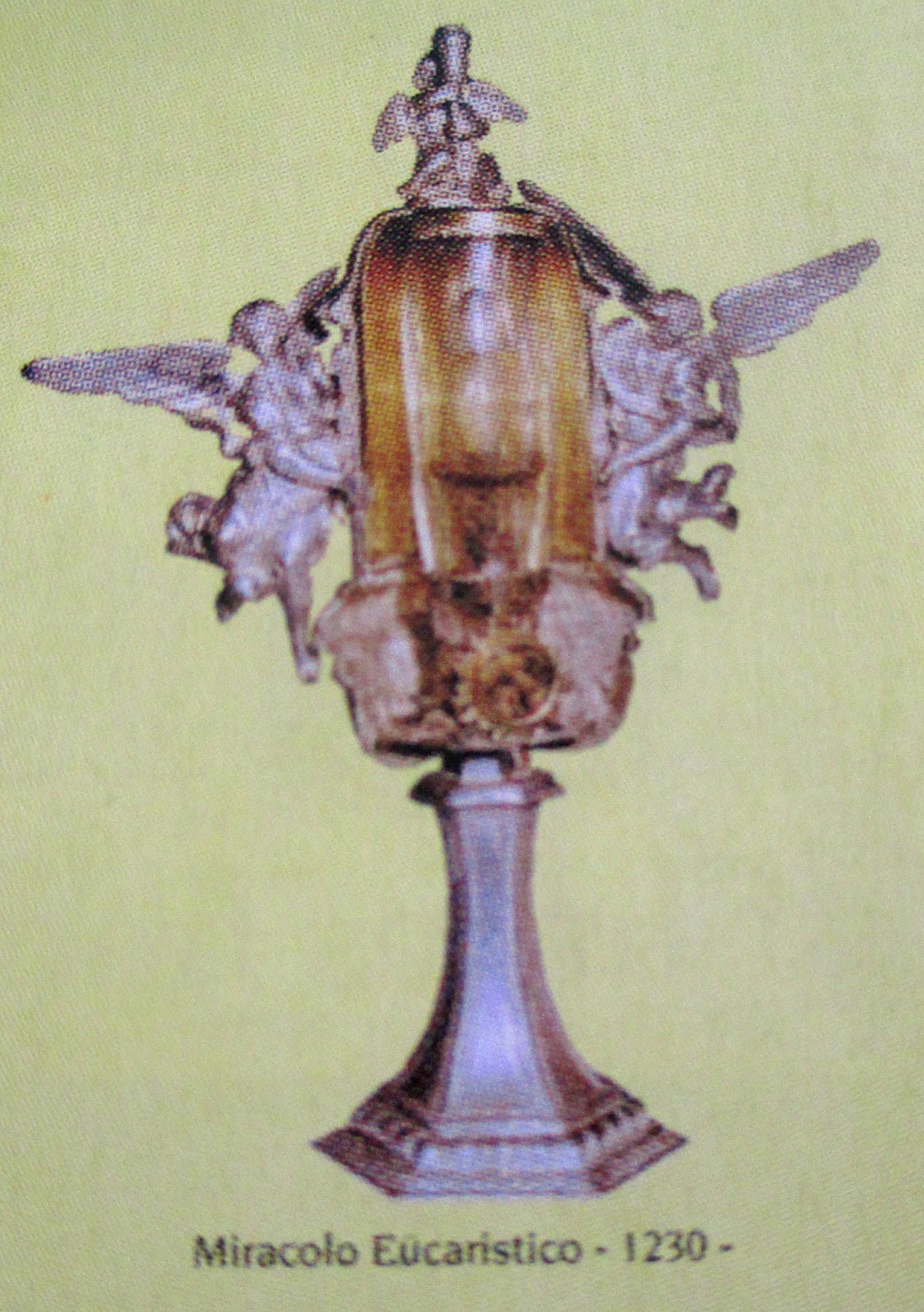
The Precious Blood was shown to the nuns who lived at the monastery and to the local bishop who deemed it miraculous. The Precious Blood was placed in a crystal cruet and reverently presented to the people of Florence. The Rosselli fresco, discussed earlier, on the altar wall represents this moment.  


The crystal cruet reliquary was given to the nuns at Saint Ambrose to take care of.  

In 1481 Madonna Maria Barbadori, the abbess of the monastery, commissioned Mino da Fiesole to build the Tabernacle (shown below) that would contain the reliquary of the Precious Blood and Cosmo Rosselli to paint the frescoes. Work was completed in 1486.


To this day, 800 years later, the Blood continues to be coagulated measuring about one half inch square.  

Eucharistic Miracle 1595 

On Good Friday 1595, a candle started a fire in one of the altar areas of the Church of Saint Ambrose.  The towns people rushed to save the Blessed Sacrament from the Tabernacle above the altar.  As they left the burning church some of the Hosts fell into the flames.  

After the fire had been extinguished, six Hosts were found joined together intact on the floor of the church.  

In 1628, Archbishop Marzio Medici of Florence examined the Hosts and found them to be incorrupt.  They were placed in a reliquary and stored with the miraculous Blood from the first miracle.  

Two miracles one of each species, the Precious Blood and Precious Body.  Both may be viewed every year in May during the Forty Hours devotion at the Church of Saint Ambrose, Piazza Sant 'Ambrogio, 1, 50121, Frienze, Italy.   
  
But we don’t have to go all the way to Florence to experience a Eucharistic miracle – the precious Body, Blood, Soul and Divinity of Our Lord is there waiting for us at every Mass and in the Tabernacle of our parish church. 

For devotional items related to the Catholic Church, please visit Lynn’s Timeless Treasures.  

Index of Eucharistic Miracles 

___
Research on the Chapel of the Sacrament was found in A Guide to the Paintings in the Churches and Minor Museums of Florence by Maud Cruttwell and Giorgio Vasari. Pg. 3 - 4. (Free Google E-Book)

Picture of the facade of the Church of Saint Ambrose in Florence, Italy from Wikipedia

Picture of fresco in the Chapel of the Miracle -  The Legend of the Miraculous Chalice by Cosimo Rosselli - From Hidden Florence Relics on Parade


Picture - another view of  The Legend of the Miraculous Chalice by Cosimo Rosselli - From The Churches of Florence East

Picture of the crystal cruet reliquary holding the Precious Blood from the Eucharistic Miracle of 1230 - From The Eucharistic Miracles of the World, pg.119.  


Picture of  the Tabernacle of the Church of Saint Ambrose from Wikipedia

Picture of the reliquary holding the Precious Hosts from the Eucharistic Miracle of 1595 - From The Eucharistic Miracles of the World, pg.119.  

Tuesday, October 20, 2015

Holy Eucharist - Eucharistic Miracle - Cascia, Italy


Eucharistic Miracle
The Face of Our Savior
Cascia, Italy - 1330
Feast Day - Corpus Christi


About 60 miles north of Rome, in the mountains of the Umbrian Valley, is the small town of Cascia, Italy. This town is known for two great things, it was the home of Saint Rita of Cascia and a Eucharistic Miracle.  


Saint Rita

Saint Rita, like Saint Jude, is the patron saint of the impossible. Born with the name of Margherita Lotti in 1381 in the city of Roccaporena she longed to be a nun.  Her parents thought it best for her to marry.  She married and had two sons.  Her husband was murdered and her sons vowed revenge.  Margherita prayed that her sons would not be able to seek vengeance and her prayers were answered. Maybe not the way she had hoped. Her sons died of influenza before they were able to commit murder and revenge. Margherita then negotiated peace between her family and the family who had murdered her husband.  In Italy in the 14th century this was considered impossible.  With God all things are possible.  

Margherita was given the gift of the Stigmata of the Crown of Thorns and became an Augustinian nun taking the name of Rita.  Many times when one is given the Gift of the Stigmata, the smell of their wound gives of a pleasant fragrance.  In the case of Rita her Stigmata gave off a putrid smell.  A smell so bad that her fellow sister required her to live away from them. For 15 years she lived segregated from her sister nuns.  

Saint Rita died May 22, 1457. At the moment of her death her Stigmata was replaced with a ruby red spot that gave off a delightful fragrance.  


Today her incorrupt body lies in a glass casket in the Chapel of Saint Rita in the Upper (Major) Basilica of Saint Rita in Cascia, Italy.  After 550 years not only is the body of Saint Rita  beautifully preserved by Our Lord but her habit and veil are also in wonderful condition.  

                      Cascia, Basilica di Santa Rita

Eucharistic Miracle 

The first stone of the Basilica of Santa Rita in Cascia was laid on June 20, 1937 and it was elevated to a Basilica by Pius XII August 1, 1955.

The Eucharistic Miracle is kept in the lower (minor) Basilica of Saint Rita.  
                                     
In 1330, a priest in Cascia was called to administer the Holy Eucharist to an ailing farmer of the town.  Instead of placing the Consecrated Host in a pyx, the priest, for whatever reason, placed the Host between the pages of his breviary. When he opened the book to take out the Host he found that the Host had turned red with fresh blood and saturated the two pages between which It was placed.
     
blessedsimonfidatiofcascia


Realizing that he had desecrated the Eucharist the priest went to Siena to the Augustinian Priory to ask counsel of Fr. Simon Fidati.  Fr. Simon now Blessed Simon Fidati gave him absolution. Knowing that this was a miracle, he took the two pages to reserve them for veneration at the Augustinian Monastery of Cascia. 

In 1930, six hundred years after the Eucharistic Miracle, the pages were given a beautiful new Monstrance to hold Them. Once the Church of Saint Rita was completed the Eucharistic Miracle was moved from the Augustinian monastery to the lower chapel in the Church of Saint Rita.  


Over the years a secondary miracle took place on the Bloodstained pages.  A face began to take shape on each page.  Both pages now portray a perfectly formed profile of a man with a beard. 


The Basilica of Saint Rita is located at Viale Santa Rita 06043 Cascia, Italy.

Though this is a Eucharistic Miracle.  We witness a Eucharistic Miracle during the Consecration every time we attend Mass.  

For devotional items related to the Catholic Church, please visit Lynn's Timeless Treasures.  
_____

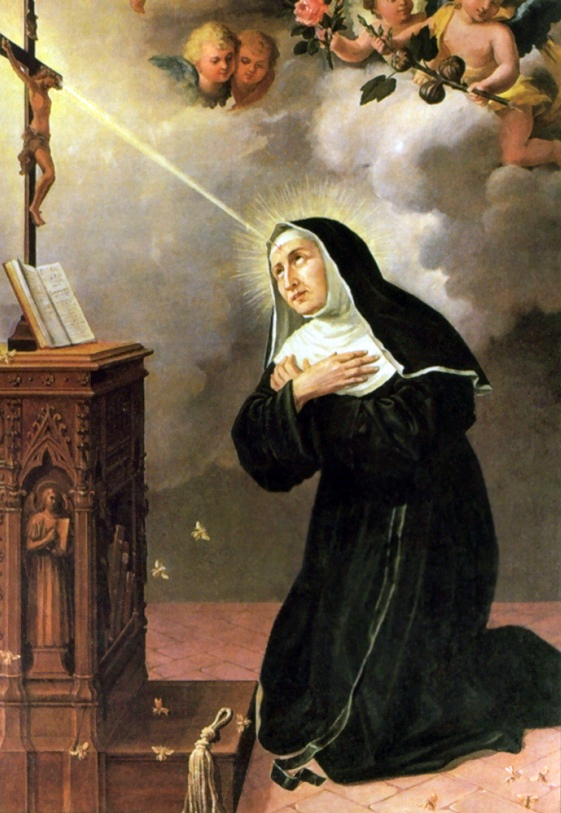
Holy Card of Saint Rita of Cascia
Tomb of Saint Rita at the Basilica of Saint Rita in Cascia - Wikipedia
Photo of the Basilica of Saint Rita in Casica from Bella Umbria

Painting of The Madonna delle Libere by Pier Paolo Agabiti depicts Blessed Simon of Cascia and Saint Rita of Cascia with Mary and the Child Jesus - Painting at the Monastery of 
Saint Rita of Cascia. 
Picture of Eucharistic Miracle in Monstrance - The Eucharistic Miracles of the World (January 2009), p. 110. 
.


Monday, October 12, 2015

Holy Eucharist - Eucharistic Miracle - Siena, Italy - 1730


Eucharistic Miracle
He Shall Live Forever 
Siena, Italy - 1730
Feast Day: Adoration the 17th of Each Month


Siena is a medieval city located in Tuscany, a region of central Italy. In the 14th century it was home to Saint Catherine and in the 15th century Saint Bernardine.  


On August 14, 1730, the day before the Feast of the Assumption, the priests of the Basilica of Saint Francis placed 351 consecrated Hosts into the ciborium in anticipation of the great crowd who would gather the following day. Later that day thieves broke into the Tabernacle and stole the golden ciborium along with the consecrated Hosts. The priests discovered the robbery the following day while preparing to celebrate Mass for the Feast of the Assumption.

Three days later on August 17th a man praying in the Church of Saint Mary in Provenzano noticed something white sticking out of the alms box.  All 351 consecrated Hosts were found inside, 348 whole Hosts and 6 halves.   The faithful people celebrated the finding of the consecrated Hosts, placed them in a monstrance and walked in solemn procession with the Hosts to the Basilica of Saint Francis.  


Instead of distributing the Hosts for consumption to the faithful people, they were retained.  In situations where it is thought that consecrated Hosts have been contaminated, it is not required that they be consumed. In these situations, the Hosts will be retained and venerated in a sacred vessel until they deteriorate.  But they did not deteriorate. 

Between the year 1730 and 1780,  bishops of the Church would be allowed to receive one of the Hosts. They always reported that the Hosts tasted fresh.  Now there were only 230 left.  It was decided that no one would be allowed to receive the Hosts - because a miracle had truly occurred. 

Fourteen tests were carried out over the years to determine the condition of the Hosts.  The most scientific examination was in 1914.   

In 1914, Pope Saint Pius X authorized an examination of the Hosts which was carried out by a number of nutritionists, health specialists, chemists and pharmacists.    

Chief chemical examiner of the Hosts in 1914 was Siro Grimaldi, professor of chemistry at the University of Siena and director of the Municipal Chemical Laboratory. 

The final conclusion, "the Hosts of Siena are a classic example of the perfect conservation of particles of unleavened bread, consecrated in the year 1730, and constitute a singular phenomenon which reverses the natural laws of conservation of organic matter." (1)


More tests were done in 1922, 1950 and 1951.  The results were the same. On September 14, 1980, Saint Pope John Paul II venerated the miraculous Hosts calling them the Real Presence of Our Lord. 

Today the miraculous Hosts are still housed in the Basilica of Saint Francis.  During the summer they are kept in the Piccolimini Chapel and in the winter the Martinozzi Chapel.

This is a Eucharistic Miracle.  We witness this same Eucharistic Miracle every time we attend Mass.  

For devotional items related to the Catholic Church, please visit Lynn's Timeless Treasures.  
Index of Eucharistic Miracles  ___
Notes
(1) The Eucharistic Miracles of the World (January 2009), p. 148 - 149. 

Pictures 
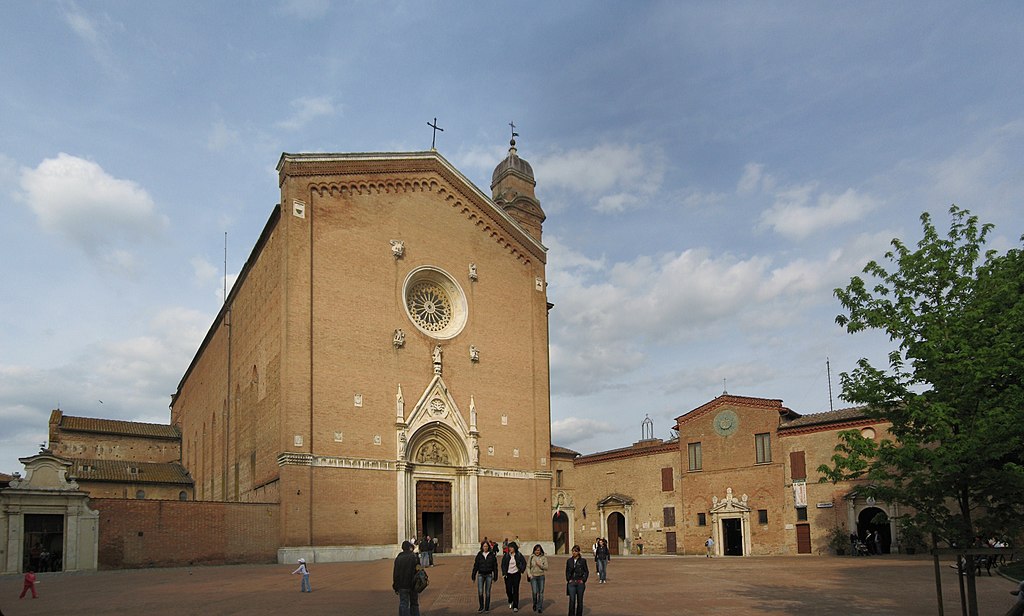
1.  Exterior of the Basilica of San Francesco
2.  The Hosts in the processional monstrance - The Eucharistic Miracles of the World (January 2009), p. 148 - 149.
3. Another view of the Hosts in the processional monstrance from filhodamisericordia.blogspot.com.

4.  Saint Pope John Paul II in adoration in front of the Hosts September 14, 1980 -  The Eucharistic Miracles of the World (January 2009), p. 148 - 149. 

Monday, October 5, 2015

Holy Eucharist - Eucharistic Miracle - Shedding His Blood - Offida, Italy


Eucharistic Miracle
Shedding His Blood
Offida, Italy - 1273
Feast Day - May 3 

The miracle of Offida begins in Lanciano in the year 1273 when newly married Ricciarella Stasio felt it necessary to utilize the services of the town witch in order to rekindle the affection of her husband Giacomo.

The witch told Ricciarella that in order to fix her marriage she should receive Holy Communion, but not consume the consecrated Host.  She should then take the Host home, burn it into a powder over her fire, and place the ashes into her husband’s food or drink. In other words, she should commit a sacrilege and desecrate the Body, Blood, Soul and Divinity of the Lord.  This is something no one should ever do!
 
For some reason Ricciarella did what the witch told her to do. She placed the consecrated Host she had received at Holy Communion on a tile and held it over the fire.  Instead of turning to powder, the outside portion of the Host turned into flesh and began to bleed.  The center of the Host retained its original form.

Panicking, Ricciarella took wax and dirt and threw it over the Host to try and cover the Blood.  But the Blood seeped through the dirt.  So Ricciarella covered the Host with a linen tablecloth decorated with silk embroidery and lace. 


She then buried this in the stable under the dung heap of their mule.  From that time on, whenever Giacomo brought their mule into the barn, the mule would genuflect toward the manure pile. 

Ricciarella lived with this grave sin for seven years.  Finally she could no longer stand the torment that her action had brought her and she confessed to the priest of the local Augustinian monastery in Lanciano.  Ricciarella and the friar went to the stable and dug up the Host.  When they uncovered the Host they found that It was intact and appeared as It had seven years earlier. 


Since the Augustinian friar was a native of Offida, Italy, the miracle was deemed property of Offida.


A craftsman in Venice fashioned a cross-shaped reliquary to hold the sacred relic. 


Today the reliquaries of the tile, the Blood-stained linen, and the cross containing the miraculous Host are exposed in St. Augustine’s Church in Offida.

Ricciarella’s house in Lanciano was made into a small chapel.  Every year on May 3rd the citizens of Offida celebrate the anniversary of the miracle.  

In 1788 Giovanni Battista Doria authenticated a parchment from the 13th century describing this miracle.  There are also Papal Bulls from Pope Boniface VIII (1295), and Pope Sixtus V (1585) that describe the miracle.  

As a Catholic, we are not obliged to believe in these Eucharistic miracles, even if they are officially recognized by the Church.  But, we must not exclude the possibility that God might intervene in an extraordinary way at any given moment to any person.  He certainly does that at every time the Sacrifice of the Mass is celebrated.  

For devotional items related to the Catholic Church, please visit Lynn's Timeless Treasures.  

___
Photos taken from Public Domain and from The Eucharistic Miracles of the World Catalog of the Vatican International Exhibition pages 132 - 133.
1.  Photo of Church of St. Augustine Offida Italy.
2.  Close up of the cloth with Blood stains.
3.  Close up of the cross-shaped reliquary that contains the Host and some wood from the True Cross.
4.  The relics of the tile and cloth below the cross.